
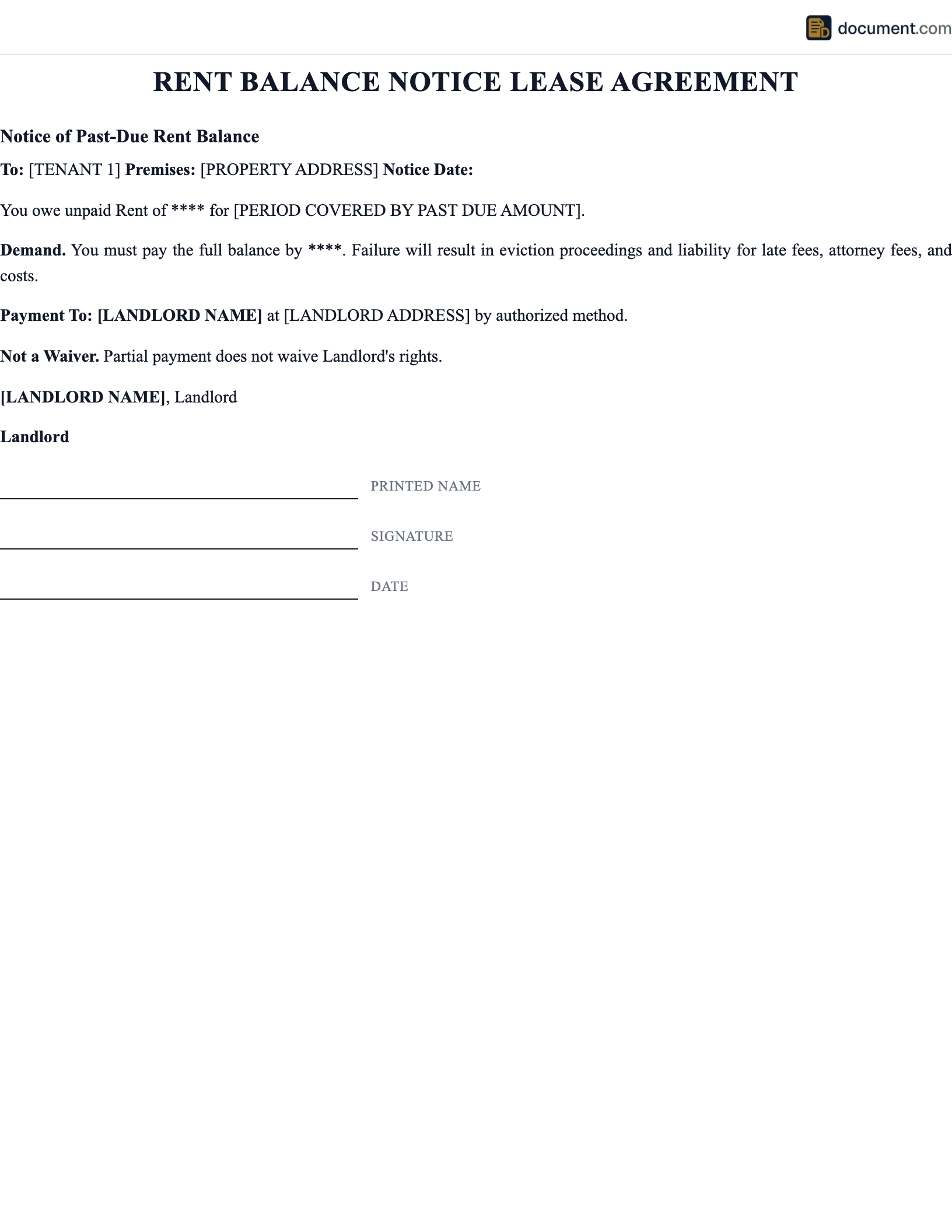



What Is a Notice of Current Rent Balance?
A notice of current rent balance is a courtesy demand that itemizes what the tenant owes under the lease. It identifies base rent by month, late fees calculated to the lease and state cap, sub-metered utilities or NNN charges where the lease assigns them, and payments allocated against the balance. Most landlords issue it within 5 to 10 days after rent becomes delinquent and before serving a statutory pay-or-quit. The notice has no independent statutory effect and does not start an eviction clock; that is its function. It documents the demand and gives the tenant a paper-trailed cure window without invoking unlawful detainer procedure.
Courts treat the notice as evidence on two issues. First, it documents the tenant's actual notice of the balance, which forecloses later challenges that the tenant did not know what was owed. Second, in security-deposit litigation under California Civil Code §1950.5, Texas Property Code §92.103, Florida §83.49, and New York Gen. Oblig. Law §7-108, the contemporaneous ledger admitted with the notice supports deductions claimed against the deposit. A notice with sloppy math, missing payment credits, or fees above the state cap weakens both the deposit case and any later eviction filing that must restate the same amount.
The notice also serves as the predicate document for rental assistance. Most state Emergency Rental Assistance Programs and city-level subsidies require a current balance statement as part of the tenant's application. Where the program conditions disbursement on partial forgiveness or a 60 to 120 day eviction moratorium, the notice establishes the baseline against which the waiver is calculated.
Pay-or-Quit Predicate in Most States
In the majority of jurisdictions the rent balance notice is the practical predecessor to a statutory pay-or-quit demand. California requires a 3-day notice under CCP §1161(2) stating the precise sum due. Texas requires the lease-specified period or 3 days under Property Code §24.005. Florida requires 3 days excluding weekends and holidays under §83.56(3). New York requires a 14-day rent demand under RPAPL §711(2) before holdover proceedings. Oregon ORS 90.394 sets a 72-hour or 144-hour pay-or-quit depending on cure history. The rent balance notice supplies the figure that the formal pay-or-quit must restate, and incorrect amounts in the formal notice are routinely fatal to the eviction filing.
FDCPA Implications for Third-Party Servers
When the notice is served by a property manager, collection agency, or attorney rather than the owner, the Fair Debt Collection Practices Act (15 USC §1692) applies. Section 1692g requires the initial communication to include the amount of the debt, the creditor's name, a 30-day window to dispute, and a statement that the debt will be assumed valid absent timely dispute. Section 1692e prohibits misstating the amount or implying eviction without legal authority. Section 1692k authorizes statutory damages up to $1,000 per violation plus attorney fees. Owners self-collecting rent are generally exempt under §1692a(6) but remain subject to state consumer-protection statutes, several of which mirror the federal framework.
Pre-5-Day Demand Use
This notice is typically the first written demand and runs in parallel with the lease's grace period. If the tenant does not respond within the cure window the landlord follows up with the statutory pay-or-quit. State-specific timelines vary substantially.
- California: 3-day pay-or-quit (CCP §1161(2)) excluding judicial holidays per CCP §12a.
- Texas: 3-day pay-or-quit (Property Code §24.005), or the lease-specified period if longer.
- New York: 14-day written rent demand (RPAPL §711(2)) before any holdover proceeding.
- Florida: 3-day pay-or-quit excluding weekends and legal holidays under §83.56(3).
- Oregon: 72-hour pay-or-quit after the 8th day of the rental period, or 144-hour after the 5th, under ORS 90.394.
- Massachusetts: 14-day notice to quit (G.L. c. 186 §11) for nonpayment of rent.
- Illinois: 5-day notice for nonpayment under 735 ILCS 5/9-209.
- Washington: 14-day pay-or-quit under RCW 59.12.030(3) following the 2019 amendments.
Ledger Itemization Requirements
Ledger-style itemization strengthens the notice and is functionally required where the formal pay-or-quit must restate the same figure. California CCP §1161(2) requires the pay-or-quit notice to state the precise amount owed, and overstatements (even by $5) have been held fatal in California Court of Appeal decisions including Levitz Furniture Co. v. Wingtip Communications and the line of cases following it. Texas Property Code §92.019 likewise requires precision in late-fee calculation, and Florida courts strictly construe §83.56 against the landlord. Each component of the balance should be traceable back to the lease provision authorizing it.
- Base rent owed, by month, with date due and amount.
- Late fees calculated per the lease and the state cap with the formula shown.
- Utilities, CAM, parking, storage, or other lease-authorized charges.
- Payments received with date, method, and confirmation reference.
- Allocation of payments per the lease, or oldest-charges-first if the lease is silent.
- Running balance as of the notice date with an explicit calculation date.
Late Fee Caps by State
| State | Cap | Statute |
|---|---|---|
| California | Reasonableness (approx. 6%) | Civ. Code §1671(d) |
| Texas | 10–12% of monthly rent | Prop. Code §92.019 |
| Massachusetts | $5/day after 30-day grace | G.L. c. 186, §15B |
| Chicago (IL) | $10 + 5% over $500 | RLTO §5-12-140 |
| New York City | $50 or 5%, whichever less | HSTPA 2019 |
Delivery and Proof of Service
The rent balance notice has no statutory delivery rule because it is not itself a statutory document. Best practice is personal delivery with a witness plus certified mail with return receipt requested. The certified mail green card is admissible as prima facie evidence of delivery in most jurisdictions. Email may be used if the lease authorizes electronic notice; without lease authorization, email is supplemental rather than substitute service.
When the notice is followed by a statutory pay-or-quit, the formal notice must be served per the state's service rules. California CCP §1162 permits personal delivery, substituted service on a person of suitable age at the residence followed by mailing, or posting-and-mailing if no person can be found. New York RPAPL §735 requires personal delivery, substituted service, or conspicuous-place delivery (nail-and-mail) plus mail. Texas Property Code §24.005(f) allows in-person delivery, mail, or affixing to the inside of the main entry door. Oregon ORS 90.155 permits first-class mail with three days added for service. Document the method on a proof-of-service declaration signed under penalty of perjury; courts routinely throw out evictions where service is defective.
How to Use This Notice
Pull the tenant ledger
Itemize every charge and payment since the last zero-balance.
Apply the state late-fee cap
Calculate late fees per state law and the lease.
Draft the notice
Use the template with current date, tenant name, itemized ledger, and payment instructions.
Deliver and document
Personal delivery + certified mail with return receipt. Keep the proof.
Wait and follow up
Give 5–14 days. If unpaid, proceed to the state statutory pay-or-quit notice.
Frequently Asked Questions
Itemization, late-fee caps, delivery, and pay-or-quit escalation.
Official Resources
Send a rent balance notice in under 5 minutes.
Pick your state, answer a few questions, and download an itemized balance notice with late-fee compliance and delivery-proof checklist.