
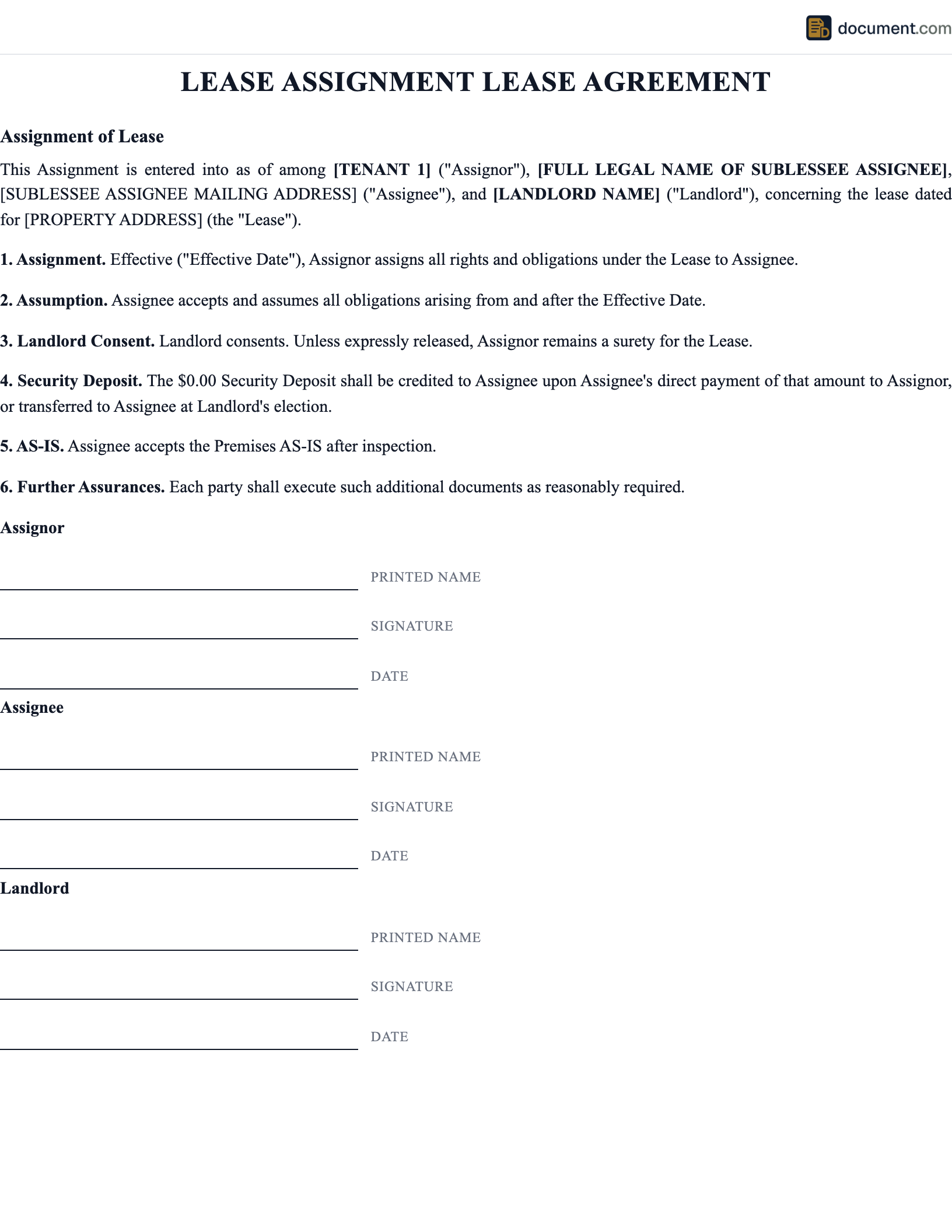



What Is a Lease Assignment?
A lease assignment is a three-party agreement in which the existing tenant (the assignor) transfers the entire remaining leasehold interest to a new tenant (the assignee) with the landlord's consent. After assignment, the assignee is in privity of estate with the landlord and pays rent directly, assumes all lease covenants, and receives all benefits of the tenancy. Assignments arise most often in commercial real estate when a business sells the going concern (the lease conveys with the M&A transaction) and in residential moves when a long-term tenant exits mid-term and finds a replacement acceptable to the landlord.
Privity governs the post-transfer obligations. After assignment, the assignee is in privity of estate with the landlord and may be sued directly for breach of any covenant running with the land (rent, repair, surrender). The original tenant remains in privity of contract with the landlord and remains liable for the full term unless released by novation. Sublease leaves the privity structure intact: the subtenant has no privity with the landlord at all and the original tenant remains primarily liable. Most commercial leases prohibit assignment without consent and treat sublease more permissively; residential leases more often prohibit both without distinction.
State law dictates the standard for landlord refusal. California Civil Code § 1995.260 imposes a reasonableness requirement on commercial-lease assignment refusals; the landlord may not unreasonably withhold consent. New York Real Property Law § 226-b imposes a similar reasonableness requirement on residential leases in buildings of four or more units, with the landlord required to respond within 30 days or consent is deemed granted. The minority common-law 'sole discretion' rule still applies in some jurisdictions for commercial leases that expressly reserve absolute landlord discretion. Assignment in bankruptcy proceeds under 11 U.S.C. § 365 with heightened protection for shopping-center leases under § 365(b)(3).
Original-tenant secondary liability and privity of contract
The privity-of-contract doctrine controls the original tenant's continuing exposure after assignment. The lease was originally a contract between the named tenant and the landlord; assigning the leasehold estate does not extinguish that contractual undertaking any more than assigning a promissory note's underlying benefits releases the maker. Restatement (Second) of Contracts § 318 codifies the rule that assignment alone does not release the assignor from contractual duties. The landlord retains the option to pursue either the assignee (under privity of estate) or the original tenant (under privity of contract) for any post-assignment default. Some leases include automatic-release clauses that operate on consent; a novation may be added to the assignment instrument to achieve the same result expressly.
Landlord-consent rules: California, New York, and the reasonableness standard
California Civil Code § 1995.260 governs commercial lease assignments: where the lease requires consent but is silent on the standard, consent may not be unreasonably withheld; where the lease expressly reserves sole discretion, that reservation is enforceable. Reasonable grounds for refusal include inadequate financial qualification of the assignee, incompatible business use, and inadequate insurance. Unreasonable grounds include protected-class discrimination under the Fair Housing Act 42 U.S.C. § 3604 and Cal. Gov. Code § 12955, retaliation, or a desire to extract a premium beyond lease economics. New York RPL § 226-b imposes a parallel reasonableness rule for residential buildings of four or more units with a 30-day deemed-consent deadline. Most other states have adopted the modern reasonable-consent rule through case law (Kendall v. Ernest Pestana, Inc., 40 Cal. 3d 488 (1985), is the leading authority).
Assignment vs. Sublease
Both let a tenant exit, but the legal and liability structures are different.
| Feature | Assignment | Sublease |
|---|---|---|
| Transfers | Entire lease interest | Partial: limited term or scope |
| New tenant's landlord | Original landlord | The original tenant (sublessor) |
| Original tenant's liability | Secondary (primary if novation) | Full primary liability |
| Rent collection | Landlord collects from assignee | Sublessor collects, pays landlord |
Landlord Consent Requirement
Almost every modern lease requires the landlord's prior written consent before assignment. The question is what standard governs the landlord's refusal. Three rules are in play:
- Sole discretion: Older common-law rule under which the landlord may refuse for any reason. Still followed in a minority of states for commercial leases.
- Reasonable consent: Modern majority rule barring the landlord from unreasonably withholding consent. Codified in CA Civil Code §1995.260 and NY RPL §226-b.
- Statutory override: Some states (California for residential, New York for rent-stabilized) impose the reasonable-consent rule by statute, trumping any 'sole discretion' language in the lease.
Novation vs. Assumption
Two commonly confused concepts. Novation releases the original tenant; assumption does not.
Novation
Three-way release: landlord accepts the assignee as the new tenant and releases the original tenant. Requires express landlord consent.
Assumption
Assignee accepts responsibility, but original tenant remains secondarily liable via privity of contract. Most common structure.
Successor Liability
The default rule in all 50 states is that the original tenant remains liable under the doctrine of privity of contract, even after assignment. This is called 'secondary liability': the landlord can first pursue the assignee and, if unable to collect, fall back to the original tenant. The only ways to eliminate this ongoing exposure are (1) a novation, (2) a contractual release in the lease itself, or (3) the passage of time until the statute of limitations runs on any remaining claims.
How to Assign a Lease
Review the anti-assignment clause
Confirm whether the lease allows assignment with consent, without consent, or prohibits it outright.
Request landlord consent in writing
Send a written request with the proposed assignee's financials, business plan (if commercial), and references.
Negotiate consent terms
Address any landlord conditions: assumption agreement, additional deposit, personal guaranty, release of original tenant.
Draft the assignment
Use the template covering assignor, assignee, effective date, assumption language, and landlord-consent signature block.
Transfer the security deposit
Decide whether the deposit rolls to the landlord with the assignment or is refunded to the original tenant and re-posted by the assignee.
Execute and deliver
All three parties sign. File a copy with the property management company and retain originals.
Frequently Asked Questions
Questions about assignment, novation, landlord consent, and original-tenant liability.
Official Resources
CA Civil Code §1995 (Commercial Assignment)
California commercial lease assignment and transfer rules
NY RPL §226-b (Subletting and Assignment)
New York reasonable-consent statute for assignment
USCourts: Chapter 11 and 11 USC §365
Bankruptcy-court assumption and assignment of leases
URLTA (Uniform Law Commission)
Reference text for Uniform Residential Landlord and Tenant Act
Transfer your lease in under 10 minutes.
Pick the assignment type, answer a few questions, and download an assignment with landlord-consent signature block, assumption language, and optional novation.