
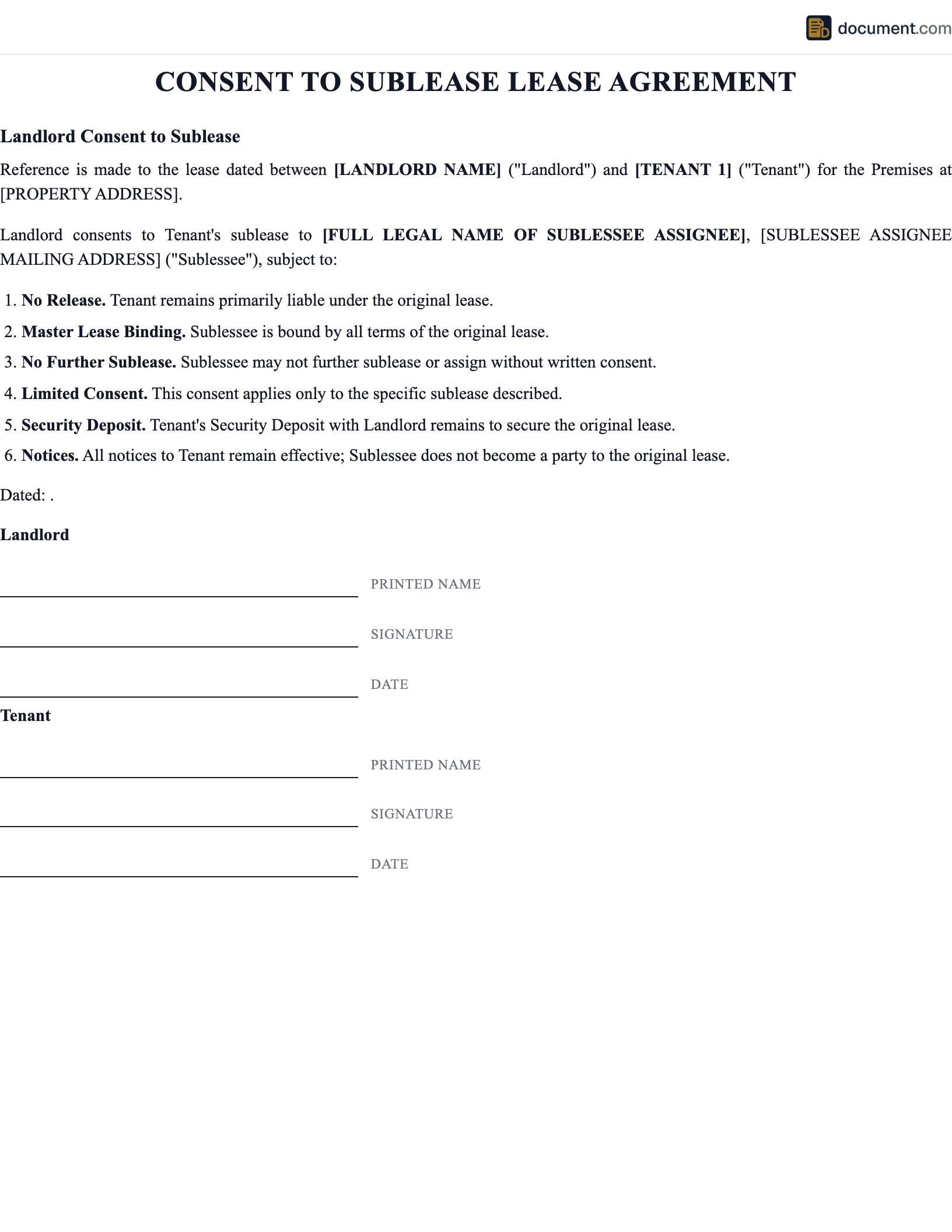



What Is a Landlord's Consent to Sublease?
A landlord's consent to sublease is a written authorization from the landlord permitting the tenant to sublet all or part of the rental property to a third party. Most residential and commercial leases prohibit subleasing without prior written consent under standard anti-subletting clauses, and many state and city sublet statutes also require the consent to be in writing and signed: NY RPL § 226-b requires written consent or written response within 30 days for residential buildings of four or more units, and CA Civ. Code § 1995.260 requires the same for commercial leases. Without consent, the sublease is voidable and both the original tenant and the subtenant face unlawful detainer (eviction) under state law: California Civ. Proc. § 1161, Texas Property Code § 24.005, Florida § 83.56(2), New York RPL § 711(2). The consent document formalizes the approval, sets the conditions (insurance, use restrictions, duration limits, fee), and creates the three-party signature record (landlord, original tenant as sublessor, subtenant) that defines who is responsible for what.
The consent document addresses four critical elements: (1) the review standard, reasonable consent under CA Civ. Code § 1995.260 and NY RPL § 226-b versus sole discretion under Texas Property Code § 91.005; (2) insurance and indemnity requirements, including commercial general liability of $1 million per occurrence with landlord as additional insured for commercial subleases and $300,000 to $500,000 renter's liability for residential; (3) which master-lease covenants flow through to the subtenant under privity of estate (operating hours, use restrictions, exclusive-use clauses, default provisions); and (4) preservation of the original tenant's primary liability under the master lease, distinguishing sublease from assignment with novation. Our template covers all four with state-specific keying for California, New York, Texas, Florida, and the rest of the U.S.
Form requirements and statutory waiting periods
Multiple states impose specific form requirements and timing rules on landlord consent. New York RPL § 226-b is the most prescriptive: the tenant submits a written request by certified mail with the proposed subtenant's name, address, current home and business addresses, length of stay, term of sublease, written consent of any co-tenant, and a copy of the proposed sublease. The landlord has 30 days to respond. Failure to respond is deemed consent under § 226-b(3). Refusal must be in writing with reasons. California Civ. Code § 1995.250 and § 1995.260 require commercial landlords to respond within a reasonable time, with case law fixing 30 days as the typical measure. Texas Property Code § 91.005 imposes no response timeline but allows refusal at the landlord's discretion absent express lease language to the contrary. Massachusetts case law (Slavin v. Rent Control Board, 363 Mass. 17, applying Clark v. Clark) imposes a reasonable-consent standard with 30-day response window. Document the request date, response date, and any conditions imposed; the form record defeats most challenges.
Review Standard: Reasonable or Absolute
The governing standard for the landlord's consent decision varies by state. The split runs along two lines: the modern reasonable-consent rule adopted in California (Civ. Code § 1995.260, commercial), New York (RPL § 226-b, residential buildings of four or more units), Massachusetts (Clark v. Clark, 1967), Illinois, Alaska, and 30 or more other states; and the common-law sole-discretion rule retained in Texas (Property Code § 91.005), Alabama, and a handful of others where the landlord can refuse for any reason or no reason. Reasonable grounds for refusal under the modern rule include poor creditworthiness (subtenant credit score under 600 or income less than three times rent), incompatible business use (commercial), evidence of fraud, criminal background relevant to the property, or insufficient income relative to obligation. Unreasonable grounds include protected-class bias under the Fair Housing Act (42 U.S.C. § 3604: race, color, religion, sex, familial status, national origin, disability), arbitrary denial without articulated reason, attempting to extract economic premium beyond cost recovery, or refusing to consider any subtenant in good faith.
Grounds landlord can refuse and deemed-consent rules
Reasonable refusal grounds under California Civ. Code § 1995.260 and parallel state statutes include the proposed subtenant's financial unsuitability (credit, income, prior tenancies), incompatibility of use (an industrial use in a retail-only space), proposed alteration outside the master lease, and material change in occupancy density or character. Unreasonable grounds include retaliation for prior protected activity, denial based on protected-class status, and attempts to extract economic premium beyond actual review costs (most state statutes including CA Civ. Code § 1950.8 cap fees at actual costs). New York RPL § 226-b is unique in imposing deemed-consent: failure to respond within 30 days of proper request is treated as consent by operation of law. CA Civ. Code § 1995.250 imposes no automatic deemed-consent but case law treats unreasonable delay as constructive consent. The consent form itself should document grounds for any conditions imposed to defeat later unreasonableness challenges.
| State | Standard | Statute/Case |
|---|---|---|
| California | Reasonable consent | Civ. Code §1995.260 |
| New York | Reasonable consent | RPL §226-b |
| Massachusetts | Reasonable (case law) | Clark v. Clark (1967) |
| Texas | Absolute discretion | Property Code §91.005 |
| Florida | Case-by-case | §83.44 (residential) |
Insurance Requirements
Insurance is the landlord's first line of defense against premises-liability claims by the subtenant or the subtenant's guests, and also the master tenant's protection from the master lease's insurance covenants. Without documented coverage from the subtenant, the landlord's general liability carrier may deny coverage on premises claims and the master tenant defaults on the master lease. The consent should specify required coverage, require certificate of insurance (ACORD 25 or equivalent) before sublease commencement, require renewal certificates annually, and require 30-day notice of any material insurance change. Verify the certificate against the carrier directly; certificate fraud is a known risk in commercial subleases. Standard requirements:
- Commercial sublease: CGL $1M per occurrence and $2M aggregate; landlord named as additional insured; waiver of subrogation.
- Residential sublease: Renter's insurance with $300K to $500K personal liability coverage; landlord named as additional interested party.
- Certificate of insurance: Delivered before sublease commences; renewed annually with copy to landlord.
- Cancellation notice: 30-day notice to landlord before any material change or cancellation.
- Higher-risk uses: Restaurants, fitness studios, daycare add umbrella to $5M; medical and laboratory uses add professional liability.
Master-Lease Flow-Through
In commercial subleases, the master lease's operating covenants flow through to the subtenant under privity of estate doctrine, which means the subtenant must comply with the master lease's terms even though no direct contract exists between subtenant and landlord. The flow-through is automatic for any obligation that runs with the leasehold (use restrictions, maintenance, hours, signage) and selective for personal covenants (the master tenant's specific obligations to maintain trade name or specific employee policies do not flow through unless expressly incorporated). The consent document should attach the master lease as an exhibit and require subtenant acknowledgment of all flow-through covenants in writing. If the master lease terminates by default, condemnation, casualty, or expiration, the sublease terminates automatically because the sublessor's leasehold disappears (unless a non-disturbance and attornment agreement, NDAA, separately ties the subtenant to the landlord). Common flow-through items:
- Hours of operation and use restrictions.
- Maintenance standards and capital-improvement approval.
- Signage, exterior modifications, and HVAC standards.
- Radius restrictions (for retail) and exclusive-use clauses.
- Compliance with applicable laws and building codes.
- Default cure periods and remedies under the master lease.
Original Tenant Liability
The original tenant (sublessor) remains fully and primarily liable for the master lease throughout the sublease term. The landlord can pursue the original tenant for unpaid rent, damage, lease breach, or any other obligation under the master lease regardless of whether the subtenant has paid or caused the issue. This is the defining legal distinction between a sublease (liability retained by original tenant) and an assignment (liability potentially released through novation). The original tenant's recourse against a defaulting subtenant runs through the sublease contract: damages, eviction (in most states the sublessor follows the same unlawful detainer process the landlord would use), and security deposit deduction. In rent control jurisdictions (San Francisco, NYC, LA, DC), the landlord may not bypass the original tenant to collect from the subtenant directly; the privity-of-contract chain runs landlord-to-tenant-to-subtenant.
Practical effect for the original tenant: keep funds available to cover any subtenant default through the sublease term; require subtenant security deposit (typically one to two months' rent) to absorb the first month of any default; build in a cure-or-quit notice procedure that mirrors state landlord-tenant law (3 days California Civ. Proc. § 1161, 3 days Texas Property Code § 24.005, 3 days Florida § 83.56); and consider escrow of subtenant rent payments through a third-party processor to avoid commingling and to create a verifiable payment record. Insurance from the subtenant is the second layer of protection; security deposit is the third.
How to Use This Consent
Collect subtenant information
Financial statements, business plan (commercial), references, insurance certificates.
Review against lease requirements
Confirm use, duration, and financial adequacy match the master lease.
Set the conditions of consent
Insurance, use restrictions, duration, sublease-rent reporting, liability preservation.
Draft the consent document
Three-party signature block: landlord, tenant (sublessor), subtenant.
Collect insurance certificates
Before sublease commences, not after.
File with property manager
Consent + sublease + certificates of insurance filed in the property's permanent lease file.
Frequently Asked Questions
Consent standards, insurance, master-lease flow-through, and original-tenant liability.
Official Resources
Approve a sublease in under 8 minutes.
Pick your state, answer a few questions, and download a landlord's consent with the insurance, flow-through, and liability-preservation language a sublease actually needs.