



What Is a Non-Renewal of Lease Notice?
A non-renewal of lease notice is a written communication from a landlord or tenant stating that the existing fixed-term lease will not roll into a new term and possession will end on or before the lease expiration date. Unlike a termination for cause or an early-termination notice, a non-renewal does not accuse the other party of breach. It simply prevents the automatic conversion to a holdover tenancy that would otherwise occur in 41 states under common-law principles or codified periodic-tenancy statutes such as California Civil Code § 1945, Texas Property Code § 91.001, and New York Real Property Law § 232-c.
A properly served non-renewal performs three legal functions at once. It defeats any automatic-renewal clause built into the lease; it gives the tenant the statutorily required time to find replacement housing or to wind down possession; and it preserves the landlord's right to refuse holdover rent and to file an unlawful-detainer action the day after expiration if the tenant remains. Without it, the landlord typically waives strict expiration and is left enforcing whatever periodic-tenancy notice the state imposes, which adds 20 to 90 days before possession can be recovered.
For tenants, the non-renewal serves a different purpose. It locks the move-out date so the landlord cannot later argue the tenant abandoned mid-term. It triggers the security-deposit accounting clock under state statute. And it preserves the tenant's right to tour replacement units and provide a forwarding address without negotiating a mid-term termination penalty. Both sides benefit from a written, dated, and properly served notice rather than a verbal heads-up that leaves the lease in legal limbo.
Notice period requirements
Thirty days is the modal notice period and the default in most state landlord-tenant codes. California Civil Code § 1946.1 imposes 60 days when the tenant has occupied the unit for a year or longer; the same statute keeps 30 days for any tenancy of less than a year. Washington requires 20 days under RCW 59.18.200 for periodic terminations but the tenancy-protection ordinances in Seattle and Tacoma stretch this to 60 or 90 days for renewal refusal. Just-cause cities (San Francisco, Oakland, Berkeley, Los Angeles for some buildings, Portland, Newark, Jersey City) typically require 60 to 90 days. Mobile-home park tenancies receive heightened protections in most states, often 6 months. Always verify against the most recent version of the state's residential landlord-tenant act before relying on a 30-day default.
Just-cause restrictions where applicable
California (statewide under AB 1482, codified at Civil Code § 1946.2 and § 1947.12), Oregon (Senate Bill 608, ORS 90.427), New Jersey (the Anti-Eviction Act, N.J.S.A. 2A:18-61.1), and a growing list of cities have replaced no-cause non-renewal with statutory just-cause regimes for covered units. In these jurisdictions, the landlord may decline to renew only by reciting one of the enumerated grounds: substantial lease breach, nuisance, criminal activity, owner move-in, withdrawal from the rental market under the Ellis Act, demolition, or substantial rehabilitation. Owner move-in often requires good-faith intent and minimum occupancy of 12 to 36 months. Several no-fault grounds trigger statutory relocation-assistance payments to the tenant, ranging from one month's rent (California baseline) to three months plus moving expenses (Oakland and San Francisco). A notice that omits the required statutory ground is void on its face and exposes the landlord to wrongful-eviction damages.
Proper Notice
Meet state-required notice periods to avoid automatic renewal
Move-Out Timeline
Clear expectations for vacating and property inspection
Deposit Return
Security deposit handling and return timeline after move-out
Form Preview
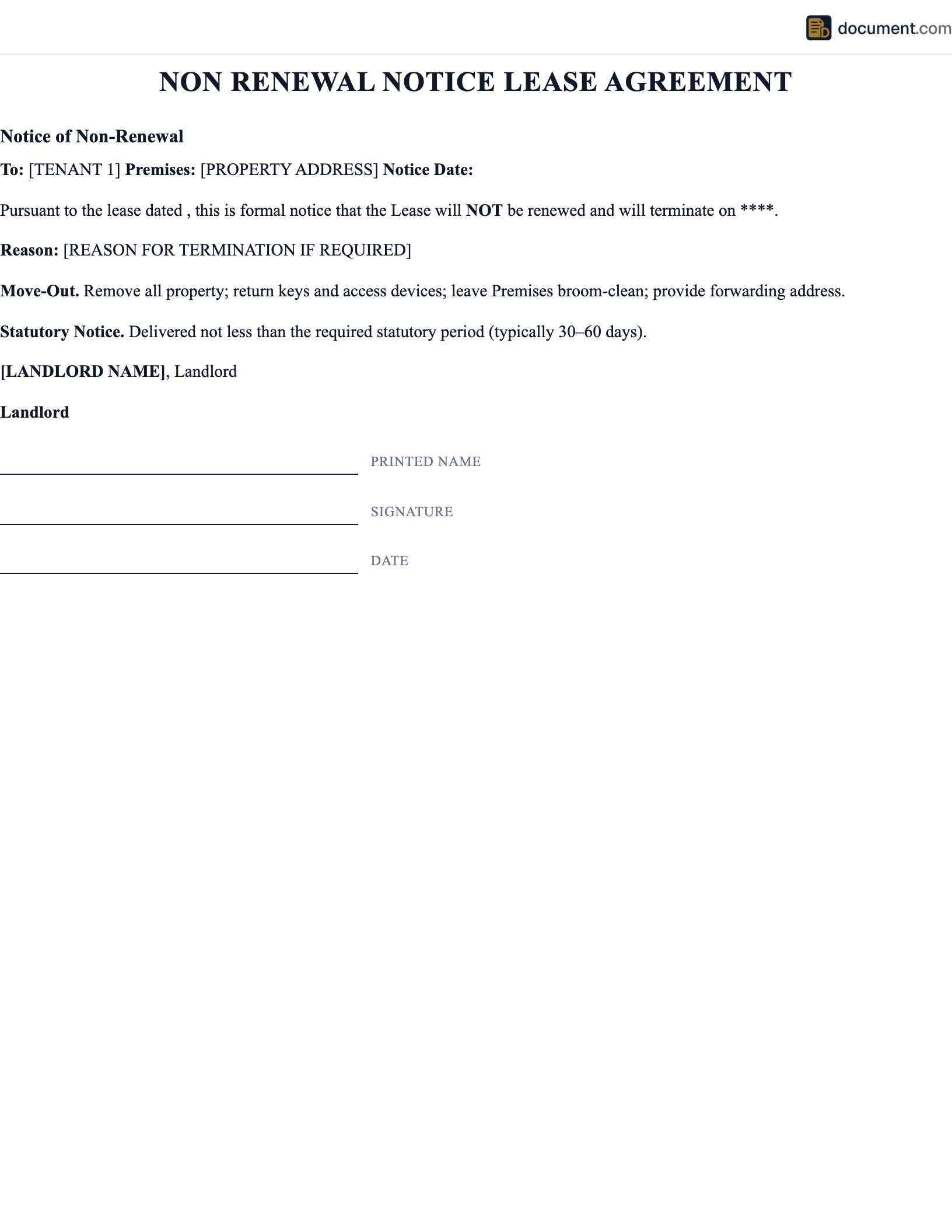
Below is a preview of the Non-Renewal of Lease Notice template. Your customized document will include all provisions for your specific situation.
NOTICE OF NON-RENEWAL OF LEASE
Lease Expiration Notice
This document is entered into on [Date] between the parties identified below:
FROM (Landlord/Tenant):
Name: [Sender Name]
TO (Landlord/Tenant):
Name: [Recipient Name]
How to Use This Document
Drafting the notice is the easy part. Service, timing, and statutory compliance determine whether it survives a court challenge. Work through the four steps below in order. Defective service is the single most common reason non-renewal notices are struck down at unlawful-detainer trial, and a struck-down notice forces the landlord to start over with a new periodic-tenancy notice that runs another 30 to 60 days.
Confirm the Required Notice Window
Read the lease for any contractual notice provision longer than the state default. Check the state landlord-tenant act for the residential periodic-tenancy notice (30 days in most states, 60 in California for tenancies over one year, 20 in Washington, 7 in week-to-week jurisdictions). Layer on any local just-cause ordinance requirement (60 to 90 days in San Francisco, Oakland, Berkeley, Los Angeles, Portland, Seattle, Newark, Jersey City). Count backward from the expiration date and select the earliest applicable trigger date. Mailing typically adds 3 to 5 days under state extension-of-time rules; calendar accordingly.
Draft the Notice with Required Elements
Identify the parties by full legal name, the property by complete street address with unit number, the date of the original lease, the expiration date, and the move-out date by which possession must be returned. In just-cause jurisdictions cite the statutory ground (California Civil Code § 1946.2 lists the permissible grounds verbatim). Include the forwarding-address request and the procedure for the joint move-out walkthrough where state law gives the tenant that right (California Civil Code § 1950.5(f) is the leading example). Sign and date.
Serve by an Approved Method
Personal delivery to an adult occupant is best. Substituted service (leaving with a competent adult at the unit and mailing a second copy) is the next-best option in most states. Certified mail with return receipt provides the cleanest evidentiary record but adds the statutory mailing extension. Posting on the door alone is generally insufficient unless preceded by reasonable diligence to locate the recipient. Retain a proof-of-service declaration signed under penalty of perjury identifying the method, date, time, and recipient. Without that record the notice is functionally untraceable in court.
Manage Move-Out and Holdover Risk
Schedule the joint walkthrough (required by California Civil Code § 1950.5(f), Massachusetts G.L. c. 186 § 15B, and several other state codes) within the statutory window before move-out. Photograph every room, document any new damage, and confirm the date keys are surrendered. If the tenant remains beyond the move-out date, refuse all rent payments to avoid creating a new periodic tenancy by acceptance, and file the unlawful-detainer complaint promptly. Holdover rent in most states equals one to three times the prorated daily rent; California Civil Code § 1947.7 caps it differently, and several states (Texas, Florida) allow lease-defined holdover penalties.
Key Components
| Component | Description |
|---|---|
| Sender Identification | Landlord or tenant name and contact information |
| Property Address | Full address of the rental property |
| Lease Reference | Original lease dates and term being non-renewed |
| Non-Renewal Date | Date by which the tenant must vacate |
| Notice Period Compliance | Reference to state law or lease clause requiring notice |
| Move-Out Instructions | Key return, inspection scheduling, forwarding address |
Frequently Asked Questions
Find answers to common questions about the Non-Renewal of Lease Notice.
Resources
Create your Non Renewal Notice Lease Agreement in under 10 minutes.
Answer a few questions and download a compliant, attorney-drafted document ready for your state.