



What Is an Intent to Vacate Letter?
An intent to vacate letter (also known as a notice of intent to vacate or tenant move-out notice) is a formal written document from a tenant to their landlord or property manager notifying them of the tenant's plan to move out of the rental property by a specific date. This letter serves as the required written notice under most state landlord-tenant laws and lease agreements, formally beginning the move-out process and establishing a timeline for the end of the tenancy.
The intent to vacate letter is one of the most important documents a tenant will send during their tenancy because it directly affects their legal obligations and financial interests. Sending proper notice protects the tenant from being charged rent beyond the move-out date, preserves their right to a full security deposit refund, and ensures compliance with the lease termination provisions. A tenant who moves out without providing written notice risks forfeiting their security deposit, being held liable for additional months of rent, and receiving a negative reference from the landlord.
There are two primary scenarios for sending an intent to vacate: end-of-term notice and early termination. End-of-term notice is given when the tenant does not wish to renew their lease at its natural expiration date or wants to end a month-to-month tenancy. Early termination (breaking the lease) occurs when the tenant needs to leave before the lease expires, which typically carries penalties unless the departure is for a legally protected reason such as military deployment, domestic violence, or the landlord's failure to maintain habitable conditions.
Beyond the legal requirements, a well-written intent to vacate letter serves practical purposes: it formally requests a move-out inspection, provides a forwarding address for the security deposit return, documents the condition in which the tenant intends to leave the property, and creates a paper trail that protects both parties in case of disputes. It also gives the landlord time to begin advertising the unit, scheduling showings, and preparing for the turnover.
End-of-Lease Notice
Notify landlord you will not renew when your lease naturally expires
Month-to-Month Exit
End a month-to-month tenancy with the required 30/60 day notice
Deposit Protection
Provide forwarding address and request move-out inspection for deposit return
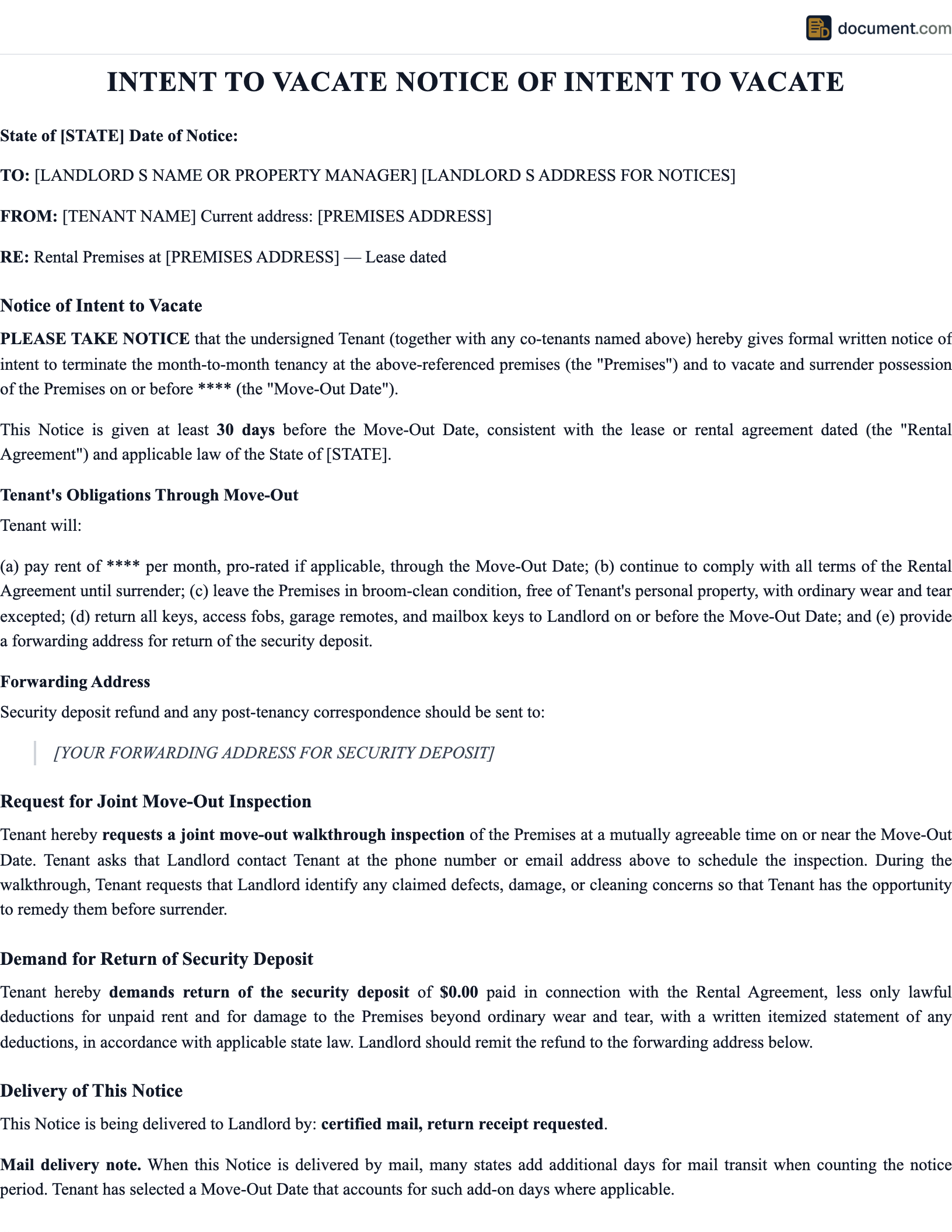
Intent to Vacate Letter Form Preview
Our intent to vacate letter template includes all required fields for a legally compliant move-out notice. Below is a preview of the key sections. Your customized letter will include your state's specific notice period and security deposit return requirements.
INTENT TO VACATE LETTER
Tenant Notice of Move-Out
TENANT INFORMATION
Tenant Name: [Full Name]
Current Address: [Rental Address, Unit #]
Lease Start Date: [Date]
LANDLORD / PROPERTY MANAGER
Name: [Landlord / PM Name]
Address: [Mailing Address]
MOVE-OUT DETAILS
Intended Move-Out Date: [Date]
Notice Period: [30/60] days
Reason: [End of lease / Relocation / Other]
FORWARDING ADDRESS & DEPOSIT
Forwarding Address: [New Address]
Security Deposit Amount: $[Amount]
Move-Out Inspection Requested: [Yes / No]
SIGNATURE
Tenant Signature: [Signature]
Printed Name: [Full Name]
Date: [Date]
How to Write an Intent to Vacate Letter
Writing an effective intent to vacate letter requires covering several key points to protect your rights and ensure compliance with your lease and state law. Follow these steps for a complete letter.
Review Your Lease Agreement
Before writing your letter, carefully review your lease for the required notice period, any specific notice format requirements, auto-renewal clauses, and early termination provisions. Most leases require written notice 30-60 days before the lease end date. If you are breaking the lease early, check for early termination fees, which are typically 1-2 months rent. Understanding your lease obligations will help you write a letter that fully protects your interests and avoids unintended financial liability.
Include Your Personal and Property Information
Start the letter with the date, your full legal name as it appears on the lease, the complete rental property address including unit number, and the landlord or property manager's name and address. If you have co-tenants on the lease who are also moving out, include all of their names. Reference your lease agreement by its start date or agreement number if applicable to clearly identify which tenancy you are terminating.
State Your Intent and Move-Out Date
Clearly and unambiguously state that you intend to vacate the property and specify the exact date you will move out. Use the full date format (e.g., "March 31, 2026") to avoid confusion. For month-to-month tenancies, the move-out date should be the last day of a rental period. For fixed-term leases, the move-out date should be the lease expiration date. Ensure the date provides at least the minimum notice period required by your state and lease agreement.
Provide Your Forwarding Address
Include the full address where you want your security deposit return and any other correspondence sent. This is one of the most important elements of the letter because your landlord is required by law to return your deposit (or send an itemized deduction statement) to your forwarding address within a state-specific deadline. If you do not yet know your new address, indicate that you will provide it before the move-out date, and follow up in writing when you have the information.
Request a Move-Out Inspection
Request a move-out inspection date and time. A walkthrough inspection with the landlord (or their representative) allows both parties to agree on the property condition, identify any issues, and potentially address them before the tenancy ends. In states like California, landlords are required to offer a pre-move-out inspection if the tenant requests one. This inspection is your best protection against unfair security deposit deductions. Suggest a few dates and times that work for you.
Address Security Deposit Return
Reference the security deposit amount you paid, request its full return in accordance with state law, and note the applicable state deadline for return (typically 14-60 days depending on your state). This demonstrates that you are aware of your rights and expect compliance. If your state requires the landlord to provide an itemized list of any deductions, mention this requirement as well. This encourages landlords to follow proper procedures.
Sign and Date the Letter
Sign the letter with your full legal name and include the date. If multiple tenants are on the lease and all are moving out, each tenant should sign. Keep the original for your records and send a copy to the landlord. Some tenants also take a photo of the signed letter with a timestamp for additional documentation.
Deliver Via Certified Mail
Send the letter via USPS certified mail with return receipt requested to create an official record of delivery. The return receipt (green card) provides proof that the landlord received the notice on a specific date, which is essential if the notice period or delivery is ever disputed. As a backup, also email a copy to the landlord and keep the delivery confirmation. If you can hand-deliver a copy, have the landlord sign and date an acknowledgment on your copy.
Key Components of an Intent to Vacate Letter
A comprehensive intent to vacate letter should include the following components to be legally effective and protect your interests as a tenant.
| Component | Description |
|---|---|
| Date of Letter | The date the letter is written; starts the clock on the notice period |
| Tenant Name(s) | Full legal names of all tenants on the lease who are vacating |
| Landlord/PM Name | Full name of the landlord or property management company |
| Rental Property Address | Complete address including unit number, city, state, and ZIP code |
| Lease Reference | Start date, end date, or agreement number to identify the lease |
| Move-Out Date | Exact date the tenant intends to vacate and return keys |
| Notice Period | Number of days being provided per lease terms and state law |
| Forwarding Address | New mailing address for security deposit return and correspondence |
| Security Deposit Amount | Amount paid, request for return, and reference to state return deadline |
| Inspection Request | Request for a scheduled move-out walkthrough inspection |
| Tenant Signature | Handwritten signature of each departing tenant listed on the lease |
| Delivery Method | Certified mail tracking number or hand-delivery acknowledgment |
Legal Requirements for Intent to Vacate
State laws establish minimum requirements for tenant move-out notice. Failing to comply can result in financial penalties, loss of security deposit, and continued rent liability.
Important: Check Your Lease Auto-Renewal Clause
Many leases contain auto-renewal clauses that automatically extend the lease for another full term (often 12 months) if the tenant does not provide timely written notice. Missing the notice window by even one day could lock you into another full year. Read your lease carefully and mark the deadline on your calendar well in advance.
State Notice Requirements
- Month-to-Month: Most states require tenants to give 30 days written notice; some states require only 15 days while others require a full calendar month
- Fixed-Term Lease: Notice window is defined in the lease, typically 30-60 days before expiration; failure to give timely notice may trigger automatic renewal
- Early Termination: Breaking a lease early typically requires paying an early termination fee (1-2 months rent) unless the departure is for a legally protected reason
- Written Notice Required: Nearly all states require notice to be in writing; verbal notice is generally insufficient and unenforceable
Protected Reasons for Early Termination
Federal and state laws allow tenants to break a lease without penalty in certain circumstances. The Servicemembers Civil Relief Act (SCRA) protects active-duty military members who receive deployment or permanent change of station orders. Most states allow early termination due to domestic violence (with a protective order or police report), the landlord's failure to maintain habitable conditions, illegal entry by the landlord, or the landlord's failure to comply with health and safety codes. Some states also provide protections for tenants who are victims of stalking or sexual assault, or tenants over a certain age who are entering assisted living facilities.
Sample Intent to Vacate Letter
Below is a sample intent to vacate letter from a tenant at the end of a lease term. Your customized document will include state-specific notice requirements and security deposit return timelines.
INTENT TO VACATE LETTER
30-Day Notice of Intent to Vacate
Date: [Month Day, Year]
To: [Landlord Name]
[Landlord Address]
Re: Notice of Intent to Vacate — [Rental Address, Unit #]
Dear [Landlord Name],
This letter serves as my formal written notice that I intend to vacate the above-referenced rental property on [Move-Out Date], which provides the required [30/60]-day notice per my lease agreement and state law.
Please send my security deposit of $[Amount], along with any required itemized deduction statement, to my forwarding address: [New Address].
I respectfully request a move-out inspection prior to my departure. Please contact me at [Phone/Email] to schedule a convenient date and time.
Tenant Signature
Printed Name: _______________
Date: _______________
Frequently Asked Questions
Find answers to common questions about intent to vacate letters, notice periods, security deposit returns, and early lease termination.
Official Resources
Use these trusted resources for additional information about tenant notice requirements, security deposit laws, and your state's landlord-tenant statutes.
Nolo Renters' Rights
State-by-state notice requirements and tenant rights guides
HUD Tenant Resources
Federal tenant rights, rental assistance, and housing resources
CFPB Housing Resources
Consumer guides on rental rights, security deposits, and complaints
SCRA Overview
Military lease termination rights under the Servicemembers Civil Relief Act
USA.gov Housing Help
Government resources for renters, complaints, and legal aid
Legal Services Corporation
Find free legal aid for landlord-tenant issues in your area
Create your Intent To Vacate in under 10 minutes.
Answer a few questions and download a compliant, attorney-drafted document ready for your state.