



What Is a Notice to Vacate?
A notice to vacate is a formal written document used by either a landlord or tenant to communicate the intention to end a rental tenancy. When issued by a landlord, it informs the tenant that they must move out of the rental property by a specified date. When issued by a tenant, it notifies the landlord that the tenant plans to vacate the premises. This document serves as the legally required first step in the tenancy termination process and must comply with state and local landlord-tenant laws.
The notice period — the amount of time between when notice is given and when the tenant must vacate — varies significantly depending on the state, local ordinances, the type of lease (month-to-month versus fixed-term), and in some cases the length of the tenancy. Most states require a minimum of 30 days notice for month-to-month tenancies, but California requires 60 days for tenancies exceeding one year, and some rent-controlled jurisdictions require 90 days or more. For fixed-term leases, the notice requirements are typically defined in the lease agreement itself.
A properly drafted and delivered notice to vacate is essential because it establishes the legal foundation for all subsequent actions. If a landlord fails to provide proper notice, any eviction proceeding that follows may be dismissed by the court. Similarly, if a tenant fails to give proper notice before moving out, they may be liable for additional rent, lose their security deposit, or face early termination fees as specified in their lease agreement.
There are important distinctions between a notice to vacate and an eviction notice. A notice to vacate can be issued for any reason (or no reason at all in jurisdictions without just-cause requirements) to end a month-to-month tenancy. An eviction notice, by contrast, is issued specifically because the tenant has violated the lease — typically through nonpayment of rent, property damage, unauthorized occupants, or illegal activity — and carries shorter cure periods and more immediate legal consequences.
Landlord to Tenant
Non-renewal, end of month-to-month, property sale, or owner move-in notice
Tenant to Landlord
End-of-lease move-out, month-to-month termination, or early lease termination
Notice Periods
30, 60, or 90 day requirements depending on state law and lease type
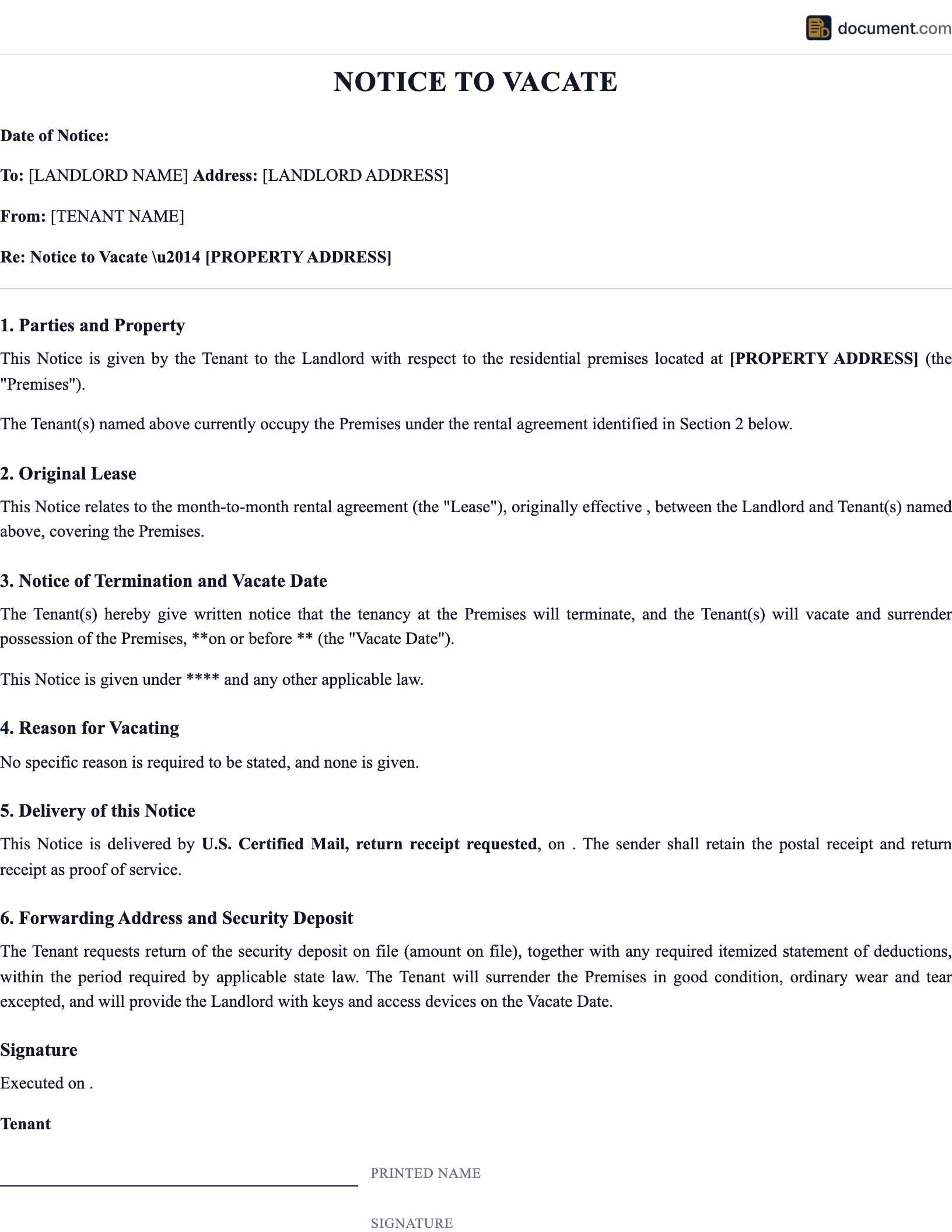
Notice to Vacate Form Preview
Our notice to vacate template includes all required fields for a legally valid termination notice. Below is a preview of the key sections. Your customized document will be tailored to your state's specific notice period and delivery requirements.
NOTICE TO VACATE
Termination of Tenancy
DATE AND PARTIES
Date: [Date]
To (Tenant/Landlord): [Full Name]
From (Landlord/Tenant): [Full Name]
RENTAL PROPERTY
Address: [Street Address]
Unit #: [Unit] City: [City] State: [State] ZIP: [ZIP]
NOTICE DETAILS
Notice Period: [30/60/90] days
Vacate By Date: [Move-Out Date]
Reason (if applicable): [Reason]
MOVE-OUT INSTRUCTIONS
Key Return Instructions: [Instructions]
Move-Out Inspection: [Date/Time]
Forwarding Address for Deposit: [Address]
SIGNATURE AND DELIVERY
Signature: [Signature]
Printed Name: [Full Name]
Delivery Method: [Certified Mail / Hand Delivery / Posted]
How to Write a Notice to Vacate
Writing a proper notice to vacate requires attention to legal requirements specific to your state and lease type. Follow these steps to ensure your notice is legally valid and protects your rights whether you are a landlord or tenant.
Determine the Required Notice Period
Check your state's landlord-tenant laws and your lease agreement to determine the minimum notice period required. For month-to-month tenancies, most states require 30 days, but some require 60 or 90 days. For fixed-term leases, check the lease for termination notice requirements — many leases require 30-60 days notice before the lease end date to prevent automatic renewal. Count the notice period carefully: notice typically begins the day after delivery and must provide a full calendar period before the vacate date.
Include All Party Information
Clearly identify all parties involved. Include the full legal name of the landlord or property management company, the full legal name(s) of all tenants listed on the lease, the complete rental property address including unit number, and the date the notice is being issued. If you are a landlord, address the notice to all tenants listed on the lease. If you are a tenant, address it to the landlord or property manager as specified in your lease.
State the Vacate Date Clearly
Specify the exact date by which the tenant must vacate or the tenant intends to vacate. Use the full date format (e.g., "January 31, 2026") to avoid ambiguity. For month-to-month tenancies, the vacate date should fall on the last day of a rental period. For fixed-term leases, the vacate date is typically the lease expiration date. Ensure the date provides at least the minimum number of days required by your state law from the date of delivery.
Include the Reason (If Required)
In jurisdictions with just-cause eviction requirements, the landlord must state a legally permitted reason for the notice, such as owner move-in, substantial renovation, withdrawal from the rental market, or sale of the property. Even in jurisdictions without just-cause requirements, it is good practice to include a brief, professional explanation. Avoid language that could be interpreted as retaliatory or discriminatory. If you are a tenant, stating a reason is generally not required but can help maintain a positive relationship for reference purposes.
Add Move-Out Instructions
For landlord-issued notices, include clear move-out instructions: how and where to return keys, the date and time for a move-out inspection, cleaning expectations, forwarding address requirements for security deposit return, and instructions for utility transfers. For tenant-issued notices, include your forwarding address for the security deposit return and request a move-out inspection date and time. Detailed instructions prevent disputes and ensure a smooth transition.
Reference the Lease Agreement
Cite the relevant section of the lease agreement and applicable state statute that authorizes the notice. This demonstrates that the notice complies with both contractual and legal requirements. For example, reference the lease clause covering termination notice requirements and the state statute governing the required notice period for the type of tenancy being terminated. This adds legal weight and credibility to the notice.
Sign and Date the Notice
Sign the notice with your full legal name and include the date of signing. If the notice is from a property management company, include both the company name and the authorized signer's name and title. While notarization is generally not required for a notice to vacate, some landlords choose to have the document notarized as additional proof of authenticity, particularly in contentious situations.
Deliver Using a Verified Method
Deliver the notice using a method that provides proof of receipt. Certified mail with return receipt requested is the gold standard because it creates an official USPS record of delivery. Hand delivery with a witness and signed acknowledgment is also effective. Many states allow posting on the door (taping to the main entry) combined with mailing a copy as an alternative when personal delivery is not possible. Keep copies of the notice, proof of mailing, and return receipt for your records — you may need them if the matter goes to court.
Key Components of a Notice to Vacate
A legally effective notice to vacate must contain specific information to be enforceable. While exact requirements vary by state, the following components are standard across most jurisdictions.
| Component | Description |
|---|---|
| Date of Notice | The date the notice is prepared and delivered, used to calculate the notice period |
| Landlord Name | Full legal name of the landlord, property owner, or property management company |
| Tenant Name(s) | Full legal names of all tenants on the lease, including co-tenants |
| Property Address | Complete address of the rental property including unit number, city, state, ZIP |
| Notice Period | Number of days being provided (30, 60, 90) per state law and lease terms |
| Vacate Date | Exact date by which the property must be vacated and keys returned |
| Reason for Notice | Required in just-cause jurisdictions; recommended in all cases for documentation |
| Lease Reference | Reference to the lease agreement including start date and relevant termination clause |
| Move-Out Instructions | Key return, cleaning requirements, inspection scheduling, and utility transfer details |
| Security Deposit Info | Forwarding address request for deposit return and timeline per state law |
| Sender Signature | Handwritten or electronic signature of the landlord or tenant issuing the notice |
| Delivery Method | How the notice was delivered: certified mail, hand delivery, or posted on door |
Legal Requirements for Notices to Vacate
Notice to vacate requirements are governed by state landlord-tenant statutes and vary significantly across jurisdictions. Failing to comply with these requirements can invalidate the notice and delay or prevent eviction proceedings.
Important: Proper Delivery Is Critical
A notice to vacate that is not properly delivered may be considered invalid by the courts. Always use a delivery method recognized by your state's law and retain proof of delivery. Certified mail with return receipt requested is accepted in all 50 states and provides the strongest evidence of delivery. If serving in person, have a witness present and obtain a signed acknowledgment.
Notice Period Requirements
- Month-to-Month Tenancy: Most states require 30 days notice; California requires 60 days for tenancies over 1 year; some rent-controlled cities require 90 days
- Week-to-Week Tenancy: Typically requires 7-15 days notice depending on the state; some states require a full week plus one additional day
- Fixed-Term Lease: Notice requirements are usually defined in the lease; the landlord generally cannot terminate early without cause
- Just-Cause Jurisdictions: Landlords must provide a legally valid reason and longer notice periods; tenant protections apply even for month-to-month tenancies
Delivery Methods
Acceptable delivery methods vary by state. The most universally accepted methods include certified mail with return receipt requested, personal hand delivery with a signed receipt, and in many states, posting on the door combined with regular mailing. Some states also accept delivery to another adult at the premises or leaving the notice at the tenant's place of employment. Electronic delivery (email or text) is generally not sufficient unless specifically authorized by state law or agreed to in the lease agreement.
Retaliation and Discrimination Protections
Federal and state fair housing laws prohibit landlords from issuing notices to vacate based on race, color, national origin, religion, sex, familial status, or disability. Additionally, most states have anti-retaliation statutes that prohibit landlords from issuing notices to vacate in response to a tenant exercising their legal rights, such as reporting code violations, requesting repairs, organizing a tenant union, or complaining to a government agency. Retaliatory notices issued within a statutory period (typically 6-12 months) after a protected activity are presumed retaliatory in many states.
Sample Notice to Vacate
Below is a sample notice to vacate from a landlord to a tenant for a month-to-month tenancy. Your customized document will include state-specific notice periods, delivery requirements, and any just-cause language required by your jurisdiction.
NOTICE TO VACATE
30-Day Notice of Termination of Month-to-Month Tenancy
Date: [Month Day, Year]
To: [Tenant Name(s)]
Re: [Property Address, Unit #, City, State, ZIP]
Dear [Tenant Name],
This letter serves as formal notice that your month-to-month tenancy at the above-referenced property will terminate in thirty (30) days. You are hereby required to vacate the premises and return all keys no later than [Vacate Date].
Please ensure the property is left in clean, broom-swept condition. All personal belongings must be removed. Please contact us at [Phone/Email] to schedule a move-out inspection.
Your security deposit of $[Amount] will be returned, less any lawful deductions, within [State Deadline] days of move-out per state law. Please provide a forwarding address for deposit return.
Landlord Signature
Printed Name: _______________
Date
Delivery Method: _______________
Frequently Asked Questions
Find answers to common questions about notice to vacate requirements, delivery methods, notice periods, and the differences between landlord and tenant notices.
Official Resources
Use these trusted resources for additional information about tenant rights, landlord obligations, notice requirements, and fair housing protections.
HUD Tenant Rights
Federal resources on tenant rights and rental assistance
HUD Fair Housing
Fair Housing Act protections against discriminatory evictions
CFPB Housing Resources
Consumer guides on renting, tenant protections, and complaints
Nolo Renters' Rights
State-by-state guides on notice requirements and tenant protections
USA.gov Housing Help
Government housing assistance, complaints, and legal resources
Legal Services Corporation
Find free legal aid for landlord-tenant disputes in your area
Related Landlord-Tenant Documents
Depending on your situation, you may need additional documents to complement your notice to vacate or to address related landlord-tenant matters.
Intent to Vacate Letter
Tenant notice to landlord of planned move-out date
Eviction Notice
Formal notice for lease violations or nonpayment of rent
Lease Agreement
Comprehensive rental agreement for residential properties
Security Deposit Return
Itemized deposit return letter with deduction breakdown
Move-In/Move-Out Checklist
Document property condition before and after tenancy
Lease Termination Agreement
Mutual agreement to end lease before expiration date
Create your Notice To Vacate in under 10 minutes.
Answer a few questions and download a compliant, attorney-drafted document ready for your state.