
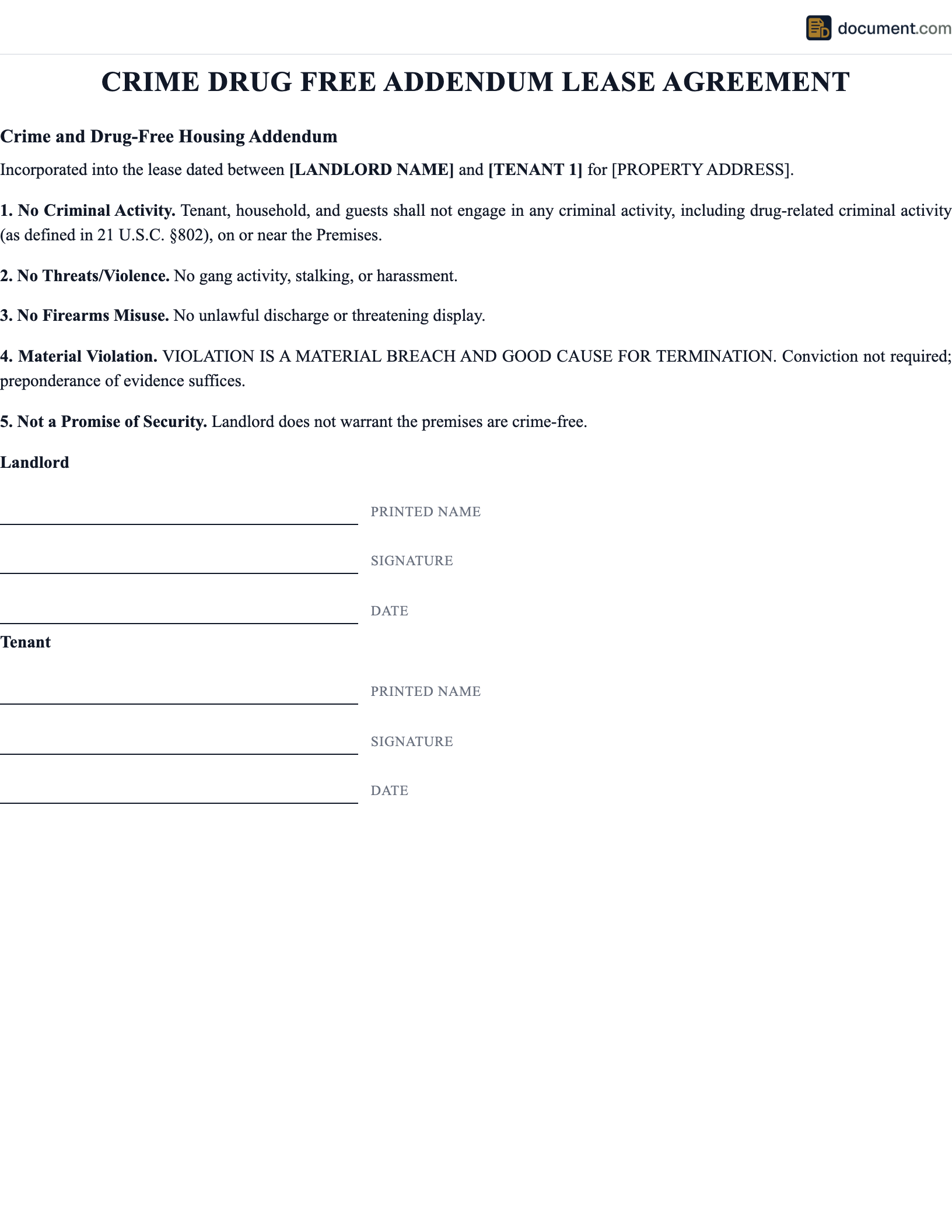



What Is a Crime and Drug-Free Addendum?
A crime and drug-free addendum is a supplemental lease document that prohibits criminal activity on or near the rental property and authorizes termination of the tenancy as a remedy. The form is mandatory for nearly all HUD-assisted housing under 24 C.F.R. §5.857 and is widely adopted by private-market landlords whose insurance carriers require it, whose municipalities run a crime-free housing program (Mesa AZ, Aurora CO, Las Vegas, Chicago, and roughly 2,000 other cities), or who simply want a predefined contract basis for evicting tenants engaged in nuisance activity. The federal architecture rests on the Anti-Drug Abuse Act of 1988 (Pub. L. 100-690) and the Quality Housing and Work Responsibility Act of 1998 (Pub. L. 105-276), both of which authorized HUD to require lease provisions allowing termination for any drug-related criminal activity by household members or guests.
Done correctly, the addendum reduces nuisance activity, limits landlord liability for premises-related harm under negligent-security tort law, and provides a predictable enforcement mechanism that does not require relitigating whether drug or violent activity is a lease breach. Done incorrectly, it creates Fair Housing Act disparate-impact exposure under HUD's April 4, 2016 Office of General Counsel guidance, conflicts with the growing list of state and local 'ban the box' housing ordinances (Newark, San Francisco, Seattle, Oakland, Berkeley, New Jersey statewide under N.J.S.A. 46:8-52), and can be defeated in court when the landlord cannot prove the tenant knew of or could have prevented the conduct.
Our template follows HUD's 2016 guidance and the post-Rucker enforcement framework: it incorporates the individualized-assessment language required to avoid disparate-impact claims, includes the substance-abuse disability carveouts required by the FHA and the ADA, adds a 'knew or should have known' modifier protecting against strict-liability eviction in private-market settings, and includes the VAWA carveout (34 U.S.C. §12491) protecting domestic-violence survivors from eviction for the perpetrator's conduct.
Public assisted housing versus private market
The HUD-mandated version differs in three important ways from the private-market version. First, the federal version invokes strict liability under HUD v. Rucker, 535 U.S. 125 (2002), permitting termination for guest conduct without tenant knowledge. The private-market version should add 'knew or should have known' to align with state common-law habitability and to defeat tenant defenses. Second, the federal version requires a pre-termination grievance hearing under 24 C.F.R. §966.54 with specified procedural rights (notice of grounds, right to examine documents, right to counsel at tenant expense, right to call witnesses). The private-market version follows state landlord-tenant procedure: typically a 3-day pay-or-quit or unconditional-quit notice. Third, the federal version applies HUD's PIH Notice 2015-19 mitigating-circumstances analysis even for one-strike violations. The private-market version can but should be drafted to apply the same analysis, both to align with the 2016 OGC guidance and to reduce litigation cost.
Crime-free housing programs and Section 8 voucher implications
Section 8 Housing Choice Voucher tenancies (24 C.F.R. Part 982) require the standard HUD lease addendum as a condition of voucher payment to the landlord. Termination of the tenancy for drug-related activity also typically terminates the voucher under 24 C.F.R. §982.553, leaving the household ineligible for housing assistance for at least three years and often permanently. Several jurisdictions have begun to limit this collateral consequence: California AB 1418 (effective January 2024) prohibits municipalities from requiring landlords to evict for criminal activity unrelated to the property, and California AB 2347 (effective January 2025) requires PHAs to provide notice and hearing before voucher termination. Local crime-free housing programs (Mesa AZ ordinance 4862, Las Vegas Municipal Code 6.95, Aurora CO Code 90-21) typically require participating landlords to use a more aggressive addendum than the HUD standard; review the specific ordinance before adopting program language.
HUD Guidance and One-Strike Rules
Three federal authorities shape the addendum for assisted housing, and a fourth shapes the federal-versus-state preemption balance:
- Anti-Drug Abuse Act of 1988 (Pub. L. 100-690): Enacted the original 'one strike' rule at 42 U.S.C. §1437d(l)(6), permitting termination for drug activity by household members or guests.
- HUD v. Rucker, 535 U.S. 125 (2002): Supreme Court affirmed strict enforcement regardless of tenant knowledge for federal public housing tenancies.
- HUD OGC Guidance, April 4, 2016: Applied disparate-impact analysis under Inclusive Communities to criminal-history screening and required individualized assessment.
- PIH Notice 2015-19: Directs PHAs to consider mitigating circumstances (nature, time elapsed, rehabilitation, household impact) before terminating.
- VAWA reauthorization (34 U.S.C. §12491): Protects domestic-violence survivors from eviction for the perpetrator's criminal conduct, including drug-related activity.
Fair Housing Act Interaction
HUD's April 4, 2016 Office of General Counsel guidance applies disparate-impact analysis under Texas Dept. of Housing v. Inclusive Communities Project, 576 U.S. 519 (2015) to criminal-history screening. The two-step framework requires the landlord to show that the screening criterion serves a substantial, legitimate, nondiscriminatory interest, then permits the tenant to show that a less-discriminatory alternative would achieve the same interest.
Blanket bans are presumptively unlawful
Refusing any applicant with any criminal history disproportionately excludes Black and Hispanic applicants and rarely survives the business-necessity defense.
Individualized assessment required
Consider nature and severity of the offense, time elapsed (typically 7 years for non-violent), evidence of rehabilitation, and conduct since release.
State and local 'ban the box' housing laws
Several jurisdictions have codified the 2016 HUD guidance into statute. New Jersey's Fair Chance in Housing Act (N.J.S.A. 46:8-52, effective January 2022) prohibits criminal history inquiries until after a conditional offer of tenancy and requires individualized assessment. The San Francisco Fair Chance Ordinance (SF Police Code §4901) bars consideration of arrests that did not result in conviction, sealed or expunged convictions, and most convictions over 7 years old. The Seattle Fair Chance Housing Ordinance (SMC 14.09) prohibits consideration of criminal history at all except for sex offenses requiring registration. The Oakland Fair Chance Access to Housing Ordinance (OMC 8.25), the Cook County Just Housing Amendment, and the Berkeley Fair Chance Access to Housing Ordinance impose similar restrictions. Detroit, Newark, and Minneapolis have enacted their own versions. Landlords operating in these jurisdictions must update their crime-free addendum to incorporate the local restrictions; using a stock HUD form invites litigation under the local ordinance.
Substance Abuse and Disability
The Fair Housing Amendments Act (42 U.S.C. §3604(f)) and the ADA (42 U.S.C. §12114(b)) both treat a history of substance abuse disorder, when the person is in recovery and not currently using, as a disability. Current illegal drug use is excluded from protection under 42 U.S.C. §12210(a). The line between 'in recovery' and 'currently using' is fact-intensive and typically requires medical documentation. HUD's October 26, 2016 OGC memorandum and 24 C.F.R. §100.202(c) require landlords to:
- Refrain from refusing to rent to applicants with documented recovery history.
- Engage in interactive dialogue about reasonable accommodations such as 90 to 180 days of additional time to complete court-ordered or voluntary treatment.
- Distinguish between current illegal drug use (not protected) and past use during rehabilitation (protected).
- Treat prescription medication for opioid use disorder (methadone, buprenorphine, naltrexone) as legitimate medical use, not illegal drug activity.
- Document the individualized analysis in writing before denying or terminating the tenancy.
How to Use This Addendum
Incorporate by reference
Add a clause to the main lease: 'The Crime and Drug-Free Addendum attached hereto is incorporated by reference and enforceable as a material term.' Without incorporation, the addendum may be treated as a separate, severable contract.
Define covered activity
Drug-related activity (manufacture, sale, distribution, use, or possession of any controlled substance under 21 U.S.C. §812) plus other criminal activity that threatens health, safety, or peaceful enjoyment of the premises by other residents.
Specify covered persons
Household members, guests, and 'persons under the tenant's control.' For private-market addendums, add a 'knew or should have known' modifier to align with California CCP §1161(4), Washington RCW 59.18.130(8), and New Jersey N.J.S.A. 2A:18-61.1(n).
Outline the termination process
Specify the state-law notice (3-day in CA/TX/WA, 10-day cure plus 30-day notice in NY, 24-hour for outrageous conduct in OR), right to cure for non-drug offenses, grievance hearing procedure for HUD-assisted housing under 24 C.F.R. §966.54.
Include the rehabilitation carveout
Allow evidence of rehabilitation, completed treatment, and time elapsed since the offense to weigh against termination. Apply the HUD 2016 OGC individualized-assessment framework.
Add the VAWA carveout
State expressly that the addendum does not authorize eviction of a domestic-violence survivor for the perpetrator's criminal conduct, per 34 U.S.C. §12491.
Frequently Asked Questions
HUD, Fair Housing Act, ADA, VAWA, and state-law questions about the crime-free addendum.
Official Resources
HUD 2016 OGC Criminal Records Guidance
Fair Housing Act disparate-impact analysis of criminal screening
24 C.F.R. §5.857, One-Strike Rule
HUD public housing and Section 8 termination regulations
HUD v. Rucker (2002)
Supreme Court decision on strict enforcement
HUD PIH Notice 2015-19
Mitigating-circumstances guidance for public housing
Add a crime-free addendum in under 10 minutes.
Pick your state, answer a few questions, and download a HUD-compliant addendum with the individualized-assessment language to keep it Fair Housing safe.