
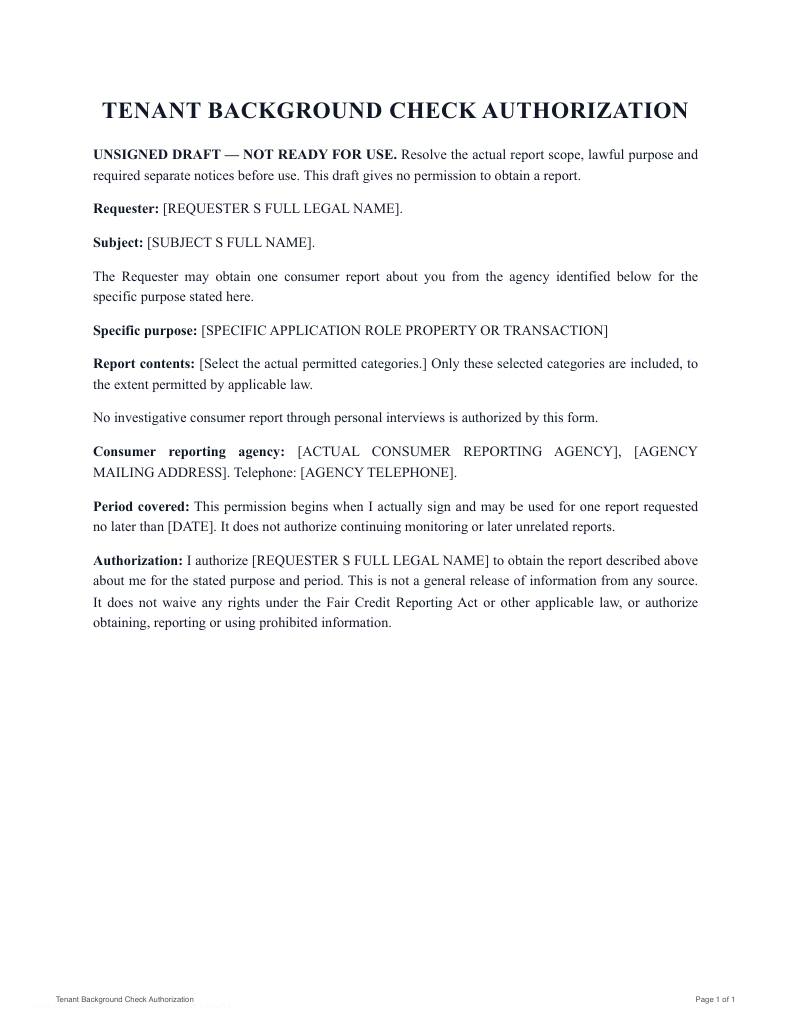
Tenant-screening authorization
This document records permission for the identified housing provider to request specified consumer-report information about a rental applicant. It should identify the applicant, requester, rental property, purpose and report categories. It does not transfer property, create a lien or require deed-recording taxes.
Keep the screening authorization separate from the rental decision. A screening report can be incomplete or inaccurate; verify identity and records, use lawful criteria and follow the applicable applicant-notice process. Do not treat the signature as a release of statutory rights.
State and local screening checks
Identify the property location and the applicant’s relevant jurisdictions. Check state and local rules on report categories, screening criteria, application fees, reusable reports, consent, disclosure and adverse action. The federal requirements described here are a starting point; this form does not establish compliance with every local rule.
Tenant screening differs from employment screening. Federal employment disclosure and pre-adverse-action duties do not automatically apply to every rental report. Personal-interview investigations can trigger additional investigative-report notices. Review the actual report and use rather than relying only on its product name.
Screening for employment
Choose the employment builder when reviewing a job applicant. In New York, employers generally cannot request or use consumer credit history. A worker’s signature does not establish a permitted exception. Read the New York and New York City employment credit rules or open the employment builder.
Prepare and deliver the authorization
Identify the actual landlord or property manager and reporting agency. Describe the property and housing purpose, select only appropriate report categories and give any required screening criteria or fee disclosures before charging or ordering.
Let the applicant review and sign the correct authorization. Obtain identifiers through the provider’s secure process and collect only what is needed to match records. Do not publish birth dates, government identifiers or reports in land records or other public repositories.
Confirm the report belongs to the correct person and evaluate it under the applicable housing and consumer-reporting rules. Provide additional notices and response opportunities when required. Retain the authorization and decision records securely for the applicable retention period.
Report use, adverse action and privacy
When a consumer report contributes to rejecting an applicant or imposing less favorable rental terms, provide the required adverse-action notice. It identifies the reporting agency, explains that the agency did not make the decision, and describes the right to dispute information and request a free report within 60 days. Credit-score use adds disclosure requirements.
Do not reuse a report for an unrelated purpose. Restrict access to people with a legitimate need, use a documented retention schedule and securely dispose of report information when retention is no longer required. Local law may impose additional written notices or procedures.
Sample and tenant builder
The sample is an uncompleted tenant authorization. It is not a completed screening report, proof of consent or a determination that an applicant is eligible. Separate state disclosures and provider materials may still be required.
Select the rental property’s state
Use the matching tenant-builder selection and review the separate screening requirements.
Frequently asked questions
Primary sources
Prepare your tenant authorization with the right screening purpose.
Review the separate disclosures and screening requirements before using your document.
Washington employment screening
For a job involving Washington work, including remote work from Washington, use the employment wizard. The work and hiring locations, report contents, relationship, decision date and employer size determine which steps apply.
Criminal records and conditional offers
Under the earlier rule, an ordinary employer must first decide whether the applicant meets the basic published job criteria without considering criminal history. Starting July 1, 2026 for employers with 15 or more employees, and January 1, 2027 for smaller employers, the amended law also requires a conditional offer before obtaining the applicant’s record. Specific statutory exceptions and local protections may apply. A future-check disclosure or unsolicited applicant disclosure during an interview can trigger immediate delivery of the written statutory explanation and the actual Attorney General’s guide.
Credit and current employees
Identify a law requiring employment credit information, or document the substantial connection to the job and disclose the reasons to the person in writing. For a current employee, resolve post-hire written notice or the narrow exception for specific unlawful activity. Carry out any adverse-action process separately.
Open the Washington employment wizard · Employer checklist · Applicant notice in Word · Attorney General’s guide and translations · Employment credit law.