



What Is a Lead-Based Paint Disclosure?
A lead-based paint disclosure is the federally mandated form required for the lease or sale of any target housing built before 1978 under the Residential Lead-Based Paint Hazard Reduction Act of 1992 (Title X), codified at 42 U.S.C. § 4852d and implemented at 24 C.F.R. § 35.92 (HUD) and 40 C.F.R. § 745.107 (EPA). Three things must occur before the lease or sale closes: the landlord or seller must disclose all known information about lead-based paint and lead-based paint hazards in the property; the EPA pamphlet 'Protect Your Family from Lead in Your Home' (EPA-747-K-12-001) must be delivered to the tenant or buyer; and the tenant or buyer must sign a written acknowledgment that becomes part of the lease or contract.
The disclosure exists because lead-based paint remains the largest source of childhood lead exposure in the United States. CDC data: approximately 24 million U.S. homes still contain lead-based paint hazards (deteriorating paint, lead-contaminated dust, lead in soil); about 4 million of those are home to a child under six; the median blood lead level in U.S. children dropped from 15 μg/dL in 1976 to under 1 μg/dL today, but elevated levels remain concentrated in pre-1978 housing. Children under six are the highest-risk population because they ingest paint chips, breathe lead dust, and have nervous systems that are still developing. Any blood lead level above 3.5 μg/dL is now considered actionable under CDC's 2021 reference value (down from 5 μg/dL in 2012).
The disclosure protects the landlord by establishing the documented compliance trail that defeats both EPA enforcement and private tort claims for lead exposure. The landlord who delivered the pamphlet, disclosed known information honestly (including 'no knowledge' if applicable), and obtained signed acknowledgment has the federal statutory safe harbor; the landlord who skipped any step faces civil penalties of $19,507 per violation, treble damages in private actions, and HUD or EPA consent decrees that have run from $250,000 to $1.6 million in published cases. The disclosure protects the tenant or buyer by providing the information needed to make informed decisions about occupancy by children under six and pregnant women, and by documenting the right to conduct a 10-day inspection at the buyer's option in sale transactions.
24 C.F.R. § 35.92 federal requirement
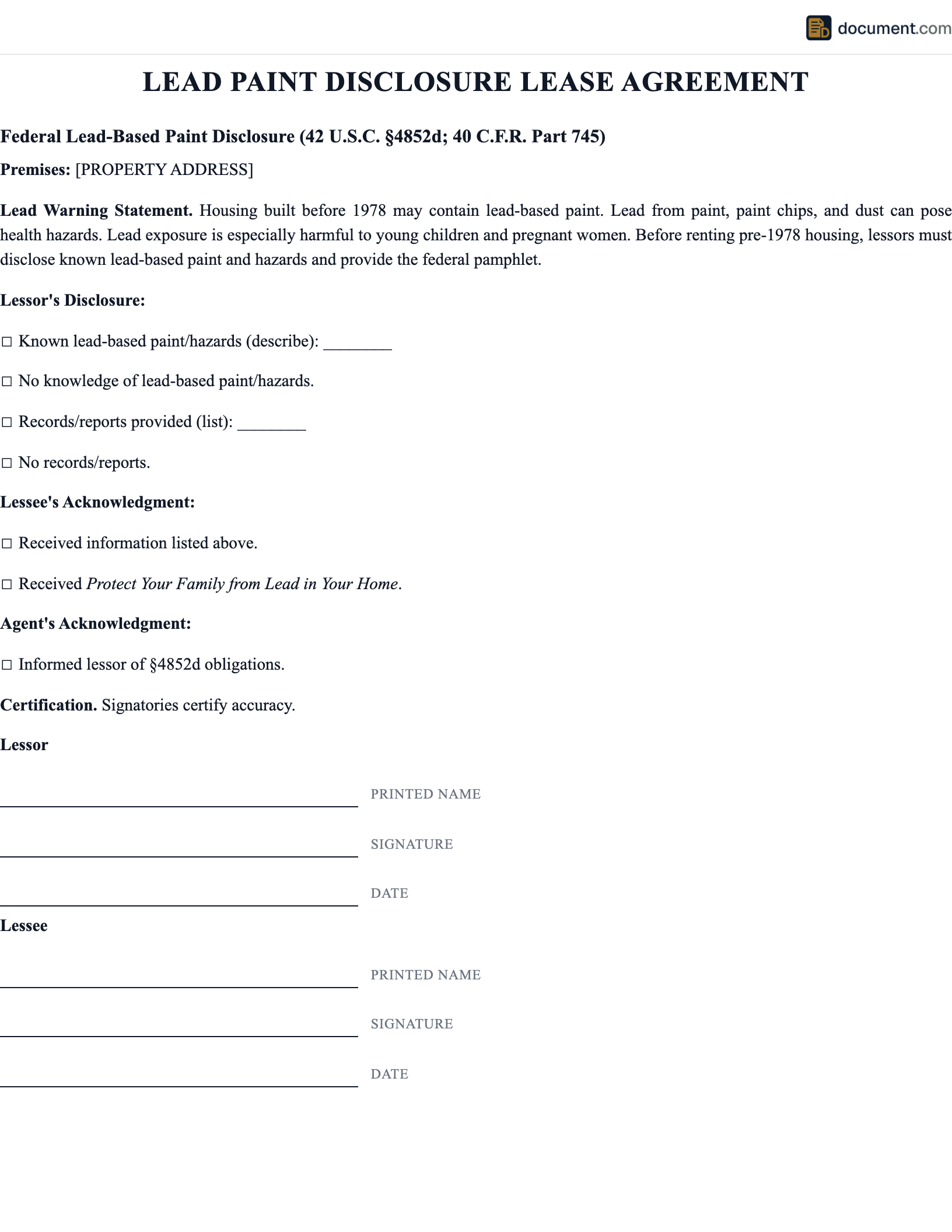
The HUD implementing rule at 24 C.F.R. § 35.92 requires four elements before any lease for target housing is signed. First, a Lead Warning Statement in the prescribed language at 24 C.F.R. § 35.92(b)(1)(i). Second, disclosure of any known lead-based paint or lead-based paint hazards in the housing, with copies of any reports or records or a statement that none exist. Third, a Lessor's Statement that the landlord has provided the information required and is aware of all of the known hazards. Fourth, a Lessee's Acknowledgment of receipt of the EPA pamphlet and the disclosure. The signed disclosure is part of the lease and must be retained by both parties for at least three years. The disclosure obligation also runs to any agent of the landlord (property manager, leasing agent), who is jointly liable for noncompliance under 24 C.F.R. § 35.94.
42 U.S.C. § 4852d civil penalties and exemptions
Civil penalties under 42 U.S.C. § 4852d(b)(1) currently $19,507 per violation per the 2024 EPA inflation adjustment. Each separate failure is a separate violation: failure to deliver pamphlet ($19,507), failure to disclose known hazards ($19,507), failure to attach signed acknowledgment ($19,507), failure to retain records ($19,507). A single noncompliant lease commonly generates three to five violations. Knowing or willful violation under § 4852d(b)(3) triggers treble damages, attorney fees, and criminal penalty up to $11,000 and one year imprisonment. Statutory exemptions under 24 C.F.R. § 35.82: zero-bedroom dwellings (studios, dormitories); housing certified lead-free; short-term leases of 100 days or fewer with no extension; elderly or disabled-only housing without children under six; rental housing certified by a state-licensed inspector. Federal civil penalty actions are brought by EPA under TSCA § 16, and consent decrees have totaled more than $5 million across published cases against major landlords (Equity Residential, Pinnacle Allied Properties).
Federal Requirement
Mandatory disclosure under 24 C.F.R. § 35.92 and 40 C.F.R. § 745.107 for pre-1978 housing
EPA Compliance
Pamphlet EPA-747-K-12-001 plus signed acknowledgment plus 3-year retention
Civil Penalties
$19,507 per violation under 42 U.S.C. § 4852d(b)(1); treble damages for knowing violation
Form Preview
Below is a preview of the Disclosure of Lead-Based Paint Hazards template. Your customized document will include all provisions for your specific situation.
DISCLOSURE OF LEAD-BASED PAINT HAZARDS
Federal Lead Paint Disclosure Form
This document is entered into on [Date] between the parties identified below:
LANDLORD/SELLER:
Name: [Owner Name]
TENANT/BUYER:
Name: [Tenant/Buyer Name]
How to Use This Document
Four steps. Each completes a specific element of the federal disclosure rule; skipping any step creates the violation that triggers $19,507 in civil penalties per occurrence.
Determine If Disclosure Is Required
Disclosure is required for target housing built before 1978 under 24 C.F.R. § 35.86. Year of original construction controls; renovation does not reset. Statutory exemptions at 24 C.F.R. § 35.82: zero-bedroom dwellings (studios, dormitories, sleeping rooms); housing certified lead-free under § 35.86 by a state-certified inspector; short-term leases of 100 days or fewer where no extension or renewal can occur; housing exclusively for elderly persons or persons with disabilities unless a child under six resides; rental housing inspected by a state-certified inspector and found free of lead-based paint. State and local rules layer on top: Maryland (Real Property § 6-803), Massachusetts (G.L. c. 111 § 197), Rhode Island (§ 42-128.1), and New Jersey (N.J.S.A. 52:27D-437.1) impose additional testing and registration requirements for some pre-1978 properties.
Disclose Known Information
Disclose any known lead-based paint or lead-based paint hazards in the unit and any common areas. Include copies of any prior lead inspection reports, risk assessments, abatement records, RRP renovation records, EPA or state enforcement correspondence, contractor reports of disturbed paint, or observed paint deterioration. If the landlord has no knowledge, state that fact expressly using the Lessor's Statement language at 24 C.F.R. § 35.92(b)(2)(iii). 'No knowledge' is acceptable but only if true; an EPA enforcement audit will compare the disclosure against any inspection reports, contractor invoices, and tenant complaints in the property file. Concealment of known information triggers treble damages under § 4852d(b)(3).
Provide the EPA Pamphlet
Deliver the current edition of 'Protect Your Family from Lead in Your Home' (EPA-747-K-12-001), available free at epa.gov/lead. Distribution can be print or electronic per 24 C.F.R. § 35.92(b)(2). Available languages include English, Spanish, Arabic, Chinese (simplified and traditional), French, Korean, Russian, Somali, Tagalog, Vietnamese; deliver the language version requested by the tenant or appropriate to the household. The pamphlet must be delivered before lease signing; delivery at signing or after does not satisfy the rule. For renovations under 6 square feet (interior) or 20 square feet (exterior), the EPA RRP rule (40 C.F.R. § 745.84) requires the additional pamphlet 'Renovate Right' (EPA-740-K-10-001) before work begins.
Obtain Signed Acknowledgment
The tenant signs a written acknowledgment confirming receipt of the EPA pamphlet, receipt of the landlord's known-information disclosure, and (for sales) the opportunity to conduct a 10-day independent risk assessment or inspection at the buyer's expense. The signature must appear on the disclosure form itself (not just the lease) and must be dated. Each adult tenant who will sign the lease must also sign the disclosure. The signed disclosure is part of the lease and must be retained for at least three years from lease commencement under 24 C.F.R. § 35.175. Best practice is to retain for the full holding period of the property plus three years after sale or final disposition.
Key Components
| Component | Description |
|---|---|
| Property Information | Address and year of construction of the property |
| Known Hazards | Disclosure of any known lead-based paint or hazards |
| Inspection Records | Results of any lead inspections or risk assessments |
| EPA Pamphlet Confirmation | Acknowledgment that the pamphlet was provided |
| Tenant/Buyer Acknowledgment | Signed confirmation of receipt and understanding |
| Record Retention | Requirement to keep signed form for three years |
Frequently Asked Questions
Find answers to common questions about the Disclosure of Lead-Based Paint Hazards.
Resources
Create your Lead Paint Disclosure Lease Agreement in under 10 minutes.
Answer a few questions and download a compliant, attorney-drafted document ready for your state.