



What Is a Mold Lease Addendum?
A mold lease addendum allocates four things between landlord and tenant: pre-rental disclosure of any known mold history, the tenant's prevention duties (ventilation, leak reporting, humidity control), the landlord's structural-cause duties (roof, plumbing, HVAC, vapor barriers), and the cost-allocation rule for remediation when mold is discovered. Required by statute in California (AB 932 codified at Civ. Code § 1941.7 and Health & Safety Code § 26147), Maryland (Real Property § 8-208.4), Texas (Property Code § 92.058 for prior remediation costing more than $1,000), Virginia (§ 55.1-1215), New Jersey (N.J.A.C. 5:10-26 for multi-family), and several local jurisdictions including New York City (Local Law 55 of 2018). The implied warranty of habitability in 49 states (Arkansas excepted) makes the addendum recommended even where no statute requires it.
The addendum exists because mold remediation is expensive and the cost-allocation question is the source of most landlord-tenant litigation in this category. Professional remediation under EPA standards costs $500 to $4,000 for areas under 30 square feet and $4,000 to $30,000 for whole-unit remediation involving drywall replacement, HVAC duct cleaning, and content cleaning. Insurance recovery is often denied because most DP-3 landlord policies cap mold at $5,000 to $10,000 and exclude long-term moisture intrusion entirely. The implied warranty of habitability puts the cost on the landlord by default for any structural cause, but the addendum lets the landlord recover from the tenant for behavior-caused mold (failure to ventilate, blocked airflow, unreported leaks) when documented.
The addendum protects the landlord by establishing the prevention duties as material lease terms (a tenant who fails to use the bathroom exhaust fan during showers commits a lease violation, not just a habitability error), by setting the reporting window for moisture intrusion at 24 to 48 hours, and by preserving the deposit-deduction right for behavior-caused remediation. It protects the tenant by requiring the landlord to disclose known history, by setting the landlord's response timeline once a report is made (typically 7 days for inspection, 14 to 30 days for remediation), and by creating a written record of the condition at move-in that prevents disputes about pre-existing mold at move-out.
Implied warranty of habitability and remediation duty
The implied warranty of habitability, recognized in every state except Arkansas, requires the landlord to deliver and maintain a unit fit for human habitation. Mold qualifies as a habitability defect when the cause is structural: roof leaks, plumbing failures, defective grading, inadequate ventilation systems, vapor-barrier failure, HVAC condensation. The leading cases are Javins v. First National Realty (428 F.2d 1071, D.C. Cir. 1970), Pugh v. Holmes (486 Pa. 272), and Hilder v. St. Peter (478 A.2d 202, Vermont 1984). The remediation duty runs to the source: the landlord must fix the moisture cause, not just clean visible mold. EPA guidance is unambiguous that mold cleanup without source remediation produces immediate recurrence. Courts in California, New York, and Massachusetts have uniformly held that bleach-and-paint cosmetic remediation is not adequate when structural moisture continues.
EPA mold guidance and remediation standards
The EPA's 'Mold Remediation in Schools and Commercial Buildings' (EPA 402-K-01-001) is the controlling national standard, supplemented by 'A Brief Guide to Mold, Moisture, and Your Home' (EPA 402-K-02-003). Areas under 10 square feet can be remediated by trained property staff with appropriate PPE (N-95 respirator, gloves, eye protection). Areas of 10 to 30 square feet should be remediated by trained mold-abatement personnel with full containment. Areas over 30 square feet require licensed remediation contractors with negative-air containment, HEPA filtration, and post-remediation clearance testing (background air sample plus interior sample; interior must be at or below background to clear). Bleach is no longer recommended for porous surfaces because it does not penetrate. Antimicrobial application is case-by-case, not routine. Document every remediation with photos, scope of work, contractor invoice, and clearance test results.
Mold Disclosure
Required by CA AB 932, MD Real Property § 8-208.4, TX Property Code § 92.058, VA § 55.1-1215
Prevention Duties
Tenant ventilation, leak reporting, humidity control under 60 percent
EPA Remediation
Source-fix first, containment, HEPA, clearance testing per EPA 402-K-01-001
Form Preview
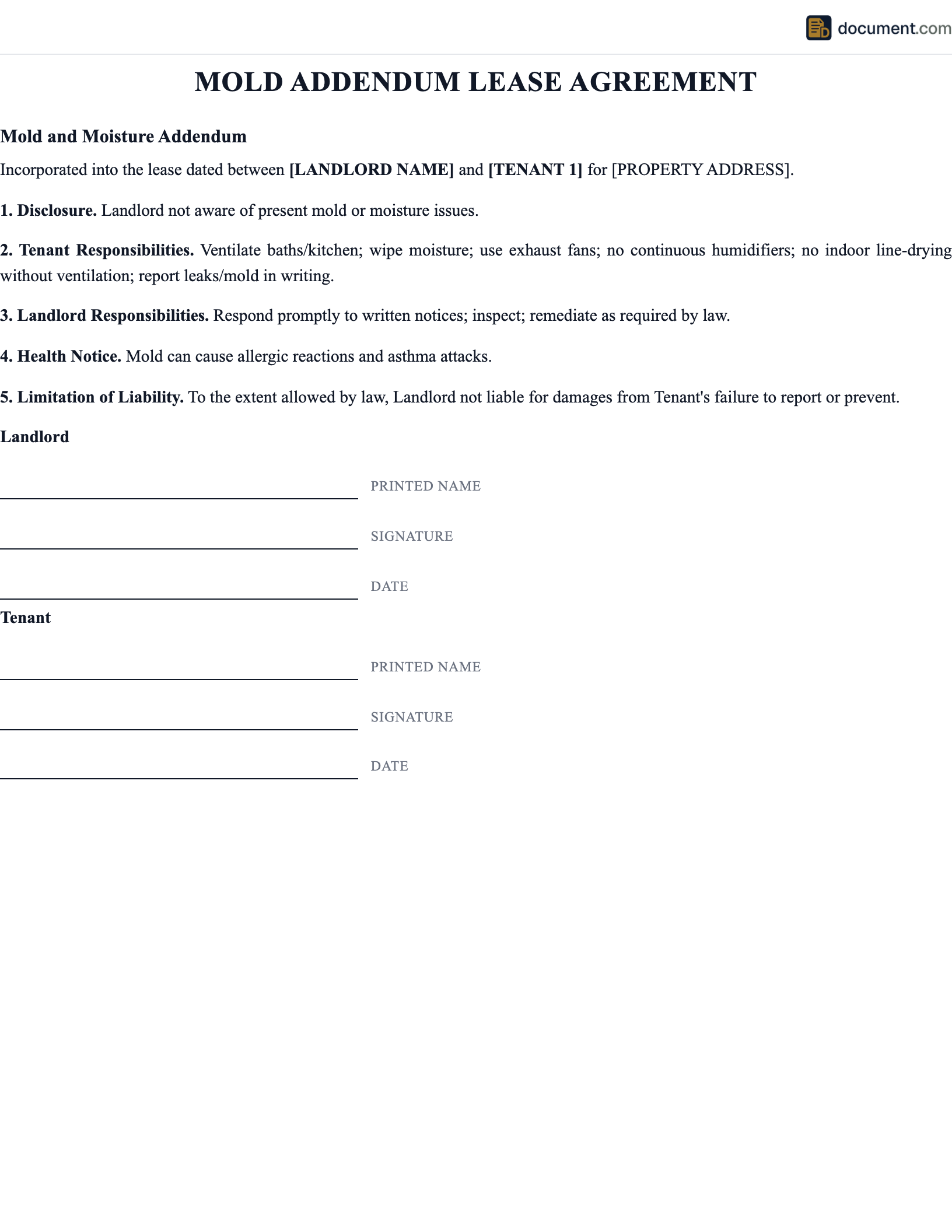
Below is a preview of the Mold Lease Addendum template. Your customized document will include all provisions for your specific situation.
MOLD LEASE ADDENDUM
Mold Disclosure and Prevention Agreement
This document is entered into on [Date] between the parties identified below:
LANDLORD:
Name: [Landlord Name]
TENANT:
Name: [Tenant Name]
How to Use This Document
Four steps. Each step generates documentation that supports a future cost-allocation or habitability claim.
Disclose Known Mold Issues
Disclose every confirmed mold remediation in the unit and in adjacent units within the prior 24 months including date discovered, location, scope (square footage), remediation contractor, treatment scope, and post-remediation clearance test results. California requires written disclosure when the landlord knows of visible mold (Civ. Code § 1941.7); Maryland requires the state mold information packet plus 12-month history (Real Property § 8-208.4); Texas requires disclosure of any past remediation over $1,000 (Property Code § 92.058). Disclose conditions conducive to mold even without confirmed presence: prior water damage, sump pump in basement, persistent humidity issues, slab-on-grade construction without vapor barrier. Silence on a known prior remediation is fraud in every state.
Define Prevention Responsibilities
Tenant duties: use bathroom exhaust fan during and 15 minutes after every shower; use kitchen range hood during cooking; do not block any HVAC supply or return register with furniture; do not dry clothing indoors without dedicated ventilation; maintain humidity below 60 percent (use a hygrometer; landlord supplies one if requested); report any visible water intrusion or condensation within 24 hours; do not use humidifiers without prior landlord approval. Landlord duties: maintain roof in watertight condition; maintain plumbing free of leaks; maintain HVAC with clean filters and proper drainage; respond to moisture reports within 48 hours with inspection and within 14 days with remediation if needed; provide annual HVAC inspection.
Establish Reporting Procedures
Require electronic written notice (email or property-management portal) within 24 hours of any visible mold, water intrusion, persistent condensation, musty odor, or unexplained respiratory symptoms among occupants. State the property manager's after-hours emergency contact for active water intrusion. State that failure to report within the window shifts remediation cost to the tenant for any spread the delay caused (a single drywall mold patch left untreated for 30 days commonly grows from 1 to 25 square feet). Require photographs with the report. Specify response timelines: inspection within 48 hours, professional assessment if needed within 7 days, remediation start within 14 days for confirmed mold over 10 square feet.
Outline Remediation Procedures
State the EPA standard: source-fix first, containment for areas over 30 square feet, HEPA-vacuum and damp-wipe non-porous surfaces, removal and disposal of contaminated porous materials, clearance testing with background-comparable air sample. Identify the remediation contractor by name; require IICRC S520 certification or state-equivalent licensing where applicable (California Bus. & Prof. Code § 7180 et seq. covers some remediation; Texas Occupations Code Ch. 1958). State the cost-allocation rule: landlord pays for structural-cause mold; tenant pays for behavior-caused mold with documented evidence of cause (photos, hygrometer logs, witness statements). Address relocation: landlord pays comparable temporary housing during remediation lasting more than 7 days for areas over 30 square feet.
Key Components
| Component | Description |
|---|---|
| Mold Disclosure | Current and historical mold presence information |
| Prevention Guidelines | Specific tenant and landlord prevention duties |
| Reporting Requirements | Timeline and method for reporting mold or moisture |
| Inspection Rights | Landlord right to inspect for mold conditions |
| Remediation Procedures | Professional assessment, treatment, and verification |
| Cost Allocation | Who pays based on the cause of mold growth |
Frequently Asked Questions
Find answers to common questions about the Mold Lease Addendum.
Resources
Create your Mold Addendum Lease Agreement in under 10 minutes.
Answer a few questions and download a compliant, attorney-drafted document ready for your state.