



What Is a Swimming Pool & SPA Addendum?
A swimming pool and spa addendum allocates four things between landlord and tenant: pool-area access rules and hours, supervision and safety duties (especially for children under 14), maintenance and repair responsibilities, and the liability framework that survives an injury claim. The pool is the highest-liability amenity on most residential properties: the CDC reports approximately 4,000 unintentional drowning deaths annually in the United States, with about 700 in residential pools and one in five involving children under 14. Per-incident defense and settlement costs in residential pool drowning cases run from $250,000 to $5 million, and most landlord DP-3 dwelling fire policies sublimit pool liability at $25,000 to $50,000. The addendum is one of three documented systems (the others being barrier compliance and certificate-of-insurance verification) that determines whether the carrier indemnifies or denies.
Three legal regimes apply to every rental pool. The Virginia Graeme Baker Pool & Spa Safety Act (15 U.S.C. § 8001 et seq.) requires anti-entrapment drain covers meeting ASME/ANSI A112.19.8 standards on every public pool, including any pool serving more than one dwelling unit in most state implementations, with civil penalties up to $100,000 per violation enforced by the Consumer Product Safety Commission. The 2021 International Swimming Pool and Spa Code (ISPSC), adopted in 32 states either by reference or by amendment, requires 4-foot barrier fencing with self-closing self-latching gates, climbing-resistant construction, and gate-latch height at least 54 inches above grade. State-specific codes layered on top: Florida § 515.27 (residential pool barrier), California Health & Safety Code § 115922 (Pool Safety Act), Arizona § 36-1681 (Maricopa and Pima 5-foot barrier), Texas Health & Safety Code § 757 (rules for residential pools serving multiple dwellings).
The addendum protects the landlord by establishing the supervision, equipment, and behavior rules in writing with tenant signature, by preserving the deduction right for tenant-caused damage to pool surfaces and equipment, and by creating the documented compliance trail (rules posted, addendum executed, insurance verified) that umbrella carriers require for indemnification. It protects the tenant by stating the rules that apply, by setting the landlord's response duty for equipment failures, and by allocating maintenance cost so the tenant is not surprised by chemical-treatment charges. Without an addendum, the lease silence shifts every dispute to common-law negligence analysis, where the foreseeable-harm doctrine and attractive-nuisance liability run heavily against the landowner.
Premises liability and the Graeme Baker Act
Premises liability law in every state imposes a duty of reasonable care on landlords toward invited users including tenants, household members, and authorized guests. For pools, that duty extends to maintaining barrier compliance, posting rules and depth markers, providing functional safety equipment (life ring, reaching pole, phone), keeping water chemistry within CDC Healthy Swimming guidelines (chlorine 1 to 4 ppm, pH 7.2 to 7.8), and removing visible hazards (broken tile, slip surfaces, deck deterioration). The federal Graeme Baker Act adds a strict-liability layer for drain entrapment: every covered pool must have an anti-entrapment cover certified to ASME/ANSI A112.19.8, with secondary protection (gravity drainage, automatic pump shut-off, vacuum release system) for any pool with a single main drain. Civil penalties up to $100,000 per day of violation are enforced by the CPSC. Insurance carriers refuse to indemnify violations regardless of waiver language in the lease."
Local fence and cover ordinances
Local pool codes typically exceed state minimums and control. Los Angeles Municipal Code § 91.3109 requires 5-foot barrier with anti-climb design and pool cover meeting ASTM F1346 for any residential pool. Miami-Dade § 8C-3 requires barrier plus pool alarm plus door alarm on house entries to the pool area. New York City Building Code § 3109 requires 4-foot barrier plus alarm. Phoenix City Code § 2-4 requires 5-foot barrier plus self-closing self-latching gate. Chicago Municipal Code § 13-32 requires barrier plus 12-inch nonclimbable horizontal-member rule. Compliance is measured at every inspection by the local building department and at every insurance-policy renewal. The addendum should reference the applicable local code by chapter and require the tenant to maintain barrier integrity (no propping gates, no creating climbing aids, no defeating alarms).
Safety Rules
Posted hours, supervision duty for children under 14, no-glass policy, no diving in shallow water
Liability Waiver
Inherent-risk assumption enforceable; full negligence waivers void in CA, NY, MA
Maintenance Duties
Landlord chemistry and equipment, tenant cleanup and reporting
Form Preview
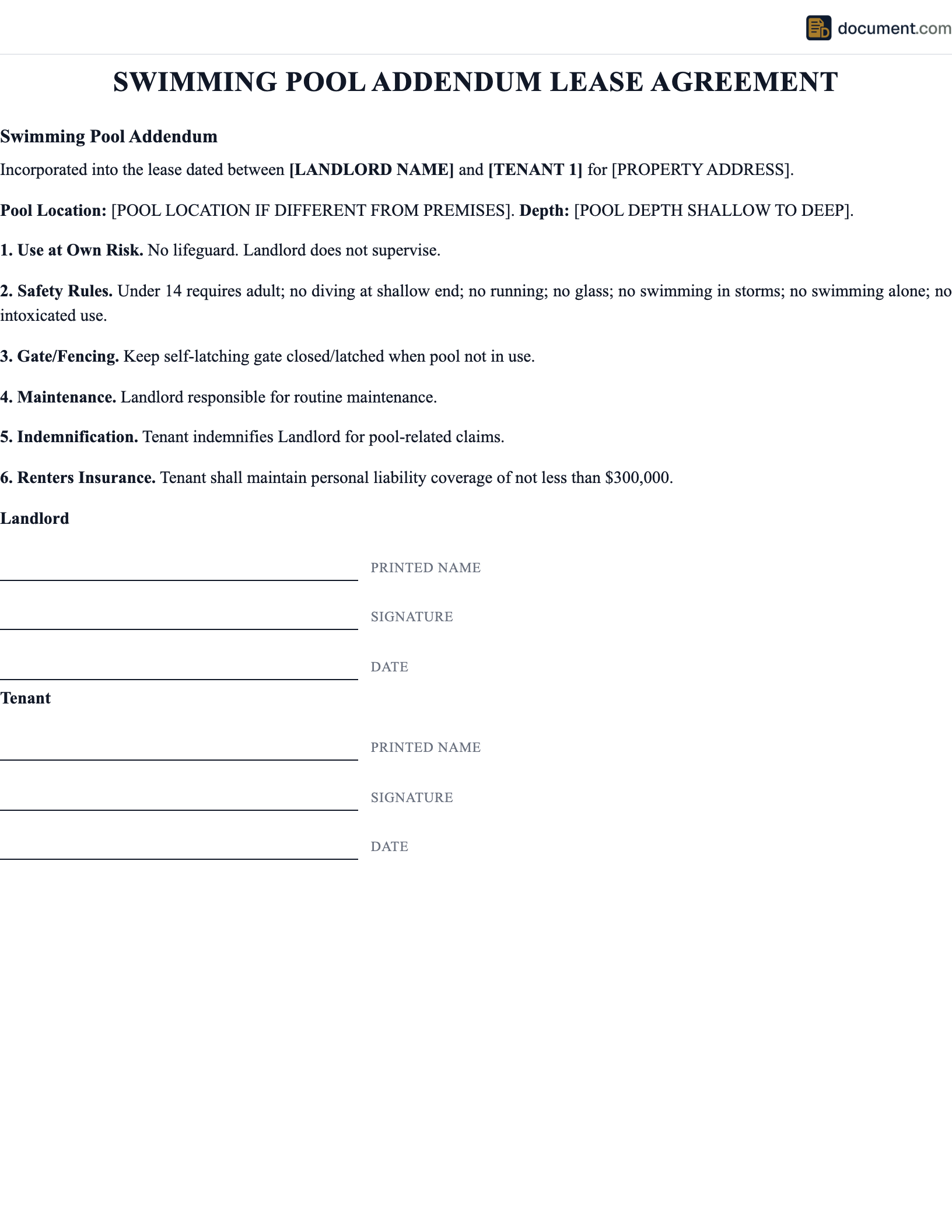
Below is a preview of the Swimming Pool & SPA Addendum template. Your customized document will include all provisions for your specific situation.
SWIMMING POOL & SPA ADDENDUM
Pool and Hot Tub Usage Agreement
This document is entered into on [Date] between the parties identified below:
LANDLORD/PROPERTY MANAGER:
Name: [Name]
TENANT:
Name: [Tenant Name]
How to Use This Document
Four steps. Each generates the documented compliance that umbrella insurance carriers require for indemnification of any pool-related claim.
Establish Operating Hours
Set hours by season and day. Standard residential: 8 AM to 10 PM weekdays, 8 AM to 11 PM weekends. Reflect local noise ordinances (Los Angeles 10 PM quiet hours under § 116.01, Miami-Dade 11 PM under § 21-28). Specify seasonal closures (May 15 through September 15 in temperate climates; year-round in Sun Belt). State the closure rule for chemical treatment (24 hours after shock), equipment failure (immediate on landlord notice), and safety violations (immediate on staff observation). Post hours visibly at the pool gate; signage plus addendum creates the duty of reasonable communication that defeats most user-side defenses.
Define Safety Requirements
Mandatory adult supervision for children under 14. No diving in pools under 9 feet (per ANSI/APSP-1 standards). No glass containers anywhere in pool area. Required shower before entry. Maximum capacity per square footage of pool surface (1 person per 15 square feet under most state pool codes). Hot tub temperature cap at 104°F per CPSC guidance, with 15-minute soak limit and warning to pregnant women, children under 5, and persons with cardiovascular conditions. No use of the pool during storms, lightning warnings, or maintenance. Reference the local pool code by chapter and require tenant compliance.
Address Liability and Waiver
Liability waiver scope depends on state law. California Civ. Code § 1668 voids negligence waivers in residential leases entirely. New York Gen. Oblig. Law § 5-321 voids them for landlord negligence. Massachusetts G.L. c. 186 § 15 voids them for negligence and willful misconduct. Texas, Florida, Georgia, and most other states allow narrow waivers of ordinary negligence with specific language and conspicuous formatting. Use defensible inherent-risk language: tenant assumes inherent pool risks (drowning, slip, sun exposure, sprain), tenant supervises children under 14, tenant complies with posted rules. Require renter's insurance with $300,000 to $500,000 liability minimum naming landlord as additional insured.
Set Maintenance and Guest Rules
Landlord duties: weekly chemistry per CDC Healthy Swimming guidelines (chlorine 1 to 4 ppm, pH 7.2 to 7.8, alkalinity 80 to 120 ppm); equipment inspection monthly; biannual professional cleaning; immediate response to algae bloom or contamination; barrier integrity inspection annually with documented log. Tenant duties: report equipment malfunctions immediately; do not bring chemicals or modify equipment; do not consume alcohol beyond personal allotment; comply with posted rules. Guest limits: typically 4 to 6 per household with 24-hour advance notice for parties exceeding the limit. Some properties prohibit private events entirely; document the rule in the addendum.
Key Components
| Component | Description |
|---|---|
| Operating Hours | Permitted pool and spa usage times |
| Safety Rules | Supervision, glass prohibition, capacity limits |
| Liability Acknowledgment | Tenant assumption of risk for pool usage |
| Maintenance Division | Landlord and tenant maintenance responsibilities |
| Guest Policy | Maximum guests, supervision, and event rules |
| Emergency Procedures | Location of safety equipment and emergency contacts |
Frequently Asked Questions
Find answers to common questions about the Swimming Pool & SPA Addendum.
Resources
Create your Swimming Pool Addendum Lease Agreement in under 10 minutes.
Answer a few questions and download a compliant, attorney-drafted document ready for your state.