
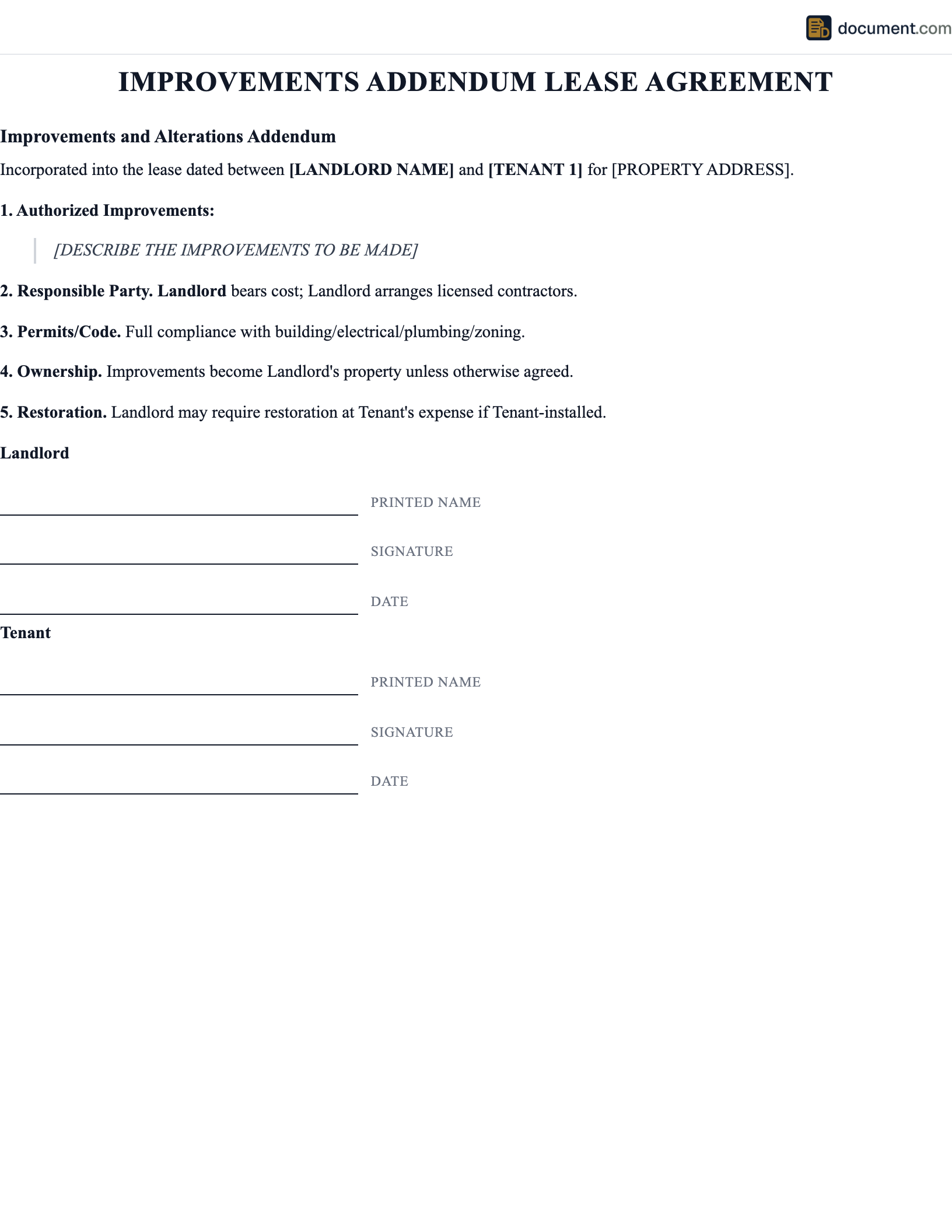



What Is an Improvements and Modifications Addendum?
An improvements and modifications addendum is a lease supplement that establishes the rules for any alteration a tenant makes to the rental premises. It covers paint, fixtures, built-ins, accessibility modifications under the Fair Housing Amendments Act (42 U.S.C. §3604(f)(3)(A)), structural changes, low-voltage and smart-home installations, and any other physical change to the unit. Without an addendum, the main lease's generic 'no alterations without consent' clause leaves four critical questions open: what counts as an alteration, who pays for it, what happens at move-out, and how does the security deposit interact with restoration. Disputes over wall repair, paint matching, drilled tile, scratched hardwood, and ceiling-fan installation are among the highest-volume small-claims-court categories nationally.
The addendum handles four structural questions. First, what requires landlord consent: cosmetic changes (paint, removable shelving, picture hangers) typically pre-approved with notice; fixtures (light fixtures, ceiling fans, built-in shelving) requiring written consent; structural changes (walls, flooring, plumbing, electrical) always requiring consent plus permits; accessibility modifications protected under the FHA but subject to restoration. Second, who pays: tenant by default, landlord by reimbursement clause for landlord-benefiting capital improvements, escrow arrangements for $5,000-plus modifications. Third, what the pre-existing condition was: documented walk-through with date-stamped photographs and a signed inspection report. Fourth, what happens at move-out: removal versus retention under the doctrine of accession, restoration to pre-modification condition, security-deposit chargeback for any deficiency.
Our template closes all four questions and includes the ADA and FHA carveouts required for accessibility modifications. It incorporates the EPA Renovation, Repair, and Painting Rule (40 C.F.R. Part 745) for any work in pre-1978 housing involving lead-based paint, the OSHA 29 C.F.R. §1926 contractor safety requirements for any major work, and the state-specific permit-disclosure obligations under California Civ. Code §1942.5, New York Mult. Dwell. Law §27, and Massachusetts G.L. c. 143 §3.
Cosmetic versus structural alterations
The threshold question for any tenant alteration is whether it is cosmetic (reversible without structural impact) or structural (affecting the building's integrity or systems). Cosmetic alterations include paint, wallpaper, removable shelving, picture hanging with adhesive strips or small nails (under 1/4-inch diameter), curtain rods, and area rugs. These are typically pre-approved subject to restoration at move-out. Structural alterations include any change to load-bearing walls, plumbing beyond fixture replacement, electrical work beyond outlet replacement, HVAC modifications, roof penetrations, and additions. These always require written landlord consent, building permits where local code requires them (typically over $500 in cost or any electrical/plumbing/structural work in most jurisdictions), and licensed-contractor performance under most state licensing statutes (California Bus. & Prof. Code §7028, Florida Stat. §489.127, Texas Occ. Code §1305.151).
FHA reasonable modifications and the Section 504 distinction
Two federal disability statutes intersect at the addendum. The Fair Housing Amendments Act (42 U.S.C. §3604(f)(3)(A)) and 24 C.F.R. §100.203 require landlords to permit tenants with disabilities to make reasonable modifications at the tenant's expense, with restoration required where reasonable. Section 504 of the Rehabilitation Act (29 U.S.C. §794) and 24 C.F.R. Part 8 apply to federally funded housing (HUD-assisted, Section 8, Section 202, Section 811) and require the landlord to pay for the modifications up to a structural-impossibility threshold and to meet UFAS or 2010 ADA Standards. The distinction matters for who pays: FHA tenant pays, Section 504 landlord pays. Both statutes prohibit refusal of the modification request. Refusal is a per-violation civil penalty of $24,792 first violation, $61,981 second, and $123,961 third or subsequent under the 2024 inflation adjustment of 42 U.S.C. §3612(g)(3).
Consent Before Alterations
Every alteration of any scope requires prior written landlord consent under the standard alterations clause that appears in nearly every residential lease. The addendum clarifies what counts as an alteration, what the approval process looks like, and what the response timeline is. A 14- to 30-day landlord response window is standard; longer windows defeat the tenant's reasonable timing for the work. Approval should be in writing, with scope, materials, contractor identity, permits, and timeline specified.
- Cosmetic: Paint, wallpaper, removable shelving, picture hanging with small nails or adhesive strips. Typically pre-approved with notice, subject to restoration at move-out.
- Fixtures: Light fixtures, ceiling fans, built-in shelving, installed appliances, security cameras. Requires written consent and licensed-electrician performance for hardwired installations.
- Structural: Walls, flooring, plumbing, electrical, HVAC, roof penetrations. Always requires written consent, building permits per local code, and licensed contractors per state licensing law.
- Accessibility: Grab bars, ramps, widened doors, lever handles, accessible fixtures. Protected under FHA 42 U.S.C. §3604(f)(3)(A), but landlord may require restoration and reasonable escrow.
- Smart-home and low-voltage: Video doorbells, smart locks, mesh wifi, security systems. Permitted under most leases but landlord can require keying and removal at move-out.
Removal vs. Retention at Move-Out
The doctrine of accession controls under the common law of every state: items affixed to the property in a way that makes removal impractical or destructive become the landlord's property at move-out. The three classic factors from Strain v. Green (Wash. 1946) and equivalents are manner of attachment, adaptation to the property, and parties' intent at installation. The addendum should override these defaults with case-by-case specifics so neither party guesses at move-out. State the disposition of each major category: paint, flooring, light fixtures, ceiling fans, built-in shelving, smart-home devices, accessibility modifications.
Landlord retains
Installed fixtures, hardwood and tile flooring, cabinetry, hardwired devices, accessibility ramps, plumbing and electrical alterations. Any item whose removal would damage the premises.
Tenant removes
Free-standing items, removable wall-mount brackets, curtains and rods, removable appliances, smart-home devices the tenant installed without hardwiring. Any item whose removal leaves no material damage.
Pre-Existing Condition Documentation
Document the pre-modification condition with date-stamped photographs of every wall, floor, ceiling, fixture, and appliance, plus a written inspection report signed by both parties. This is the single most important step for distinguishing tenant-caused damage from pre-existing defects at move-out. California Civ. Code §1950.5(f) and Massachusetts G.L. c. 186 §15B(2)(c) both codify the move-in condition statement requirement for security deposit purposes. New Jersey N.J.S.A. 46:8-19, Maryland Real Prop. §8-203.1, and Washington RCW 59.18.260 impose similar requirements. The addendum extends this protection to alteration-specific work: when the tenant repaints a wall, the move-in photo establishes the baseline color; when the tenant installs shelving, the photo establishes the wall was previously unscarred. Failure to document at move-in shifts the credibility burden to the landlord at move-out and weakens any deposit chargeback claim.
Photographic standards and retention
The photograph standard is high-resolution (at least 8 megapixels), date-stamped (camera EXIF data preserved), captured from multiple angles, and stored in cloud or off-device backup. Cell phone photos are admissible in small claims and landlord-tenant court but should be transferred to a date-stamped folder rather than left on a device. Retain photographs for the deposit-return window plus the state's statute of limitations on contract claims (typically 3 to 6 years). California Civ. Code §1950.5(g) requires the landlord to provide an itemized statement and supporting documentation within 21 days of move-out; the corresponding tenant best practice is to retain move-in and move-out documentation for at least the same period.
Reimbursement and Escrow
Two financial mechanisms keep alteration costs clear and protect both parties from disputes. Reimbursement allocates landlord cost-sharing for capital improvements that outlast the tenancy. Escrow protects against tenant default on restoration obligations. Both are documented within the addendum or by attached schedule.
- Reimbursement: Landlord agrees to share or credit the tenant for capital improvements that benefit future tenants (HVAC upgrades, water-heater replacement, accessibility ramps with future-tenant utility). Uncommon in residential leases. Standard in commercial tenant-improvement allowances at $20 to $80 per square foot for office space.
- Escrow: Tenant deposits restoration funds with a neutral party (landlord's attorney, title company, escrow agent) before work begins. Funds are released as work is completed satisfactorily, or used to fund restoration if the tenant defaults. Standard for $5,000-plus modifications and expressly authorized for FHA reasonable modifications under 24 C.F.R. §100.203(a).
- Security deposit interaction: The escrow deposit is separate from the security deposit and cannot replace it. The security deposit covers ordinary tenant obligations (rent, damage); the escrow deposit covers restoration of the specific alteration.
How to Use This Addendum
Attach to the main lease
Reference the base lease by date, address, and parties. State that the addendum is incorporated by reference and that any conflict is resolved by the addendum.
List the approved scope
Be specific. 'Tenant may paint interior walls with landlord-approved colors and shall return walls to original color at move-out. Tenant may hang pictures using removable adhesive strips or nails under 1/4-inch diameter.'
Document the pre-existing condition
Attach date-stamped walk-through photographs and a move-in condition report. Both parties sign and date. Retain photographs in cloud backup for deposit-return window plus state statute of limitations.
Specify removal and restoration
For each category, state whether tenant removes, landlord retains, or there is an option to negotiate at move-out. Apply the doctrine of accession for any item not expressly addressed.
Address escrow or reimbursement
For modifications over $5,000, attach the escrow agreement specifying disbursement triggers, deficiency-completion procedure, and return mechanism for unused funds. For ADA modifications, comply with 24 C.F.R. §100.203.
Require permits and licensed contractors
State expressly that tenant obtains all required permits (typically over $500 in cost or any electrical, plumbing, or structural work). Require licensed-contractor performance for hardwired installations under state licensing statutes.
Frequently Asked Questions
Questions about consent, fixtures, FHA modifications, and restoration.
Official Resources
HUD Reasonable Modifications Guidance
FHA §3604(f)(3)(A) tenant modification rights
ADA Housing Guidance
Accessibility modifications under Title II and III
EPA RRP Rule (40 C.F.R. Part 745)
Lead-safe renovation in pre-1978 housing
URLTA, Uniform Law Commission
Reference text for URLTA repair and alteration provisions
Add an improvements addendum in under 8 minutes.
Pick your state, answer a few questions, and download a modifications addendum with pre-existing condition capture, restoration rules, and FHA safe-harbor language.