



What Is a Smoking Addendum?
A smoking addendum is a lease supplement that prohibits combustible and vapor products in defined areas of the rental property and sets the consequences for violation. Smokers are not a protected class under the Fair Housing Act (42 U.S.C. § 3601) or under any state fair-housing statute, so the prohibition is fully enforceable in every state and in every type of housing. HUD's 2018 Smoke-Free Housing Rule (24 C.F.R. § 965.653) makes smoke-free policies mandatory in all federally subsidized public housing covering tobacco, hookah, and waterpipe smoking in units, indoor common areas, administrative offices, and outdoor areas within 25 feet of any building. Private landlords have the same authority without the federal trigger.
The addendum exists for three financial reasons. Insurance carriers (State Farm, Travelers, Liberty Mutual, Farmers, Allstate) offer 5 to 20 percent rate reductions on landlord DP-3 dwelling fire policies for documented no-smoking properties; an undisclosed smoker can void loss-of-rent endorsements and reduce recoveries to actual cash value rather than replacement cost. Smoke damage at move-out costs $2,000 to $7,000 per bedroom for ozone treatment, HVAC duct cleaning, oil-based primer repaint, carpet replacement, and 60- to 90-day vacancy during deodorization, and most of that is recoverable from the security deposit only when a documented no-smoking clause exists. Secondhand-smoke nuisance claims by neighboring tenants under the implied covenant of quiet enjoyment (Birke v. Oakwood Worldwide, 169 Cal. App. 4th 1540) expose the landlord to rent abatement and damages when no enforcement basis exists.
The addendum protects the landlord by establishing the prohibited products in language that survives judicial parsing, by setting a graduated penalty schedule that supports an eventual eviction without the cure-period delays that defeat enforcement, and by preserving the deposit-deduction right for smoke-related damage that would otherwise be litigated as ordinary wear and tear. It protects the tenant by stating the rules upfront with defined cure opportunities rather than surprise penalties at move-out. Without an addendum, a generic lease silence invites the argument that the landlord acquiesced to smoking on the property.
Vaping, marijuana, and product scope
Courts have held repeatedly that a clause prohibiting 'smoking' or 'cigarettes' does not extend to vapor products absent express language. Draft the scope to cover combustible tobacco (cigarettes, cigars, pipes, hookahs, waterpipes), electronic nicotine delivery systems (vapes, e-cigarettes, pod systems, heat-not-burn devices like IQOS), and combustible cannabis in flower or pre-roll form. Cannabis prohibition is enforceable in every state including those with recreational legalization: California Health & Safety Code § 11362.45(d) expressly preserves the landlord's right to prohibit on-premises consumption; Colorado Rev. Stat. § 38-12-301 confirms the same; Washington RCW 69.50.445 prohibits public consumption and explicitly excludes private rentals from any user-protection rule. Edibles, tinctures, and topical cannabis products are not 'smoking' and require a separate substance-use clause if the landlord wants to prohibit them.
FHA disability accommodation requests
A tenant with a disability may request a reasonable accommodation under the Fair Housing Act (42 U.S.C. § 3604(f)(3)(B)) to modify the no-smoking rule. The landlord's response analysis: the request must be from a person with a qualifying disability; the accommodation must be necessary to enable equal use of the unit; the accommodation must be reasonable (no fundamental alteration, no undue financial or administrative burden, no direct threat to others). Marijuana-use accommodations are routinely denied because cannabis remains a Schedule I controlled substance under federal law (21 U.S.C. § 812) and the FHA does not require accommodation of illegal-under-federal-law conduct. Tobacco-smoking accommodations are denied because secondhand smoke creates a direct threat to other tenants' health under the implied covenant of quiet enjoyment. Document every denial in writing with the legal basis cited.
No-Smoking Policy
Enforceable under HUD 24 C.F.R. § 965.653 (federal housing) and uniform state law
Vaping and Cannabis Included
Express language required to cover ENDS and combustible cannabis in legal-use states
Three-Tier Penalties
Written warning, fine, then notice to quit under state unlawful-detainer rules
Form Preview
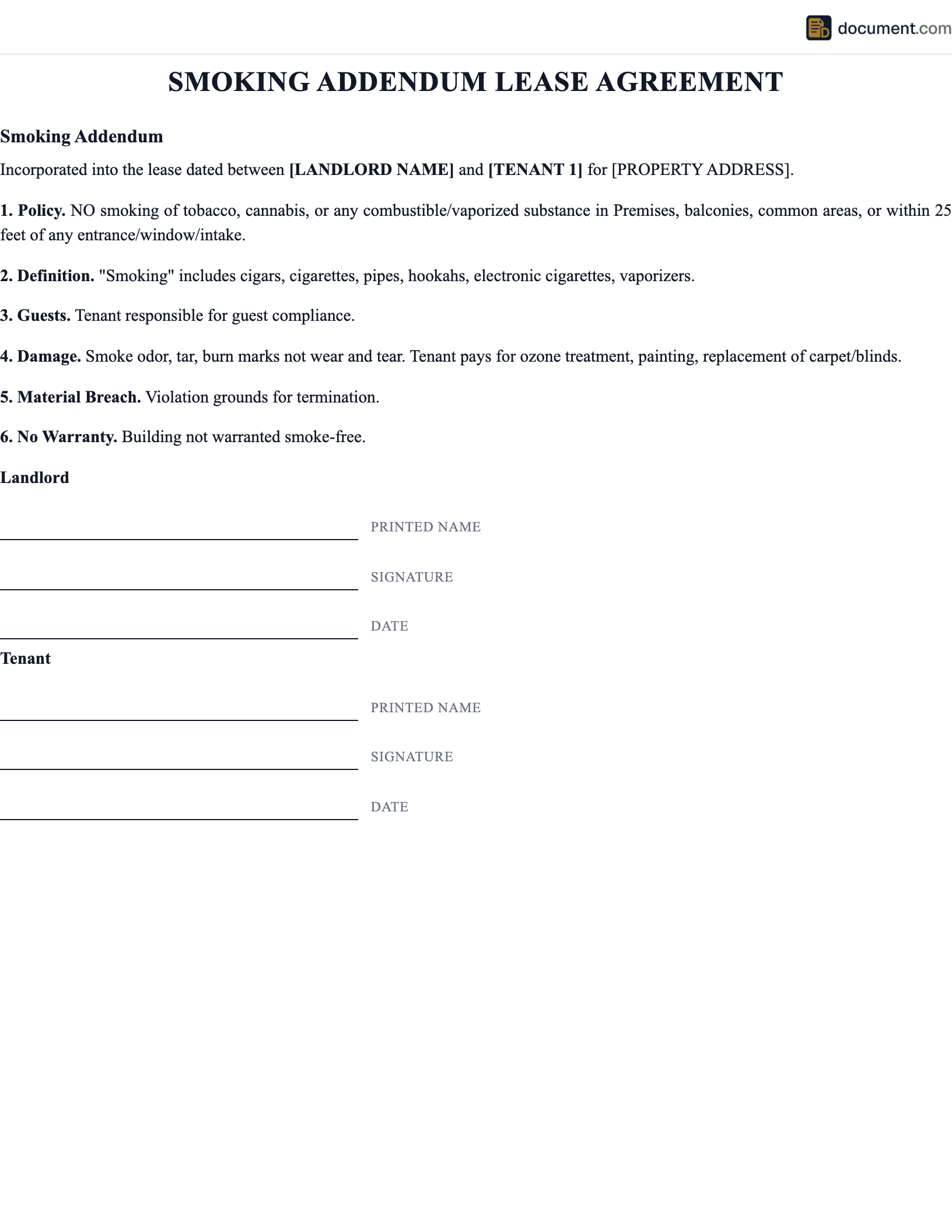
Below is a preview of the Smoking Addendum template. Your customized document will include all provisions for your specific situation.
SMOKING ADDENDUM
No-Smoking Policy Agreement
This document is entered into on [Date] between the parties identified below:
LANDLORD:
Name: [Landlord Name]
TENANT:
Name: [Tenant Name]
How to Use This Document
Four steps to a defensible no-smoking policy. Skipping any one of them creates the gap that defeats enforcement.
Define Prohibited Products
List by category, not by example. Combustible tobacco: cigarettes, cigars, cigarillos, pipes, hookahs, waterpipes, bidis, kreteks. Electronic nicotine delivery systems (ENDS): e-cigarettes, vape pens, pod systems, mods, heat-not-burn devices including IQOS and Glo. Combustible cannabis: flower, pre-rolls, blunts, joints, bongs, dab rigs in heated form. Add a catch-all: 'any device or product producing smoke, vapor, aerosol, or combusted materials.' Specify that edibles, tinctures, and topical cannabis are not subject to the smoking prohibition but may be subject to other lease restrictions on illegal-under-federal-law conduct.
Identify Restricted Areas
Prohibited areas: inside the leased premises, balconies and patios, all interior common areas (hallways, lobbies, stairwells, laundry rooms, elevators), all exterior common areas within 25 feet of any building entrance or open window (HUD's Rule 24 C.F.R. § 965.653 standard, also adopted by most local ordinances). Permitted areas: clearly marked outdoor smoking zones if the property has them. Specify that the prohibition applies to the tenant, all household members, all guests, and all invitees, and that the tenant is responsible for guest compliance.
Set Violation Consequences
Three-tier escalation: first violation, written notice with 7-day cure period and $100 to $250 fine charged as additional rent; second violation within 12 months, $250 to $500 fine and final warning; third violation, notice to quit and unlawful-detainer filing under state law (California Civ. Proc. § 1161, Texas Property Code § 24.005, Florida § 83.56). Material-breach-of-lease states allow 3-day or 7-day notice without cure for repeated violations. Charge actual damages on top of fines: ozone treatment ($300 to $800), HVAC duct cleaning ($400 to $1,000), repaint with sealing primer ($800 to $2,000 per bedroom).
Address Enforcement and Evidence
Specify acceptable evidence of violation: dated complaint logs from neighboring units, photographs of cigarette butts or ash, witness statements from staff or neighbors, smoke-detector or air-quality sensor readings, nicotine residue swab tests ($50 to $150 per sample), and visible nicotine staining at inspection. State the tenant's right to written notice within 48 hours of any documented violation and a 14-day window to respond before any fine is assessed. State the landlord's right to enter and inspect with 24-hour notice (most states; California Civ. Code § 1954). Self-help (changing locks, removing belongings) is illegal in every state under unlawful-detainer statutes.
Key Components
| Component | Description |
|---|---|
| Prohibited Products | Comprehensive list of banned smoking and vaping products |
| Restricted Areas | Where smoking is and is not permitted on the property |
| Guest Policy | Tenant responsibility for guest compliance |
| Violation Penalties | Graduated fines and consequences for violations |
| Damage Responsibility | Tenant liability for smoke damage and cleaning costs |
| Lease Termination | Grounds for lease termination for repeated violations |
Frequently Asked Questions
Find answers to common questions about the Smoking Addendum.
Resources
Create your Smoking Addendum Lease Agreement in under 10 minutes.
Answer a few questions and download a compliant, attorney-drafted document ready for your state.