



What Is a Bed Bug Addendum?
A bed bug addendum is a written supplement to a residential lease that allocates four things between landlord and tenant: pre-rental disclosure of any known infestation history in the unit or adjacent units, a tenant duty to report signs of bed bugs within a defined window (typically 24 to 48 hours), treatment-cost responsibility under the implied warranty of habitability, and the cooperation duties (laundering, clearing closets, vacating during application) that determine whether the tenant or the landlord pays. The addendum is enforceable in every state and is required by statute in California (Civ. Code § 1954.603), New York (Multiple Dwelling Law § 27-2018.1), Maine (14 M.R.S. § 6021-A), and several local jurisdictions including New York City (HPD rules) and San Francisco (Health Code Article 11).
The addendum exists because bed bug economics punish silence. A single fertilized female (Cimex lectularius) lays 200 to 500 eggs over her lifetime; a missed infestation in one unit becomes a building-wide problem within 60 to 90 days through wall voids, electrical conduits, and shared laundry. Professional heat treatment of a one-bedroom unit costs $1,500 to $3,500 in most U.S. markets, chemical treatment costs $500 to $1,500 with two to three follow-up visits, and tenant displacement during treatment runs $200 to $400 per night. The party who failed to disclose or failed to report typically pays.
The addendum protects the landlord by creating a documented baseline (the unit was free of bed bugs at move-in), establishing tenant reporting and cooperation duties as material lease terms, and preserving the right to charge treatment cost back to a tenant who introduced the infestation. It protects the tenant by creating a written record of any pre-existing condition the landlord knew about, by setting a defined response timeline once a report is made, and by documenting the cost-allocation rule in advance so neither party can rewrite it after the fact. Without an addendum, the parties fall back on common-law habitability rules, which favor the tenant on cost but favor neither party on speed.
Disclosure obligations by state
California Civil Code § 1954.603 requires every landlord to provide a bed-bug information notice (DRE-prescribed language on biology, signs, and prevention) before lease signing, with separate disclosure of any current infestation in the unit and any infestation in adjacent units within two business days of confirmation. New York Multiple Dwelling Law § 27-2018.1 requires landlords of multiple dwellings to file an annual building-wide bed-bug report with HPD using Form NYC-RA-89 and provide the prior year's filing to every new tenant. Maine 14 M.R.S. § 6021-A imposes the strictest single-unit rule: pre-rental disclosure of any infestation in the prior 12 months, plus 24-hour disclosure of any inspection result. Arizona § 33-1319 requires disclosure on tenant request only. Florida § 83.51 and Texas Property Code § 92.052 fold bed bugs into general habitability without bespoke disclosure rules. Use the state-specific template; the wrong notice voids the protection.
Treatment-cost allocation
The default rule in 47 states puts cost on the landlord under the implied warranty of habitability (Javins v. First National Realty, 428 F.2d 1071, and its state-court progeny). The exception runs the other way only when the landlord proves tenant introduction: receipts for used furniture acquired in the 30 days before the infestation, a prior tenant address confirmed as infested, or international travel records combined with luggage that arrived without heat-treatment certification. Maine, New York City, San Francisco, and Berkeley place cost on the landlord by local rule regardless of source. Arkansas, the only state that does not recognize the implied warranty of habitability, defers entirely to lease language. The addendum should state the default rule, any exceptions, and the documentation standard for shifting cost.
Disclosure
Pre-rental and ongoing notices required by CA Civ. Code § 1954.603, NY MDL § 27-2018.1, and ME 14 § 6021-A
Reporting Window
Tenant duty to report signs within 24 to 48 hours, in writing, with photo evidence
Cost Allocation
Landlord by default under habitability; tenant if introduction is proven
Form Preview
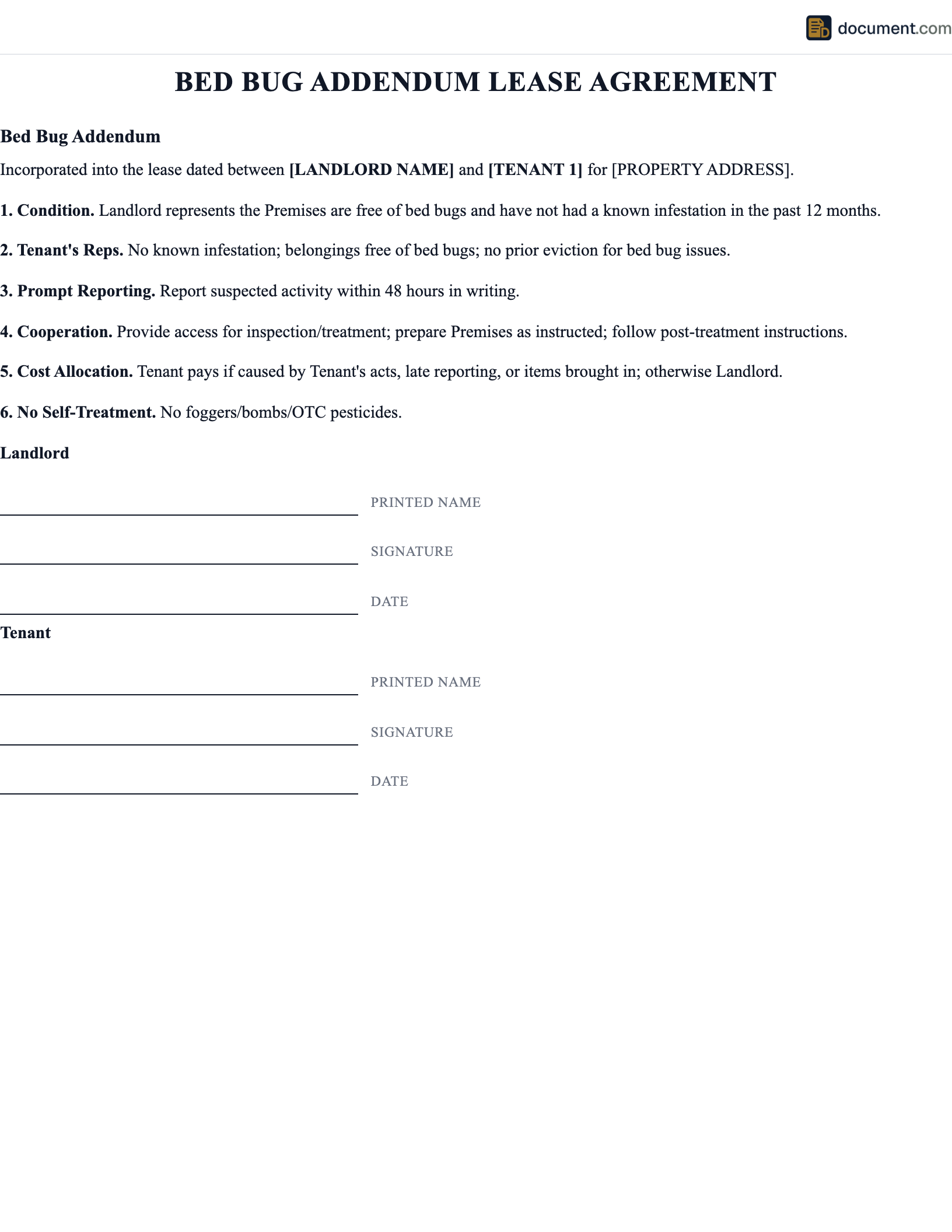
Below is a preview of the Bed Bug Addendum template. Your customized document will include all provisions for your specific situation.
BED BUG ADDENDUM
Supplemental Pest Management Agreement
This document is entered into on [Date] between the parties identified below:
LANDLORD:
Name: [Landlord Name]
TENANT:
Name: [Tenant Name]
How to Use This Document
Four steps. Complete each before signature; the protection runs only with documented compliance at every stage.
Disclose Known History
Disclose every confirmed infestation in the unit and in adjacent units (above, below, side-to-side, common laundry) within the prior 12 months. Include the date confirmed, treatment company, treatment method (heat, chemical, both), follow-up inspection date, and confirmation of clearance. California requires the bed-bug information notice (Civ. Code § 1954.603) regardless of history. New York requires the prior year's HPD building report (Form NYC-RA-89). Maine requires written disclosure within 14 days of any new lease for any unit with prior-year infestation. Silence on a known prior infestation is fraud in every state.
Define Reporting Obligations
Require written notice within 24 to 48 hours of any sign: live insects, shed exoskeletons, blood spots on bedding (rust-colored stains the size of a pinhead), translucent eggs in seams and crevices, sweet musty odor, or unexplained welts on skin in linear or clustered patterns. Require electronic reporting (email or portal) so the timestamp is provable. List the property manager's after-hours contact. State that failure to report within the window shifts treatment cost to the tenant for any spread the delay caused.
Establish Treatment Protocol
Specify professional inspection within 72 hours of report, treatment within 7 days of confirmation, follow-up at 14 and 30 days, and post-treatment inspection at 60 days using a canine-assisted detection or sticky-trap monitoring. Identify the licensed pest-control company by name (most states require structural pest-control license; California Bus. & Prof. Code § 8516). Set a 72-hour preparation window after treatment notice. List preparation duties: launder all soft items at 120°F or higher, clear closets and drawers, vacuum and dispose of bag in sealed container, pull furniture 6 inches from walls, remove pets and houseplants, vacate for 4 to 6 hours during chemical application.
Assign Financial Responsibility
State the default rule: landlord pays under the implied warranty of habitability. State the exception: tenant pays if landlord proves introduction (used-furniture receipts within 30 days, prior infested address, untreated international luggage). State the exception to the exception: tenant pays the spread-cost increment only if the landlord proves the delay-to-report exceeded the addendum's window. List the documentation standard: pest-control invoice itemized by labor, chemicals, follow-up, and post-treatment inspection. Cap tenant liability at the lesser of actual cost or three months' rent unless the lease provides otherwise.
Key Components
| Component | Description |
|---|---|
| Property Condition Statement | Landlord disclosure of current bed bug status |
| Infestation History | Disclosure of any previous bed bug incidents |
| Tenant Reporting Duty | Requirement to report signs within 24-48 hours |
| Inspection Rights | Landlord right to inspect and treat as needed |
| Treatment Responsibilities | Who pays for inspection, treatment, and preparation |
| Tenant Cooperation | Requirements for preparation, access, and follow-up |
Frequently Asked Questions
Find answers to common questions about the Bed Bug Addendum.
Resources
Create your Bed Bug Addendum Lease Agreement in under 10 minutes.
Answer a few questions and download a compliant, attorney-drafted document ready for your state.