



What Is a Pay or Quit Notice?
A pay or quit notice is a formal legal document that serves as the mandatory first step in the eviction process when a tenant has failed to pay rent. Often referred to as a "notice to pay rent or quit," "demand for rent," or "notice of non-payment," this document officially notifies the tenant that they must either pay the full amount of overdue rent within a specific number of days (as required by state law) or surrender possession of the rental property. It is arguably the most critical document in landlord-tenant law because without a properly served pay or quit notice, a court will dismiss any subsequent eviction action for non-payment.
The notice period — the number of days the tenant has to pay or vacate — varies dramatically by state, ranging from as few as 3 days in states like California, Florida, and Texas to 14 days in New York, Vermont, and Washington. These differences reflect each state's approach to balancing landlord property rights against tenant housing stability. Some states further complicate the picture by having different notice periods for different situations — for example, different periods for first-time versus repeat non-payment, or different periods based on the lease type (weekly vs. monthly vs. annual).
The content of the notice is strictly regulated in most states. At minimum, it must include the tenant's name, the property address, the exact amount of rent owed, the number of days to comply, and a clear statement that the tenant must either pay in full or vacate. Many states restrict what charges can be included — for example, California prohibits including late fees, and several states prohibit including attorney fees or other costs. Including unauthorized charges is one of the most common defects that invalidates a pay or quit notice, forcing the landlord to start the entire process over.
The pay or quit notice gives the tenant a "cure period" — a defined window of time to remedy the default by paying the full amount owed. If the tenant pays within this period, the notice is satisfied and the tenancy continues as if the notice had never been served. This right to cure is a fundamental tenant protection that exists in every state. Some states also allow tenants to "redeem" the tenancy even after the notice period expires — by paying the full amount before or during the eviction hearing — though this right may be limited to a certain number of times per year.
Demand for Rent
Formal demand for the exact amount of unpaid rent with a payment deadline
Cure Period
3-14 days (by state) for the tenant to pay in full and satisfy the notice
Eviction Prerequisite
Required legal precursor before a landlord can file an eviction lawsuit
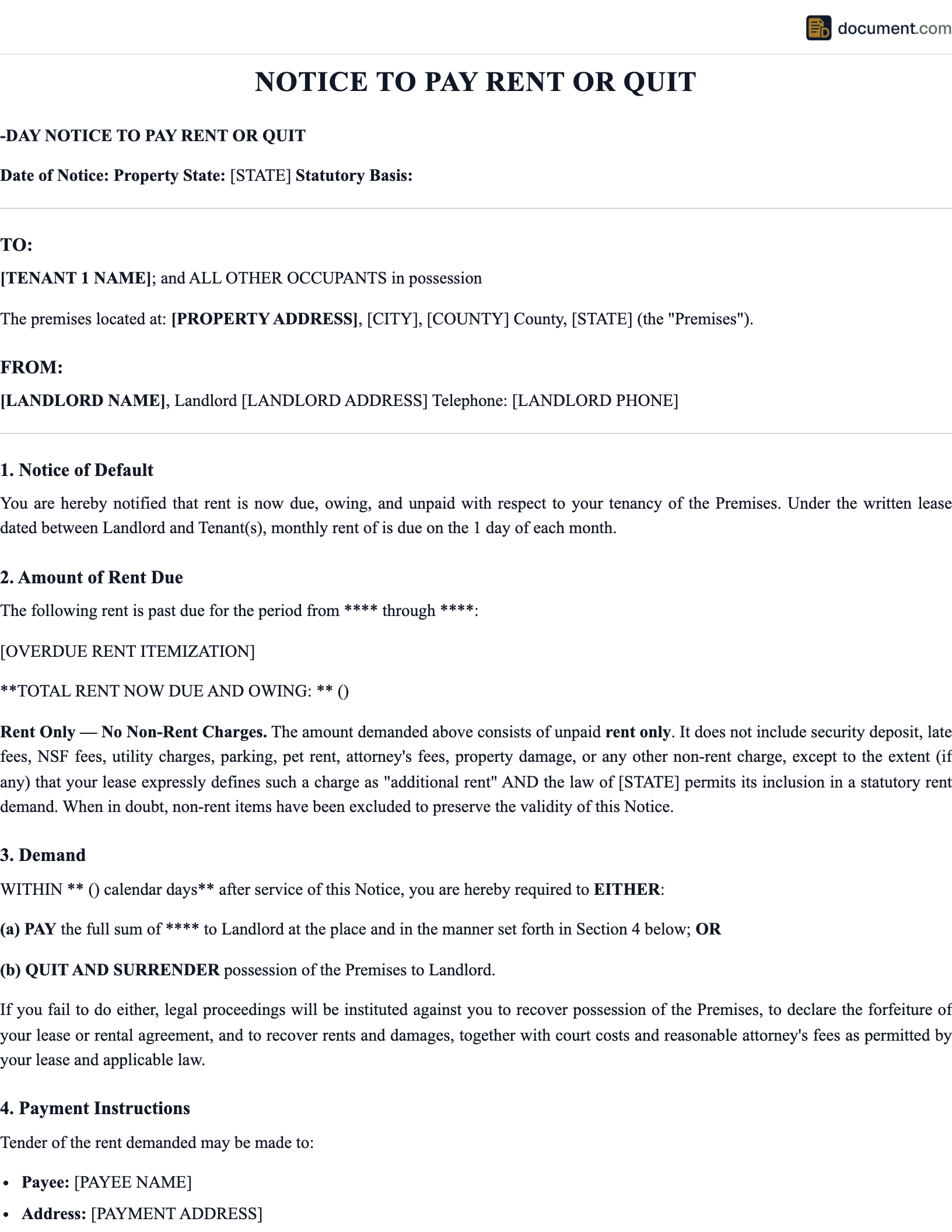
Pay or Quit Notice Form Preview
Our template includes all legally required elements for a valid pay or quit notice with state-specific compliance.
NOTICE TO PAY RENT OR QUIT
Demand for Payment of Past Due Rent
TENANT & PROPERTY
To: [Tenant Name(s)] and all other occupants
Property: [Address, Unit]
AMOUNT DUE
Rent Period: [Month(s)/Year]
Amount Due: $[Exact Amount]
NOTICE PERIOD
You have [Days] days from service of this notice to pay the full amount or vacate the premises.
PAYMENT INSTRUCTIONS
Pay To: [Name]
Address: [Address]
Methods: [Accepted Methods]
SERVICE INFORMATION
Landlord Signature: [Signature]
Date Served: [Date]
Method: [ ] Personal [ ] Post & Mail [ ] Certified Mail
How to Write a Pay or Quit Notice
A pay or quit notice must be drafted with precision. Any defect in the notice will result in the eviction case being dismissed. Follow these steps carefully.
Confirm Rent Is Actually Overdue
Verify that the rent due date has passed and that any applicable grace period (per the lease or state law) has expired. Check your records to ensure no payment was received — a crossed or delayed payment can create problems if you serve the notice while payment is actually in transit. Also verify the correct rent amount, as leases with multiple tenants or amended terms can create confusion about the amount due.
Determine the Exact Amount to Demand
Calculate the precise amount of unpaid rent. In most states, you can ONLY include the rent itself — not late fees, utilities, damage charges, or other amounts. Some states (like Texas) allow late fees if specified in the lease, but many (like California) strictly prohibit including anything other than rent. Demanding too much makes the notice defective. If multiple months are overdue, include the total but itemize each month's rent separately for clarity.
Look Up Your State's Notice Period
Every state specifies the exact number of days a pay or quit notice must provide. This is not optional — using the wrong number of days makes the notice invalid. Common periods are 3 days (CA, FL, TX), 5 days (CO, IL, IN), 7 days (GA, MI), 10 days (AR, IA), and 14 days (NY, VT, WA). Also check local ordinances, as some cities require longer periods than the state minimum. The notice period begins the day after service, not the day of service.
Draft the Notice with Required Language
Include the tenant's full legal name and "all other occupants," the complete property address with unit number, the exact amount of rent owed, the rent period(s) covered, the number of days to comply, a clear statement that the tenant must pay in full or vacate, and where and how to make the payment. Some states require specific statutory language — for example, California requires certain notices to include specific text about COVID-19 protections in some jurisdictions.
Include Payment Instructions
State where and how the tenant can make the payment. Include the landlord's or property manager's name and address, acceptable payment methods, and business hours if applicable. The tenant must have a reasonable way to tender payment. If you only accept payment at a specific location during limited hours, the tenant may argue they were unable to pay within the notice period. Make the payment process as clear and accessible as possible.
Serve the Notice Using a Legal Method
Proper service is the single most important step. Most states require personal service as the first attempt. If the tenant cannot be found, use the alternative method permitted by your state (substituted service, posting and mailing, or certified mail). Document everything — the date, time, method, and who served the notice. A proof of service declaration signed by the person who served the notice is essential evidence in court. Consider using a professional process server for added reliability.
Wait for the Full Notice Period
After serving the notice, you must wait for the full notice period to expire before taking any further action. Count the days carefully — the day of service is typically day zero, and the notice period starts the following day. If the last day falls on a weekend or holiday, the deadline may extend to the next business day in some states. Do not file the eviction lawsuit even one day early, as premature filing will result in dismissal.
File the Eviction Lawsuit if Necessary
If the notice period expires and the tenant has neither paid nor vacated, you can file an eviction lawsuit (unlawful detainer action) with the local court. Bring the original notice, proof of service, the lease agreement, and a ledger of payment history. The court will schedule a hearing, and the tenant will be served with a summons and complaint. If the court rules in your favor, you will receive a judgment for possession and can request a writ of possession to have the sheriff enforce the eviction.
Key Components of a Pay or Quit Notice
Every pay or quit notice must include these elements to be legally valid and enforceable in court.
| Component | Description |
|---|---|
| Tenant Name(s) | Full legal names of all tenants on the lease plus "and all other occupants" |
| Property Address | Complete address including unit or apartment number |
| Exact Rent Amount | Precise dollar amount of unpaid rent (no late fees in most states) |
| Rent Period(s) | The specific month(s) for which rent is owed |
| Notice Period | Number of days to pay or quit as required by state law (3-14 days) |
| Pay or Quit Demand | Clear statement that tenant must pay in full or vacate within the notice period |
| Payment Location | Where the tenant can make the payment (address, office location) |
| Payment Methods | Accepted forms of payment (check, money order, cashier's check, online) |
| Landlord Name | Full name of landlord or authorized property manager |
| Landlord Signature | Signature of the landlord or authorized agent |
| Date of Notice | Date the notice was prepared and the date it was served |
| Proof of Service | Declaration documenting the date, time, and method of service |
Legal Requirements for Pay or Quit Notices
Pay or quit notice requirements are strictly enforced by courts. Even minor defects can invalidate the notice and require you to restart the process.
Critical: Do Not Include Unauthorized Charges
In many states, including charges other than rent in a pay or quit notice renders the entire notice defective. California courts have consistently held that including late fees, utility charges, or other non-rent amounts in a 3-day notice makes it void and requires the landlord to start over. This is the single most common mistake landlords make with pay or quit notices. Only include what your state's law specifically authorizes — when in doubt, limit the demand to unpaid rent only.
State Notice Periods
- 3-Day States: California, Florida, Nevada, Texas, Utah, Virginia — the shortest notice periods, requiring prompt tenant action
- 5-Day States: Colorado, Illinois, Indiana, Missouri, Wisconsin — moderate notice providing slightly more time to cure
- 7-10 Day States: Georgia, Michigan, Tennessee (7 days); Arkansas, Iowa, Kansas, North Carolina (10 days)
- 14-Day States: Massachusetts, New York, Vermont, Washington — the longest notice periods providing maximum time to cure
Tenant's Right to Cure
The pay or quit notice establishes a cure period during which the tenant can pay the full amount owed and avoid eviction. This right to cure is absolute during the notice period — if the tenant pays in full before the deadline, the landlord must accept payment and the notice is satisfied. After the notice period expires, the right to cure varies by state. Some states allow tenants to redeem the tenancy by paying even after the deadline, while others cut off the right to cure once the notice period ends. A few states limit the number of times a tenant can cure per year to prevent abuse of the system.
Consequences of Non-Payment
If the tenant fails to pay or vacate within the notice period, the landlord can file an eviction lawsuit. The court process typically takes 2-8 weeks from filing to judgment, depending on the jurisdiction. If the court rules for the landlord, it issues a judgment for possession (allowing the landlord to regain the property) and often a money judgment for unpaid rent plus court costs. The sheriff or marshal then enforces the judgment through a writ of possession. The eviction may also appear on the tenant's public record and could affect their ability to rent in the future.
Sample Pay or Quit Notice
Below is a sample pay or quit notice. Your document will include state-specific notice periods and required language.
[3/5/7/14]-DAY NOTICE TO PAY RENT OR QUIT
TO: [TENANT NAME(S)] and all other occupants of the premises located at:
[Street Address, Unit #, City, State, ZIP]
YOU ARE HEREBY NOTIFIED that rent for the above premises in the amount of $[AMOUNT] for the rental period of [MONTH(S)/YEAR] is now due and unpaid.
Within [NUMBER] days after service of this notice upon you, you are required to either:
1. PAY the full amount of rent stated above to [Landlord/Manager Name] at [Payment Address]; OR
2. QUIT and deliver up possession of the premises.
If you fail to pay the full rent or vacate the premises within the time stated above, legal proceedings will be commenced against you to recover possession of the premises, to declare the forfeiture of the lease or rental agreement, and to recover rents, damages, and costs of suit.
Landlord/Agent Signature
Name: _______________
Date: _______________
Proof of Service
Method: _______________
Date Served: _______________
Frequently Asked Questions
Find answers about pay or quit notices, notice periods, service methods, and tenant cure rights.
Official Resources
Use these trusted resources for additional information about pay or quit notices and eviction procedures.
Related Landlord-Tenant Documents
These documents support the rent collection and eviction process.
Eviction Notice
All types of eviction notices including cure or quit
Late Rent Notice
Courtesy notice before escalating to pay or quit
Lease Agreement
Comprehensive residential lease with payment terms
Lease Termination Letter
Formally end a lease agreement
Rent Increase Notice
Formal notice of upcoming rent increase
Lease Amendment
Modify lease terms including payment schedules
Create your Pay Or Quit Notice in under 10 minutes.
Answer a few questions and download a compliant, attorney-drafted document ready for your state.