



What Is a Hunting Lease Agreement?
A hunting lease is a written grant of recreational access to private land for the purpose of hunting specified game during specified seasons, in exchange for a fee paid by the lessee to the landowner. Mechanically it conveys a profit a prendre in common-law terms (the right to take game, an interest in real property under the Restatement (First) of Property §450), wrapped in a license-style services contract that allocates liability, safety rules, vehicle access, camping, and game-management obligations. The lease typically runs for one annual hunting cycle starting before the state archery opener and ending after the late-muzzleloader season; multi-year leases are common in commercial deer-lease markets in Texas, Mississippi, Alabama, and Georgia where hunters invest in food plots, blinds, and stands.
The economic stakes have become substantial. The Quality Deer Management Association estimates that hunting-lease income in the southeastern United States exceeds $1 billion annually, with whitetail leases ranging from $5 to $25 per acre per year on working timberland and $30 to $50 per acre on managed deer properties with established food-plot programs and trophy-class genetics. Western elk and mule-deer leases on private ranches in Wyoming, Montana, and Colorado run $2,000 to $10,000 per hunter per season for guided trophy hunts. Waterfowl leases on private impoundments in Arkansas and Louisiana command $500 to $2,000 per blind per season. A well-drafted lease converts that income into a durable revenue stream while preserving the landowner's recreational-use protections and forestalling tort exposure.
Two structural choices shape every hunting lease. First, exclusive versus non-exclusive: an exclusive lease grants the lessee the sole right to hunt the property for the term and commands a 2x to 3x rent premium; a non-exclusive lease lets the landowner grant additional rights to other parties. Second, the relationship to the state recreational-use statute: charging a fee typically removes the immunity that Wisconsin Stat. §895.52, Texas Civil Practice and Remedies Code §75.002, California Civil Code §846, and Florida §375.251 grant to landowners who open property for free recreation. The lease must replace the lost statutory protection with contractual waivers, indemnification, and required insurance.
State-specific hunter-education compliance
Every state requires hunter-education certification for hunters born after a statutory cutoff date. Texas Parks and Wildlife Code Chapter 62 requires it for anyone born on or after September 2, 1971. Wisconsin Stat. §29.591 sets the cutoff at January 1, 1973. New York Environmental Conservation Law §11-0713 sets it at January 1, 1980. The lease must require every lessee and guest to carry the state hunter-education card, the current state hunting license, federal duck stamp and HIP registration where applicable, and any species-specific tags before entering the property. The landowner who fails to require proof exposes himself to a negligent-entrustment theory if an unlicensed hunter injures a third party. Build the documentation requirement into the lease and verify it before issuing any gate code or key.
Recreational-use immunity and the loss of immunity when a fee is charged
The recreational-use statutes in 49 states give landowners broad immunity from liability for injuries to recreational users when the access is provided without charge. Wisconsin Stat. §895.52 imposes no duty to keep the property safe for recreational users and no liability for injury except for willful or malicious failure to warn of a known dangerous condition. Texas Civ. Prac. and Rem. Code §75.002 caps damages at $500,000 per person and $1 million per occurrence for nonpaying recreational users. The protections fall away or narrow significantly once the landowner charges a fee, with limited exceptions: Texas §75.004 preserves the cap if the annual fee does not exceed 20 times the property tax; Wisconsin retains immunity for groups paying under $2,000 per year. Above the threshold, the lease must replace lost statutory protection with an express assumption-of-risk clause, an indemnification by the lessee, and a hunting-liability insurance requirement of at least $1 million per occurrence naming the landowner as additional insured.
Liability Waivers
Protect landowners from hunting-related injuries and claims
Game Management
Set harvest limits, antler restrictions, and species rules
Clear Boundaries
Define access areas, roads, camping, and off-limits zones
Form Preview
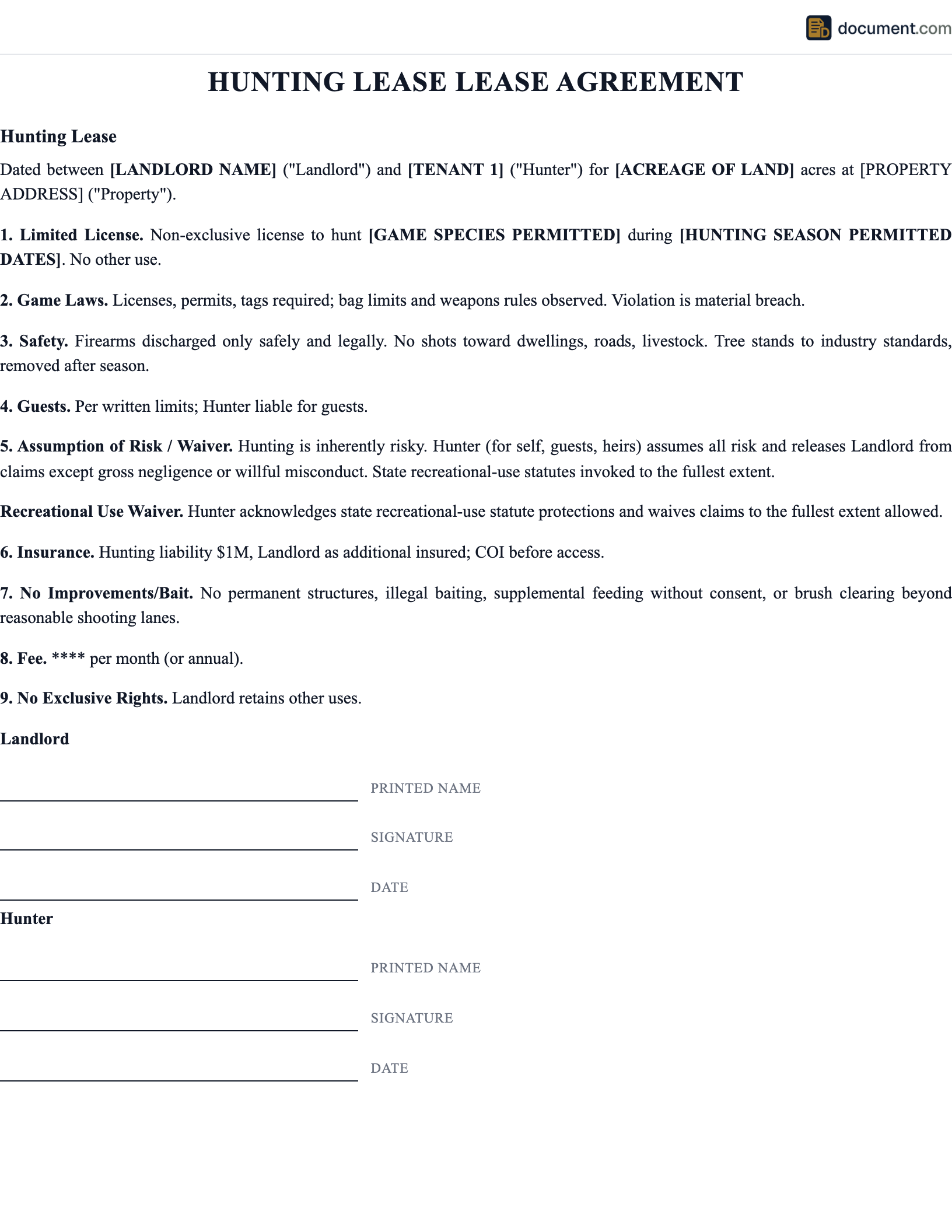
HUNTING LEASE AGREEMENT
Private Land Hunting Access Contract
This Hunting Lease Agreement is entered into on [Date] between:
LANDOWNER:
Name: [Name]
Property: [Acreage & Location]
LESSEE (Hunter/Club):
Name: [Name]
License #: [Number]
1. PERMITTED GAME & SEASON
Species: [Game]
Season: [Dates]
How to Create a Hunting Lease
Four steps move the lease from a verbal handshake to a written agreement that protects the landowner, complies with state hunter-education law, and establishes the rules of the property for the season.
Describe the property, the boundaries, and the access points
Attach a legal description or county-recorded plat with GPS coordinates of the corner pins, a topographic or aerial map marking the huntable acreage, the access road or gate the lessee may use, designated parking areas, and any zones excluded from hunting (the home compound, livestock pastures, crop fields under USDA program contract, conservation easements with hunting restrictions, neighboring-property safety buffers within 200 yards of any boundary). Identify locked gates and the keys or codes the lessee will receive. Distinguish exclusive from non-exclusive use clearly and specify whether the landowner retains hunting rights for himself and immediate family.
Set season dates, permitted species, and game-management rules
Cite the state Department of Fish and Wildlife season dates by species (whitetail archery, muzzleloader, gun, late season; turkey spring; waterfowl by zone; small game). Tighten state bag limits as needed for property goals (1 buck per hunter with 13-inch inside spread minimum is standard for managed properties; 1 doe per 100 acres is typical for population control). Require mandatory harvest reporting via text or club app within 24 hours including date, GPS coordinates, sex, age, and weight. Address baiting and feeders by state rule (legal year-round in Texas; restricted in Michigan under MCL §324.40111c; restricted in Wisconsin within 300 yards of an active feeder). Prohibit night hunting, hunting from vehicles, and harvest of non-target species.
Specify weapons, tree-stand rules, and the safety zones
List permitted weapons by season (centerfire rifle, shotgun with slug, muzzleloader, vertical bow, crossbow) and require strict compliance with state caliber and ammunition rules. Address tree stands: prohibit permanent stands above grade, allow portable hang-on, climber, and ladder stands subject to harness use and annual inspection, require all stands removed within 14 days of season end. Establish 200-yard safety zones from any structure, road, or property boundary. Require hunter-education certification (Texas Parks and Wildlife Code Ch. 62 cutoff September 2, 1971; Wisconsin Stat. §29.591 cutoff January 1, 1973; New York ECL §11-0713 cutoff January 1, 1980). Verify proof before issuing keys or gate codes.
Build the liability stack: waiver, indemnification, and insurance
Charging rent narrows or eliminates recreational-use immunity in most states. Replace it with three contractual layers. First, an express assumption-of-risk and liability waiver signed by every lessee and guest, written in plain language describing the inherent risks of hunting (firearms accidents, tree-stand falls, terrain hazards, wildlife encounters). Second, a contractual indemnification by the lessee for any third-party claims arising from the lessee's use of the property. Third, hunting-liability insurance of at least $1 million per occurrence naming the landowner as additional insured (American Hunting Lease Association, Outdoor Underwriters, or USAA Hunt Lease Insurance), with the certificate delivered before access begins. Add the landowner's personal umbrella of $1 million to $5 million as a backstop.
Key Components
| Component | Description |
|---|---|
| Property Description | Legal description, acreage, boundaries, and access points |
| Season & Game | Permitted species, season dates, bag limits, restrictions |
| Firearms Rules | Permitted weapons, ammunition, safety zones |
| Tree Stand Rules | Permanent vs. portable, placement, removal dates |
| Liability Waiver | Hold harmless clause, insurance requirements |
| Vehicle Access | Roads, ATVs, parking, camping provisions |
| Lease Fee | Annual or seasonal fee, payment schedule, refund policy |
Liability & Insurance
Recreational-use immunity protects landowners who open property for free recreation. Charging hunting-lease rent typically removes that immunity, exposing the landowner to ordinary premises-liability standards under Restatement (Second) of Torts §343. The lease must replace lost statutory protection with contractual waivers, indemnification, and required insurance, with carrier names and minimum limits specified.
Landowner Liability Warning
Wisconsin Stat. §895.52, Texas Civ. Prac. and Rem. Code §75.002, California Civil Code §846, and Florida §375.251 all condition recreational-use immunity on free access. Texas §75.004 preserves the cap if the annual fee does not exceed 20 times the property tax; Wisconsin retains immunity for groups under $2,000 per year. Above the threshold, ordinary tort liability applies and the lease must replace the lost statutory protection.
Hunter Requirements
Valid hunting license, hunter safety card, liability insurance ($1M minimum)
Landowner Protections
Hold harmless clause, indemnification, commercial umbrella policy
Frequently Asked Questions
Resources
Create your Hunting Lease Lease Agreement in under 10 minutes.
Answer a few questions and download a compliant, attorney-drafted document ready for your state.