



What Is an Equipment Lease Agreement?
An equipment lease agreement is a contract between an equipment owner (lessor) and a business (lessee) that allows the business to use specific equipment for a set period in exchange for regular payments. Equipment leasing is one of the most common ways businesses acquire the machinery, technology, and tools they need without the large upfront capital expenditure of purchasing.
Equipment leases are governed by the Uniform Commercial Code (UCC) Article 2A in most states, which provides default rules for lease formation, warranties, risk of loss, and remedies. Unlike real property leases, equipment leases deal with personal property (movable goods) and involve different tax, accounting, and legal considerations.
The two primary categories are capital leases (finance leases) and operating leases, each with different implications for your balance sheet, tax deductions, and end-of-lease options. Our templates cover both types and can be customized for any equipment category and state.
All Equipment Types
Construction, medical, IT, restaurant, agricultural, and more
Flexible Options
Capital lease, operating lease, FMV buyout, and $1 purchase option
UCC Compliant
Meets UCC Article 2A requirements for your state
Equipment Lease Agreement by State
Each state has different rules for equipment leases, including sales/use tax treatment, UCC Article 2A modifications, personal property tax requirements, and filing obligations. Select your state for a template customized to your jurisdiction.
Capital vs. Operating Leases
The distinction between capital (finance) and operating leases affects your balance sheet, tax deductions, and end-of-lease options. Understanding the differences is essential for making the right financial decision for your business.
Capital Lease (Finance Lease)
A capital lease is essentially a purchase financed through lease payments. The equipment appears on your balance sheet as both an asset and a liability. You can depreciate the asset and deduct the interest portion of payments. Capital leases typically end with a $1 buyout or automatic ownership transfer. Under ASC 842, a lease is classified as a finance lease if it transfers ownership, contains a bargain purchase option, the lease term is 75%+ of the asset's useful life, or the present value of payments is 90%+ of fair value.
Operating Lease
An operating lease is a true rental arrangement. The lessor retains ownership and the risks of ownership (obsolescence, residual value). Payments are generally fully deductible as a business expense. At the end of the term, you can return the equipment, purchase it at fair market value, or renew the lease. Operating leases are ideal for equipment that becomes obsolete quickly (technology, medical) or is needed for a specific project duration.
ASC 842 Accounting Update
Under ASC 842 (effective for all companies), both capital and operating leases require recognition of a right-of-use asset and lease liability on the balance sheet. However, the income statement treatment differs: finance leases show separate depreciation and interest expense, while operating leases show a single straight-line lease expense. Consult your accountant for proper classification.
Key Components of an Equipment Lease
A comprehensive equipment lease agreement should address all of the following provisions to protect both the lessor and lessee.
| Component | Description |
|---|---|
| Parties | Legal names and addresses of lessor and lessee |
| Equipment Description | Make, model, serial number, year, condition, and accessories |
| Lease Term | Start date, duration, renewal options, early termination |
| Payment Terms | Amount, frequency, late fees, security deposit |
| Maintenance & Repairs | Who maintains, service schedules, authorized providers |
| Insurance Requirements | Property, liability, loss payee, coverage amounts |
| Purchase Option | FMV, $1 buyout, fixed price, or return |
| Default & Remedies | Events of default, cure periods, repossession rights |
| Indemnification | Liability for injuries, damages, and third-party claims |
Equipment Types Covered
Our equipment lease templates work for all types of business equipment:
Construction Equipment
Excavators, bulldozers, cranes, loaders, backhoes, and heavy machinery
Medical Equipment
MRI machines, X-ray systems, dental chairs, ultrasound, and diagnostic equipment
Restaurant / Kitchen
Commercial ovens, refrigeration, dishwashers, prep stations, and POS systems
IT / Technology
Servers, computers, networking equipment, copiers, phone systems, and software
Agricultural Equipment
Tractors, combines, harvesters, irrigation systems, and farming implements
Manufacturing Equipment
CNC machines, lathes, presses, assembly line equipment, and robotics
Office Equipment
Copiers, printers, furniture systems, phone systems, and AV equipment
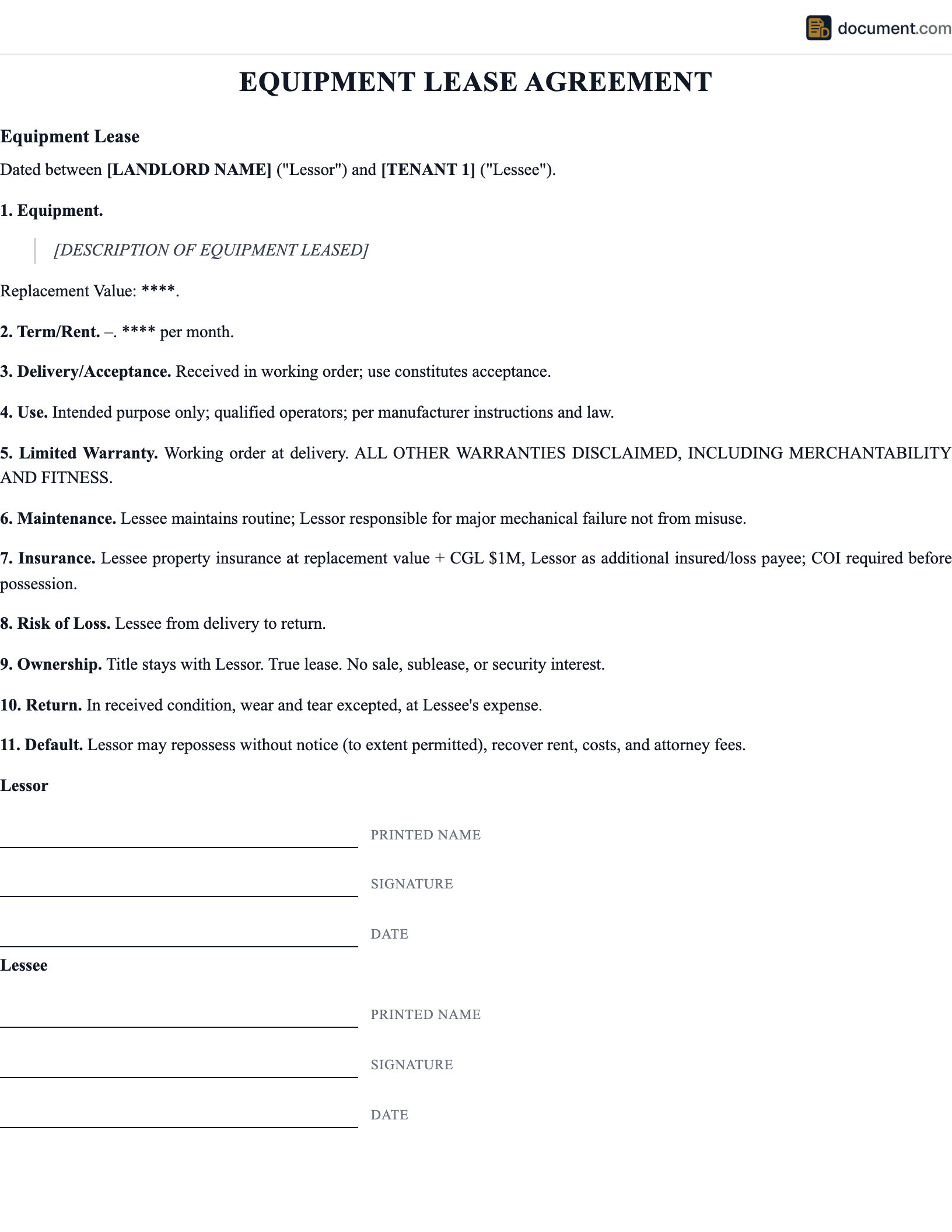
Sample Equipment Lease Agreement
Below is a preview of our equipment lease agreement template. Your customized document will include all terms for your specific equipment type and state requirements.
EQUIPMENT LEASE AGREEMENT
Capital Lease / Operating Lease
This Equipment Lease Agreement ("Lease") is entered into on[Date]between:
LESSOR (Equipment Owner):
Name: [Lessor Name/Entity]
Address: [Lessor Address]
LESSEE (Equipment User):
Business Name: [Lessee Entity]
Address: [Lessee Address]
1. EQUIPMENT DESCRIPTION
Type: [Equipment Type]
Make/Model: [Make] Serial #: [Serial]
Condition: ☐ New ☐ Used — [Description]
2. LEASE TERM & PAYMENT
Term: [Months/Years] Payment: $[Amount]/month
Lease Type: ☐ Capital ☐ Operating
Purchase Option: ☐ FMV ☐ $1 Buyout ☐ Fixed Price ☐ Return
Frequently Asked Questions
Find answers to common questions about equipment lease agreements, capital vs. operating leases, maintenance obligations, and purchase options.
Create your Equipment Lease Agreement in under 10 minutes.
Answer a few questions and download a compliant, attorney-drafted document ready for your state.