
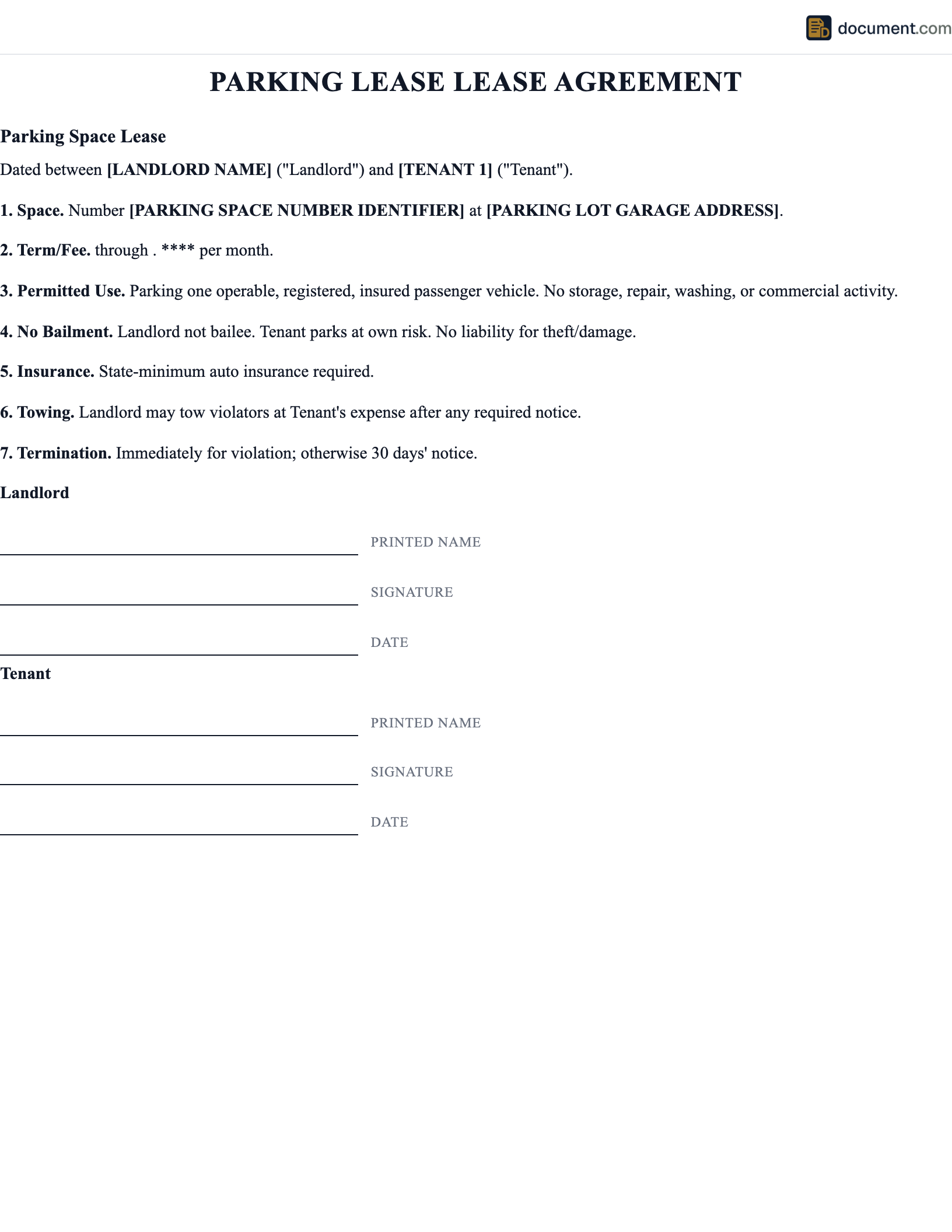



What Is a Parking Space Lease Agreement?
A parking space lease agreement is a written contract granting one party the right to park a vehicle in a designated space owned or controlled by another party, for a stated term, at a stated rent. The document identifies the space (garage level, row, and number), the authorized vehicle (make, model, year, color, license plate), the term (typically month to month), the rent and payment date, the cure period for nonpayment, the use restrictions (no commercial use, no overnight residential occupancy, no fluid changes), and the towing procedure for unauthorized vehicles. It is used for urban monthly parking, apartment and condo overflow parking, deeded garage spaces in residential buildings, and driveway rentals in dense neighborhoods near transit, hospitals, and stadiums.
The legal characterization of the arrangement matters more than the title on the document. Most parking arrangements are licenses (revocable permission to use property for a specific purpose), not leases (transfers of a possessory interest). The classification controls available remedies on default: a true lease requires unlawful-detainer proceedings under the state landlord-tenant act; a license can be revoked by written notice with the contractual cure period and unauthorized vehicles removed under the state private-property tow statute. The template selects either structure and aligns the cure period, deposit rules, and tow language with the choice.
Distinguished from rental of the residential or commercial unit
Parking is governed by different bodies of law than the rental of a home, apartment, or commercial space. A residential lease is governed by the state landlord-tenant act (California Civil Code §1940 et seq., New York Real Property Law §220 et seq., Texas Property Code Chapter 92), which imposes habitability warranties, deposit caps, eviction procedures, and quiet-enjoyment covenants that do not translate to parking. A commercial lease is governed by general contract law and UCC Article 2A for any embedded equipment, with much greater freedom of contract. A standalone parking license sits outside both regimes and is governed primarily by general contract law, the state private-property tow statute, and the ADA. When parking is bundled into a residential lease as a single rent for the unit and the space, the parking inherits the residential protections including the habitability warranty and the deposit cap; unbundling later may constitute an unlawful rent increase in rent-stabilized jurisdictions.
License vs. Lease Distinction
The four elements of a lease under Restatement (Second) of Property §1.2 are description of premises, term, rent, and possessory transfer. Parking arrangements typically satisfy only the first three. The owner retains control of the lot, the user has no right to exclude others from the surrounding lot, and the arrangement is intended to be revocable. The classification controls remedies, cure periods, deposit rules, and the application of habitability warranties that exist in residential landlord-tenant law but have no counterpart in parking-space law.
Why the classification controls enforcement and remedies
A misclassified license treated as a lease forces the lot owner into 30-to-90-day unlawful-detainer proceedings to remove a defaulting parker, when a properly drafted license could be revoked in 5 to 10 days with the unauthorized vehicle towed under the state private-property tow statute. A misclassified lease treated as a license exposes the owner to wrongful-eviction damages, attorneys'-fee awards, and potential treble damages under the state tow statute if the vehicle was towed without statutory compliance. California Civil Code §1947.7 (Davis-Stirling) and New York DHCR rules on unbundled parking both create traps for owners who treat a bundled residential parking arrangement as a standalone license.
| Feature | License | Lease |
|---|---|---|
| Nature | Revocable permission | Possessory interest |
| Default remedy | Revocation + towing | Formal eviction |
| Cure period | Contract-based (5 to 10 days) | State statutory (3 to 14 days) |
| Typical use | Monthly parking | Deeded or long-term spaces |
Cure Period and Default
The cure period before revocation tracks the legal characterization of the arrangement. License-based parking uses a contractual cure period, typically 5 to 10 days from written notice of nonpayment, after which the license terminates and the unauthorized vehicle may be towed under the state private-property tow statute. True leases of parking space follow the state pay-or-quit rules: 3 days in California under Code of Civil Procedure §1161(2), 3 days in Texas under Property Code §24.005, 14 days in New York under RPAPL §711(2), 3 business days in Florida under §83.20. Residential parking bundled into a housing lease follows the residential pay-or-quit timeline because it is part of the unitary tenancy and cannot be terminated separately under the implied covenant of quiet enjoyment.
Default mechanics matter as much as the timeline. Send the cure notice by both email and certified mail, retain the certified-mail receipt as proof of service, document the date the cure period expires, and place a written tow-warning on the vehicle 24 hours before any tow under California Vehicle Code §22658 or the equivalent state statute. Acceptance of partial rent during the cure period waives the default in many jurisdictions and restarts the clock; refuse partial payment in writing if intending to terminate.
Towing Statutes by State
Strict compliance with state private-property tow statutes is required, and substantial-compliance defenses generally fail in court. Treble damages and attorneys'-fee awards are common penalties for noncompliant tows in California, Texas, Florida, and Illinois.
- California (Veh. Code §22658 and §22953): Entry-point signage at least 17 by 22 inches with 1-inch lettering, 24-hour notice to owner before residential tow, licensed tow operator, written notice to vehicle owner within 48 hours of storage. Treble damages plus attorneys' fees for noncompliance.
- Texas (Occ. Code §2308): Tow-truck operator licensed by the Texas Department of Licensing and Regulation, signage at every entrance with required text, notice to vehicle owner within 2 hours of tow, vehicle storage at a registered facility.
- Florida (§715.07): Signage with exact statutory wording at entrance, unauthorized tow exposes operator to treble damages plus attorneys' fees and costs.
- New York (Veh. and Traf. Law §1224): Written notice to registered owner within 24 hours, sign requirements at every entrance, towing operator licensed by the New York DMV.
- Illinois (625 ILCS 5/18a): Tow operator licensed by the Illinois Commerce Commission, signage and notice requirements, treble damages for noncompliant tows.
ADA Accessibility
Public accommodations and commercial facilities must comply with the 2010 ADA Standards for Accessible Design under 28 C.F.R. Part 36. Multifamily housing of four or more units built after March 13, 1991 must comply with Fair Housing Act Design and Construction requirements under 24 C.F.R. §100.205 and the related FHA accessibility guidelines. Lease provisions that purport to waive accessibility are unenforceable as a matter of public policy under 42 U.S.C. §12182 and 42 U.S.C. §3604(f).
- Minimum 1 accessible space per 25 total spaces, scaling per ADA Standards Table 208.2 (lots of 100 spaces require 4 accessible including 1 van-accessible; lots of 500 spaces require 9 accessible including 2 van-accessible).
- At least 1 van-accessible space for every 6 accessible spaces.
- Accessible space dimensions: 96 inches wide with 60-inch access aisle. Van-accessible: 132 inches wide or 96 inches wide with a 96-inch access aisle, plus 98 inches of vertical clearance for the van-accessible route.
- Signage with the International Symbol of Accessibility per ADA Standards 502.6, plus a tow-warning sign citing the state private-property tow statute.
- Accessible spaces must be located on the shortest accessible route to the building entrance per ADA Standards 208.3.
How to Use This Agreement
Six steps move the agreement from a verbal understanding to a written license that withstands scrutiny on default and on tow.
Identify the space
Specific number, building location, garage level, and row, precise enough to defeat ambiguity in any later dispute or tow.
Identify the vehicle
Make, model, year, color, and license plate of the authorized vehicle, with substitution permitted only on written notice and updated license-plate filing.
Set the term and rent
Monthly is industry standard, with rent due on the first and a 5-day grace period; deeded garage spaces may run for 1-year or multi-year terms with annual escalators.
Choose license or lease structure
License for monthly arrangements; lease for deeded spaces or long-term ground-lease arrangements where possessory interest is intended.
Specify use restrictions
Passenger vehicles only; no commercial vehicles, trailers, or boats; no overnight residential occupancy; no fluid changes or repairs that risk stormwater contamination.
Include towing authorization
Reference the state private-property tow statute by section number, require licensed tow operators, and meet signage and notice requirements.
Frequently Asked Questions
License versus lease classification, state towing statutes, ADA accessible parking, deposit caps, and rent-control treatment.
Official Resources
Rent a parking space in under 5 minutes.
Pick your state, answer a few questions, and download a parking lease with the right structure, towing rules, and ADA compliance for your lot.