



What Is a Condominium Lease Agreement?
A condominium lease agreement is a specialized rental contract used when a condo unit owner rents their unit to a tenant. Unlike standard residential leases, a condo lease must address the unique aspects of condominium living, including HOA (Homeowners Association) rules and restrictions, condo association approval requirements, shared amenity access, and the three-way split of maintenance responsibilities between the owner, HOA, and tenant.
Condominium leases are more complex than standard rental agreements because the tenant must comply with both the lease terms and the condo association's governing documents — including CC&Rs (Covenants, Conditions & Restrictions), bylaws, and house rules. Violations of HOA rules by a tenant can result in fines to the unit owner, making it essential that the lease clearly communicates all association requirements.
Our condominium lease templates are designed to protect condo owners, comply with state landlord-tenant laws, and ensure tenants understand their obligations under both the lease and the condo association's rules. Each template includes provisions for HOA compliance, insurance requirements, move-in/move-out procedures, and amenity access.
HOA Compliant
Incorporates condo association rules and restrictions
State Specific
Meets your state's landlord-tenant law requirements
3-Way Protection
Clear roles for owner, HOA, and tenant responsibilities
Condominium Lease Agreement by State
Condo rental regulations, HOA disclosure requirements, and tenant rights vary significantly by state. Select your state below for a condominium lease that complies with your state's specific requirements.
HOA Rules & Restrictions for Condo Rentals
Condo associations have significant authority to regulate rentals within their communities. Understanding and incorporating these rules into your lease is essential for protecting both the unit owner and tenant.
Common HOA rental restrictions include minimum lease terms, tenant approval requirements, caps on the number of units that can be rented simultaneously, and prohibitions on short-term vacation rentals. The condo lease should reference the association's governing documents and require the tenant to comply with all current and future HOA rules.
Key Condo Lease Features
HOA Rules Compliance
Lease incorporates condo association rules, bylaws, and restrictions that tenants must follow
Association Approval
Process for obtaining condo board approval before the tenant can move in, including application fees and timelines
Parking & Amenities
Assigned parking spaces, pool access, gym privileges, common area usage rules, and guest policies
Maintenance Split
Clear division of responsibilities between condo owner, HOA, and tenant for repairs and upkeep
Move-In/Move-Out Procedures
Elevator reservations, move-in deposits, designated moving hours, and building access protocols
Special Assessments
Who pays for HOA special assessments levied during the lease term — typically the unit owner
Noise & Pet Policies
Condo-specific quiet hours, pet breed and size restrictions, and common area pet rules
Insurance Requirements
Renter's insurance requirements plus information about the HOA master insurance policy coverage
Key Condominium Lease Provisions
A comprehensive condominium lease agreement should address all standard lease provisions plus these condo-specific terms.
| Provision | Description |
|---|---|
| HOA Rules | Tenant must comply with all condo association rules, bylaws, and CC&Rs |
| Board Approval | Lease contingent on condo association approval of the tenant |
| Parking Assignment | Designated parking space(s), garage access, and vehicle restrictions |
| Amenity Access | Pool, gym, clubhouse, and common area usage rights and rules |
| Insurance | Renter's insurance requirements and HOA master policy information |
| Move-In/Out | Building procedures, elevator reservations, move-in deposits, and approved hours |
| Noise Rules | Quiet hours, noise restrictions, and flooring requirements (if any) |
| Pet Policy | HOA pet restrictions, breed/size limits, common area pet rules, and deposits |
Condo Maintenance Responsibilities
One of the most important aspects of a condominium lease is clearly defining who is responsible for what maintenance. Unlike a standard rental, condo maintenance involves three parties: the HOA, the unit owner (landlord), and the tenant.
Maintenance Clarity Is Critical
Unclear maintenance responsibilities are the #1 source of disputes in condo rentals. Your lease should explicitly state who handles each type of repair — from a leaking faucet (owner) to a broken hallway light (HOA) to a clogged drain from misuse (tenant). Reference the condo association's governing documents for the owner-vs-HOA split.
- HOA Responsibility: Building exterior, roof, common areas, elevators, hallways, landscaping, shared systems
- Owner Responsibility: In-unit appliances, HVAC, plumbing fixtures, electrical systems, flooring, paint, windows
- Tenant Responsibility: Day-to-day cleaning, minor upkeep, reporting repairs promptly, preventing damage
- Special Assessments: One-time HOA charges for major repairs are typically the owner's responsibility
Sample Condominium Lease Agreement
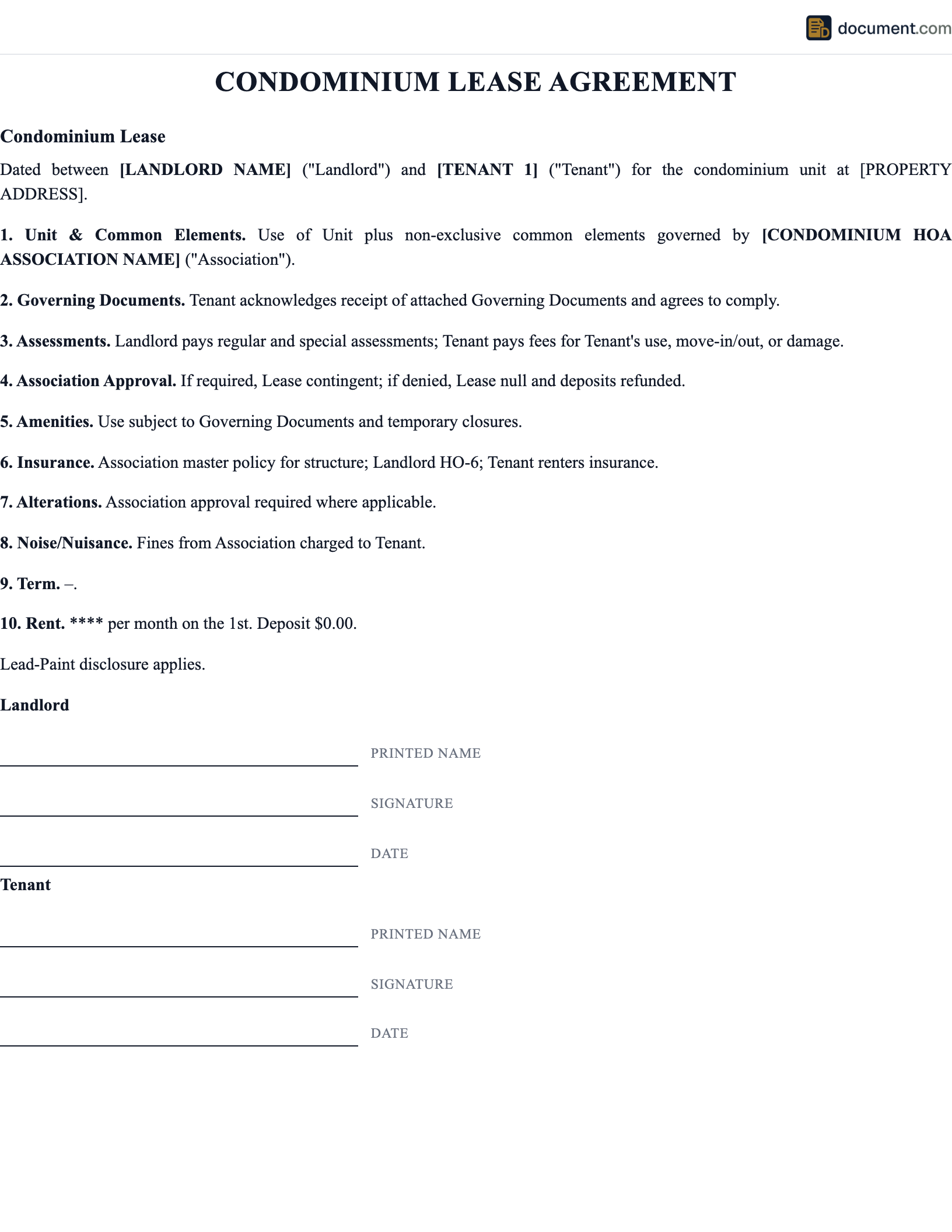
Below is a preview of our condominium lease agreement template. Your customized document will include all condo-specific provisions, HOA requirements, and state-mandated disclosures.
CONDOMINIUM LEASE AGREEMENT
Condo Unit Rental Contract
This Condominium Lease Agreement is entered into on[Date]between:
UNIT OWNER (LANDLORD):
Name: [Owner Name]
Address: [Owner Address]
TENANT(S):
Name: [Tenant Name(s)]
1. CONDO UNIT
Unit: [Unit #] Building: [Building Name/Address]
Association: [HOA Name]
2. LEASE TERM & RENT
Term: [Start] to [End]
Monthly Rent: $[Amount]
3. HOA COMPLIANCE
Tenant agrees to comply with all rules, regulations, and bylaws of the condominium association, a copy of which has been provided to Tenant.
Frequently Asked Questions
Find answers to common questions about condominium lease agreements, HOA rules for rentals, and condo tenant rights.
Official Resources
Use these resources for guidance on condominium law, HOA regulations, and tenant rights.
Create your Condominium Lease Agreement in under 10 minutes.
Answer a few questions and download a compliant, attorney-drafted document ready for your state.