



What Is a Restaurant Lease Agreement?
A restaurant lease agreement is a specialized commercial lease designed for food service operations including full-service restaurants, fast-casual establishments, cafes, bars, and food courts. Unlike standard commercial leases, restaurant leases must address industry-specific concerns such as kitchen ventilation and grease trap requirements, health department compliance, liquor licensing, extended operating hours, odor and noise management, and the substantial build-out investment typical of restaurant spaces.
Restaurant leases represent some of the most complex commercial lease negotiations because of the significant capital investment required to build out a restaurant space. Commercial kitchen equipment, ventilation systems, grease traps, walk-in coolers, and dining area finishes can cost $100,000 to $1 million or more. This investment makes lease terms particularly important, as the tenant needs sufficient time to recoup their investment.
Key negotiation points in restaurant leases include the tenant improvement allowance for kitchen build-out, exclusive use provisions preventing competing restaurants, percentage rent provisions based on sales, hours of operation (especially if the property is in a mixed-use development or has residential neighbors), patio and outdoor seating rights, signage visibility, parking adequacy, and delivery access for food and beverage vendors.
Restaurant businesses have a higher failure rate than many other commercial tenants, which makes landlords particularly careful about financial qualifications, experience requirements, and lease security. Landlords may require larger security deposits, personal guarantees, and detailed business plans before leasing restaurant space. Understanding these dynamics helps both parties negotiate effectively.
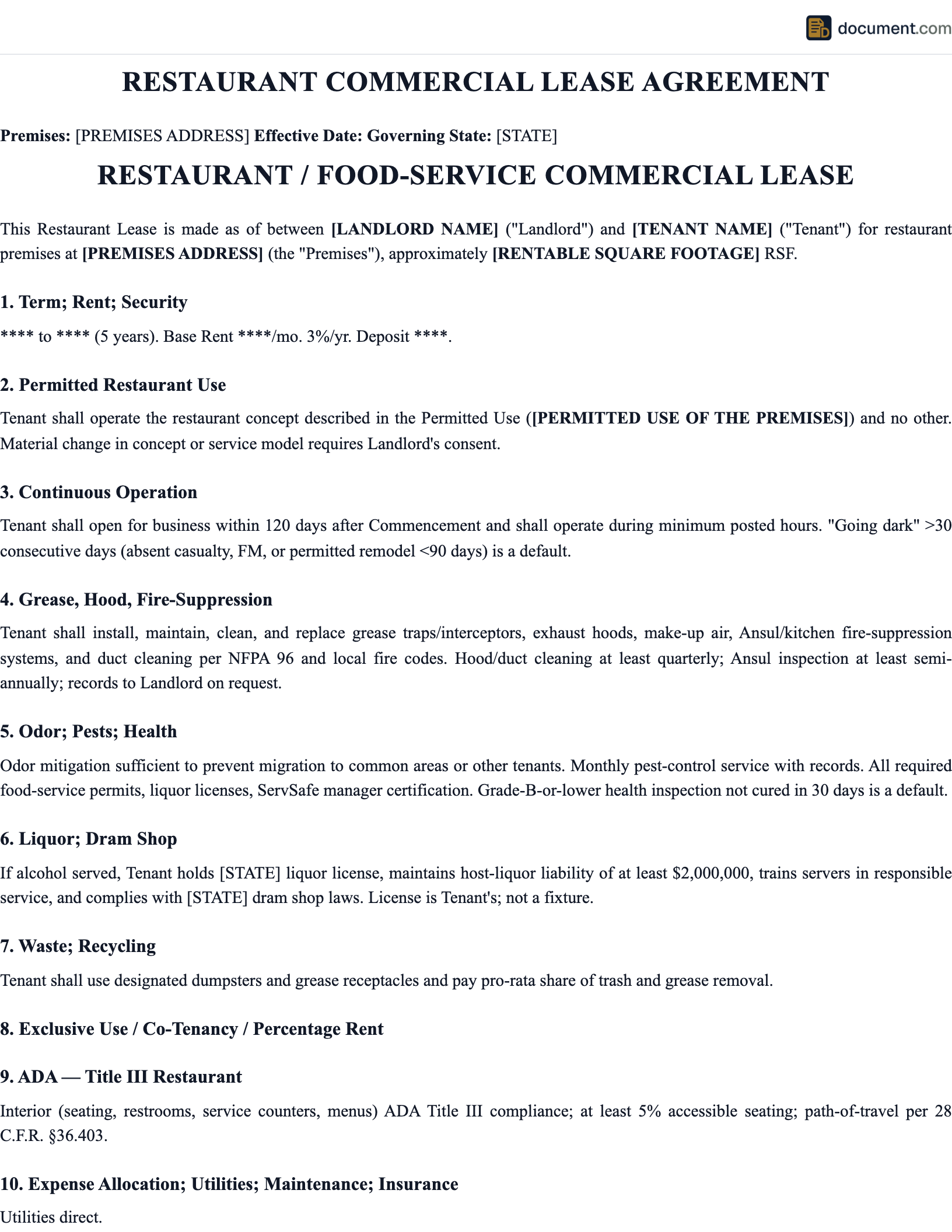
Restaurant Lease Agreement Form Preview
Our restaurant lease agreement form includes all the fields required for a valid document. Below is a preview of the key sections. Your customized document will be tailored to your state's specific requirements.
RESTAURANT LEASE AGREEMENT
Legal Document Template
LANDLORD
Name: [Full Legal Name / Entity]
Property: [Building/Center Name]
Address: [Property Address]
TENANT / OPERATOR
Name: [Restaurant Entity Name]
Concept: [Restaurant Name/Concept]
Experience: [Years in Food Service]
Tax ID: [EIN]
PREMISES
Suite: [Number]
Total SF: [Square Feet]
Kitchen SF: [Square Feet]
Dining SF: [Square Feet]
Patio: [Yes/No - SF]
FINANCIAL TERMS
Base Rent: $[Amount]/month
Percentage Rate: [%] above $[Breakpoint]
TI Allowance: $[Amount]
Deposit: $[Amount]
CAM: $[Amount]/month
Key Provisions
A restaurant lease agreement requires several important provisions to be legally effective and protect all parties involved. Review each provision carefully.
Kitchen and Equipment
Specify the kitchen equipment provided by the landlord, tenant-installed equipment, ventilation and hood system requirements, grease trap specifications, and maintenance responsibilities for all kitchen systems.
Health Department Compliance
Define responsibilities for maintaining health department permits, passing inspections, correcting violations, and the consequences of repeated failures or license revocation.
Hours of Operation
Establish permitted operating hours, including any restrictions from building rules, zoning ordinances, noise ordinances, or neighboring tenant agreements. Address delivery hours separately.
Exclusive Use
Negotiate exclusive use provisions preventing the landlord from leasing to directly competing food establishments, defining the scope of exclusivity by cuisine type, service style, or product category.
Build-Out and TI Allowance
Detail the tenant improvement allowance, construction standards, landlord approval requirements for kitchen plans, and whether the build-out investment can be amortized into rent.
Waste and Odor Management
Address grease disposal, food waste management, odor control requirements, pest control obligations, and compliance with environmental regulations specific to food service operations.
When to Use A Restaurant Lease Agreement
Understanding when to use a restaurant lease agreement helps ensure you select the right document for your situation. Below are the most common use cases.
Full-Service Restaurants
Traditional dine-in restaurants requiring complete kitchen build-outs, dining rooms, bar areas, and potentially outdoor seating, with complex lease requirements for ventilation and equipment.
Fast-Casual Concepts
Quick-service and fast-casual restaurants with simplified kitchen requirements but high-volume operations, often in shopping center food courts or strip mall locations.
Bars and Nightclubs
Establishments focused on beverage service with specific needs for liquor licensing, extended hours, sound attenuation, security requirements, and enhanced liability provisions.
Cafe and Coffee Shops
Lower-intensity food service operations with simpler kitchen requirements but still needing proper ventilation, health compliance, and appropriate hours of operation.
How to Draft A Restaurant Lease Agreement
Drafting a restaurant lease agreement involves several steps to ensure the document is legally sound, complete, and enforceable in your state. Follow these steps for a thorough and professional document.
Gather Required Information
Collect all necessary details including party names, addresses, property or subject matter descriptions, financial terms, and any state-specific requirements for your jurisdiction.
Select Your State
Choose your state to ensure the document includes all required provisions, disclosures, and formatting requirements mandated by your jurisdiction's laws.
Complete All Sections
Fill in every section of the document carefully, including all parties, terms, conditions, and any special provisions relevant to your specific situation.
Review and Sign
Review the completed document for accuracy, have all parties sign, and arrange for notarization or witnesses if required by your state. Keep copies for all parties.
Distribute and Store
Provide signed copies to all parties involved. Store the original in a secure location and file any required copies with the appropriate government offices or recording agencies.
Legal Requirements
Legal requirements for a restaurant lease agreement vary by state. Each state has its own statutes governing this type of document, including specific provisions, disclosures, notice periods, and execution requirements. Selecting your state ensures your document meets all local requirements.
Important Legal Notice
This document template is provided for informational purposes and general guidance. While designed to comply with common legal requirements, laws vary by state and locality. For significant transactions or complex situations, consult with a licensed attorney in your jurisdiction to ensure full compliance with applicable laws.
- State Compliance: Each state has specific legal requirements that must be met for this document to be enforceable
- Proper Execution: The document must be properly signed by all parties, with notarization or witnesses as required by your state
- Required Disclosures: Many states mandate specific disclosures or addenda that must accompany this type of document
- Filing Requirements: Some states require filing or recording with government offices for the document to be fully effective
Restaurant Lease by State
Select your state for a restaurant lease agreement customized to your jurisdiction's specific legal requirements, disclosures, and formatting standards.
Sample Restaurant Lease Agreement
Below is a preview of our restaurant lease agreement template. Your customized document will include all fields and provisions required for your specific state and situation.
RESTAURANT LEASE AGREEMENT
Template Preview
LANDLORD
Name: [Full Legal Name / Entity]
Property: [Building/Center Name]
Address: [Property Address]
TENANT / OPERATOR
Name: [Restaurant Entity Name]
Concept: [Restaurant Name/Concept]
Experience: [Years in Food Service]
Tax ID: [EIN]
PREMISES
Suite: [Number]
Total SF: [Square Feet]
Kitchen SF: [Square Feet]
Dining SF: [Square Feet]
Patio: [Yes/No - SF]
FINANCIAL TERMS
Base Rent: $[Amount]/month
Percentage Rate: [%] above $[Breakpoint]
TI Allowance: $[Amount]
Deposit: $[Amount]
CAM: $[Amount]/month
Frequently Asked Questions
Common questions about creating and using a restaurant lease agreement, including legal requirements, costs, and best practices.
Create your Commercial Restaurant Lease Agreement in under 10 minutes.
Answer a few questions and download a compliant, attorney-drafted document ready for your state.