



Utah Restaurant Lease Agreement Overview
Utah presents restaurant operators with a regulatory environment unlike most other states. The Utah Department of Alcoholic Beverage Services — which took over from DABC in a rebranding but retained the same control-state structure — manages distilled spirits sales through state-operated stores and issues on-premise restaurant licenses with minimum food revenue requirements that directly affect the business model. A restaurant that relies heavily on bar sales for profitability and derives a smaller proportion of revenue from food may find itself in DABC compliance difficulty. This is not a licensing detail to sort out post-lease; it is a prerequisite for signing.
Salt Lake City's restaurant market has matured considerably, with competitive neighborhood submarkets in Sugar House, 9th and 9th, the Granary District, and downtown near the convention center. Outside SLC, Park City, Snowbird, Alta, and Deer Valley operate in a resort economy where winter ski season revenue dominates and the rest of the year can be challenging. Lease terms in resort markets need to reflect that reality through seasonal percentage rent structures, operating hour flexibility, and force majeure provisions for low-snowpack resort closures. Our Utah restaurant lease template addresses DABC license contingencies, food revenue minimum compliance, Salt Lake County and Utah County health department timelines, ski resort seasonal provisions, grease interceptor compliance with local sewer authorities, and ADA upgrade responsibility for older downtown SLC commercial building stock.
$40
Filing fee
Required
Notarization
0
Witnesses required
County
Filing office
Utah Requirements
Utah restaurant lease requirements center on the DABC licensing structure and its minimum food revenue requirements, the delegated county health inspection process, and the seasonal provisions necessary for resort-market operators. These are not generic requirements that apply the same way in every state.
Utah Alcohol Licensing: State Control, Food Revenue Minimums, and License Caps
Utah's Department of Alcoholic Beverage Services is a control-state agency — restaurants cannot buy distilled spirits from private distributors. Full-Service Restaurant Liquor Licenses require that a minimum percentage of total receipts come from food sales. License availability is also capped by population ratios in some categories, which can create wait times. Confirm current DABC rules, cap status, and application timelines with the agency before executing any lease that depends on full liquor service.
Key Requirements for Utah Restaurant Leases
- County Health Department Food Permit: Identify whether Salt Lake County, Utah County, or the applicable local health department has inspection authority; build permit timeline into rent commencement negotiations
- DABC Full-Service Restaurant License Contingency: Include a contingency with a 90-day minimum timeline and a clear termination right if the license application is denied or delayed beyond a specified date
- Grease Interceptor and Hood System Condition: Document current interceptor size and hood condition, confirm compliance with Salt Lake City Public Utilities or applicable local sewer authority, and assign upgrade responsibility in the lease
- Ski Resort Seasonal Percentage Rent and Operating Flexibility: For Park City, Snowbird, Alta, or Deer Valley adjacent restaurants, negotiate breakpoints calibrated to actual seasonal revenue patterns and include resort-closure force majeure language
- ADA Compliance for Older SLC Buildings: Obtain a written landlord representation regarding current ADA compliance status and negotiate TI allowance coverage for entrance, restroom, and pathway upgrades
How to File in Utah
The DABC licensing timeline is Utah's most distinctive pre-opening constraint. Build 60 to 90 days for DABC review into your lease commencement structure from the start, and run the county health permit process in parallel to avoid adding those timelines sequentially.
Confirm Zoning, DABC License Eligibility, and License Availability
Contact the local municipality to confirm restaurant-use zoning. Contact the Utah Department of Alcoholic Beverage Services directly to verify that the specific address supports the Full-Service Restaurant License or other license category you need, and ask about current license availability and wait times. In some categories, licenses are capped by population ratios and may not be immediately available.
Inspect Kitchen Infrastructure and Confirm Grease Interceptor Compliance
Walk the kitchen with a contractor and confirm hood system condition, grease interceptor size relative to Salt Lake City Public Utilities or the applicable local sewer authority's requirements for your cooking volume, and gas and electrical service adequacy. For older SLC downtown spaces, assess ADA compliance gaps in entrances, restrooms, and pathways simultaneously. Use findings to negotiate TI allowance amounts before executing the lease.
Execute Lease with DABC Contingency and Adequate Rent Commencement Lead Time
Include a clearly worded DABC license contingency with a minimum 90-day review period and a termination right if the license is denied or delayed beyond a defined date. Set rent commencement after DABC license issuance and county health permit receipt, not after construction completion. For Park City and resort-area leases, include seasonal percentage rent provisions and operating hour flexibility.
Complete Buildout and Pass County Health Department Pre-Opening Inspection
After construction, schedule the pre-opening inspection with the Salt Lake County, Utah County, or applicable local health department. The inspector will verify hood and grease systems, food storage configurations, and sanitation layout. Address all deficiencies before submitting the DABC application.
Submit DABC Application and Coordinate Opening to Market Timing
File the DABC license application after health permit clearance and track the review timeline. For resort-area operators, time your opening to align with early ski season if winter revenue represents the majority of annual volume. Once the DABC license is in hand, calendar annual renewal dates and establish your grease interceptor pumping schedule.
Utah Fees & Costs
Utah restaurant startup costs are driven by the DABC licensing process, county health permitting, and a combined sales tax structure that varies by location. Resort-market operators have additional costs to model around seasonal occupancy and operating structure.
| Fee / Cost | Amount |
|---|---|
| County Health Department Food Establishment Permit (Annual) | $200 to $800 depending on establishment size and county; confirm current fee with Salt Lake County or Utah County health department |
| Utah DABC Full-Service Restaurant Liquor License (Annual) | Confirm current fee and availability directly with Utah Department of Alcoholic Beverage Services; license caps by population category can affect availability and timing |
| Utah and Local Sales Tax on Food and Beverages | State base rate of 4.85% plus local additions; combined rate reaches approximately 7.75% in Salt Lake City and can reach 8.35% in some jurisdictions |
| SLC Public Utilities Grease Trap Inspection and Pumping | Quarterly to semi-annual pumping required; cost varies by interceptor size; assign responsibility in the lease before signing |
| Attorney Review of Lease | $300 to $800 for Utah commercial attorney review with DABC contingency drafting and seasonal provision analysis |
Sample Utah Restaurant Lease Agreement
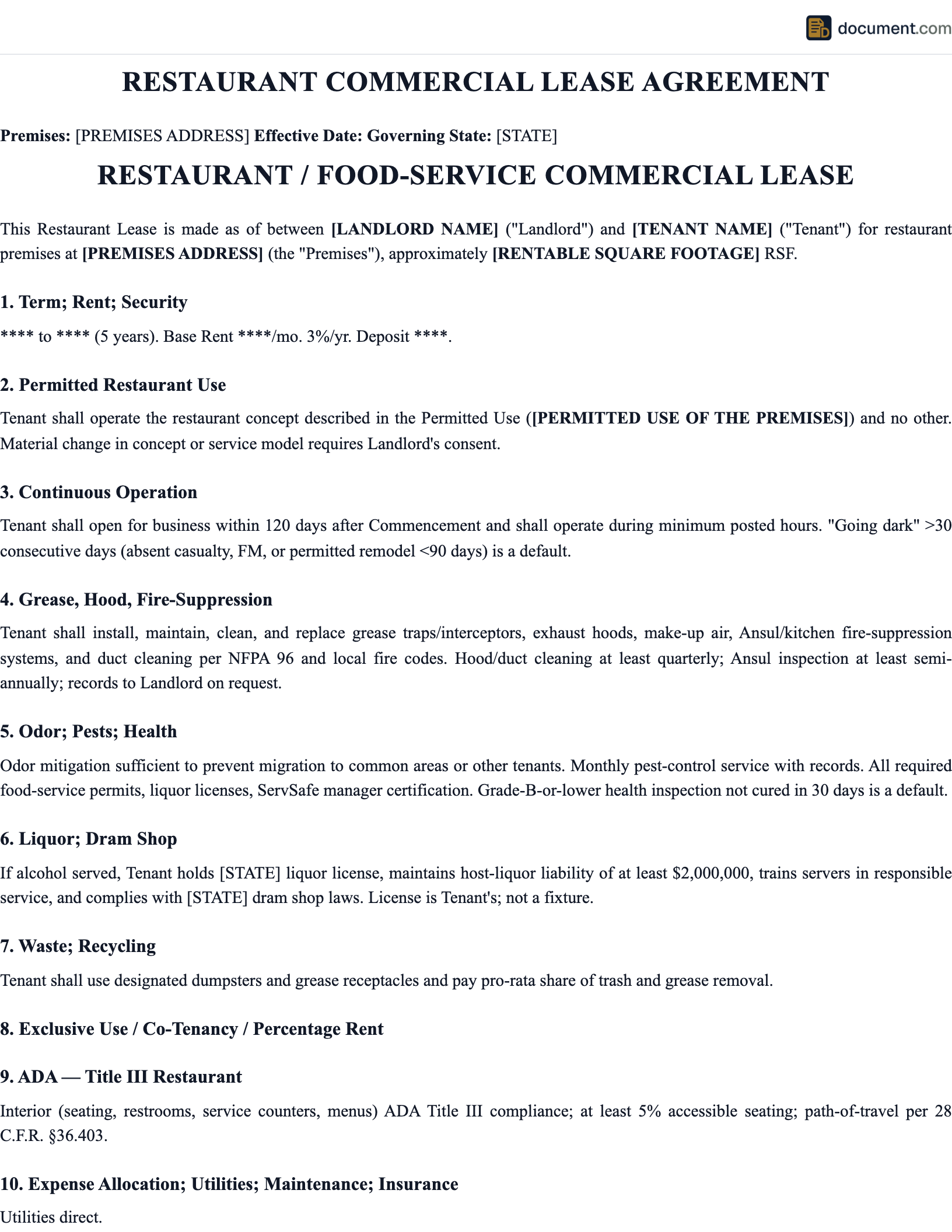
Below is a preview of our Utah-specific template. Your customized document will include all fields and provisions required for filing in any Utah county.
RESTAURANT LEASE AGREEMENT
STATE OF UTAH
Legal Document Template
LANDLORD
Name: [Full Legal Name / Entity]
Property: [Building/Center Name]
Address: [Property Address]
TENANT / OPERATOR
Name: [Restaurant Entity Name]
Concept: [Restaurant Name/Concept]
Experience: [Years in Food Service]
Tax ID: [EIN]
PREMISES
Suite: [Number]
Total SF: [Square Feet]
Kitchen SF: [Square Feet]
Dining SF: [Square Feet]
Patio: [Yes/No - SF]
FINANCIAL TERMS
Base Rent: $[Amount]/month
Percentage Rate: [%] above $[Breakpoint]
TI Allowance: $[Amount]
Deposit: $[Amount]
CAM: $[Amount]/month
Utah Restaurant Lease Agreement FAQ
Answers to common questions about filing an restaurant lease agreement in Utah, including requirements, fees, and procedures.
Official Utah Resources
Use these official state resources to verify requirements, find your local filing office, and access government forms for Utah.
Related Utah Documents
Depending on your situation, you may need additional documents alongside your Utah restaurant lease agreement.
Create your Utah Commercial Restaurant Lease Agreement in under 5 minutes.
Answer a few questions and download a Utah-compliant document, ready for the state agency.