



What Is a Gross Commercial Lease?
A gross commercial lease, also known as a full-service lease, is a type of commercial rental agreement where the tenant pays a single, fixed monthly rent amount that includes most or all property operating expenses. The landlord is responsible for paying property taxes, building insurance, common area maintenance (CAM), and often utilities out of the rental income. This structure provides tenants with predictable monthly costs and simplifies budgeting.
Gross leases are particularly common in multi-tenant office buildings, professional service centers, and Class A commercial properties. They appeal to tenants who want simplicity and budget certainty, as the landlord absorbs the variability of operating expenses. However, landlords typically build expected expenses into the base rent, so gross lease rates are higher than net lease rates on a per-square-foot basis.
There are several variations of gross leases, including full-service gross leases (where the landlord covers everything), modified gross leases (where some expenses are shared), and industrial gross leases. Understanding which expenses are included and which fall to the tenant is critical when negotiating a gross lease. Most gross leases include an expense stop or base year provision that shifts costs above a certain threshold to the tenant.
Commercial lease structures vary significantly by state, and local laws may impose specific requirements on commercial landlords regarding disclosures, security deposits, and lease terms. Always ensure your gross lease agreement complies with your state's commercial landlord-tenant statutes.
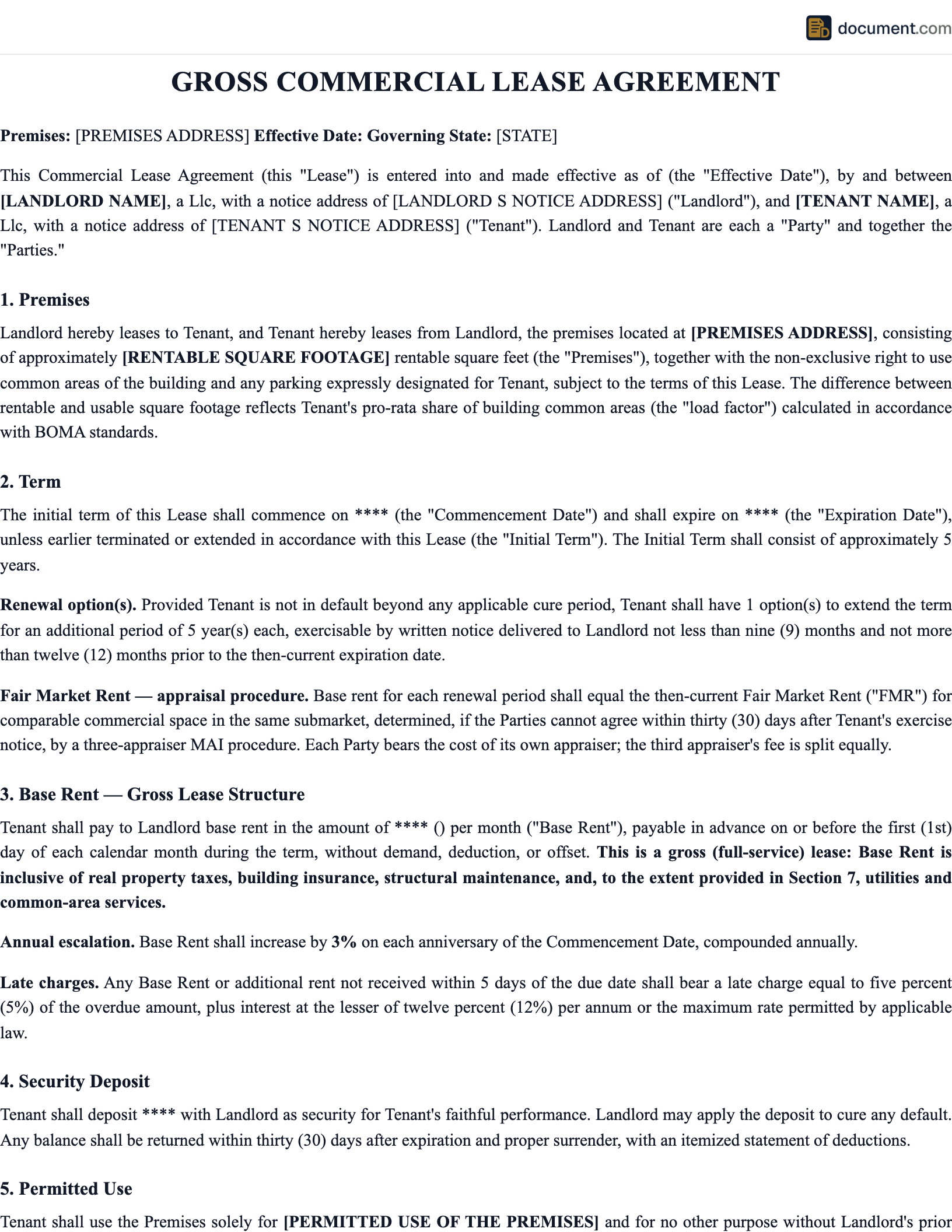
Gross Commercial Lease Agreement Form Preview
Our gross commercial lease agreement form includes all the fields required for a valid document. Below is a preview of the key sections. Your customized document will be tailored to your state's specific requirements.
GROSS COMMERCIAL LEASE AGREEMENT
Legal Document Template
LANDLORD
Name: [Full Legal Name]
Address: [Business Address]
Contact: [Phone/Email]
TENANT
Name: [Full Legal Name / Entity]
Address: [Current Address]
Tax ID: [EIN/SSN]
PREMISES
Address: [Property Address]
Suite: [Number]
Rentable SF: [Square Feet]
Usable SF: [Square Feet]
FINANCIAL TERMS
Base Rent: $[Amount]/month
Expense Stop: $[Amount]/SF
Security Deposit: $[Amount]
Escalation: [%]/year
Key Provisions
A gross commercial lease agreement requires several important provisions to be legally effective and protect all parties involved. Review each provision carefully.
Base Rent and Included Expenses
Clearly define the monthly rent amount and itemize which operating expenses are included (property taxes, insurance, CAM, utilities, janitorial services).
Expense Stop / Base Year
Establish the base year or expense stop amount above which operating cost increases pass through to the tenant as additional rent.
Common Area Maintenance
Detail what constitutes common areas, how maintenance is performed, the landlord's maintenance standards, and any CAM charge reconciliation procedures.
Utility Provisions
Specify whether utilities are included in rent, separately metered, or submetered, and how utility costs are allocated among tenants.
Tenant Improvements
Address any build-out allowance, construction standards for tenant improvements, landlord approval requirements, and restoration obligations at lease end.
Insurance Allocation
Define the landlord's building insurance coverage and the tenant's required insurance, including general liability minimums and any additional insured requirements.
When to Use A Gross Commercial Lease Agreement
Understanding when to use a gross commercial lease agreement helps ensure you select the right document for your situation. Below are the most common use cases.
Professional Office Tenants
Law firms, accounting practices, and consulting companies that want a single predictable monthly payment covering all occupancy costs without managing property expenses.
Medical and Dental Offices
Healthcare providers who need to focus on patient care rather than property management, with all building expenses handled by the landlord.
Small Business Tenants
Startups and small businesses that benefit from cost certainty and simplified accounting without the complexity of tracking variable property expenses.
Corporate Branch Offices
Companies leasing satellite offices that want consistent budgeting across locations without the administrative burden of paying separate property expense invoices.
How to Draft A Gross Commercial Lease Agreement
Drafting a gross commercial lease agreement involves several steps to ensure the document is legally sound, complete, and enforceable in your state. Follow these steps for a thorough and professional document.
Gather Required Information
Collect all necessary details including party names, addresses, property or subject matter descriptions, financial terms, and any state-specific requirements for your jurisdiction.
Select Your State
Choose your state to ensure the document includes all required provisions, disclosures, and formatting requirements mandated by your jurisdiction's laws.
Complete All Sections
Fill in every section of the document carefully, including all parties, terms, conditions, and any special provisions relevant to your specific situation.
Review and Sign
Review the completed document for accuracy, have all parties sign, and arrange for notarization or witnesses if required by your state. Keep copies for all parties.
Distribute and Store
Provide signed copies to all parties involved. Store the original in a secure location and file any required copies with the appropriate government offices or recording agencies.
Legal Requirements
Legal requirements for a gross commercial lease agreement vary by state. Each state has its own statutes governing this type of document, including specific provisions, disclosures, notice periods, and execution requirements. Selecting your state ensures your document meets all local requirements.
Important Legal Notice
This document template is provided for informational purposes and general guidance. While designed to comply with common legal requirements, laws vary by state and locality. For significant transactions or complex situations, consult with a licensed attorney in your jurisdiction to ensure full compliance with applicable laws.
- State Compliance: Each state has specific legal requirements that must be met for this document to be enforceable
- Proper Execution: The document must be properly signed by all parties, with notarization or witnesses as required by your state
- Required Disclosures: Many states mandate specific disclosures or addenda that must accompany this type of document
- Filing Requirements: Some states require filing or recording with government offices for the document to be fully effective
Gross Lease by State
Select your state for a gross commercial lease agreement customized to your jurisdiction's specific legal requirements, disclosures, and formatting standards.
Sample Gross Commercial Lease Agreement
Below is a preview of our gross commercial lease agreement template. Your customized document will include all fields and provisions required for your specific state and situation.
GROSS COMMERCIAL LEASE AGREEMENT
Template Preview
LANDLORD
Name: [Full Legal Name]
Address: [Business Address]
Contact: [Phone/Email]
TENANT
Name: [Full Legal Name / Entity]
Address: [Current Address]
Tax ID: [EIN/SSN]
PREMISES
Address: [Property Address]
Suite: [Number]
Rentable SF: [Square Feet]
Usable SF: [Square Feet]
FINANCIAL TERMS
Base Rent: $[Amount]/month
Expense Stop: $[Amount]/SF
Security Deposit: $[Amount]
Escalation: [%]/year
Frequently Asked Questions
Common questions about creating and using a gross commercial lease agreement, including legal requirements, costs, and best practices.
Create your Commercial Gross Lease Agreement in under 10 minutes.
Answer a few questions and download a compliant, attorney-drafted document ready for your state.