
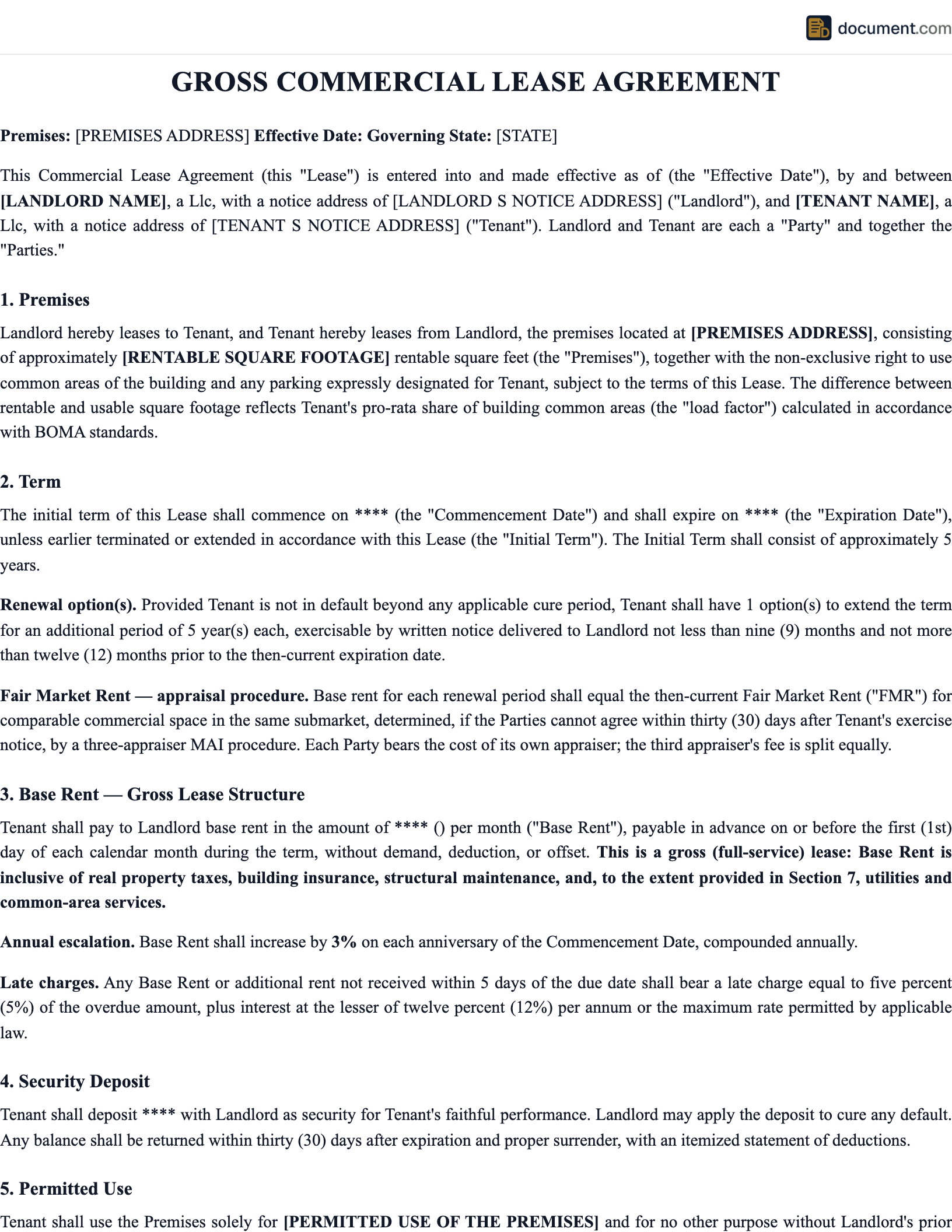



South Carolina Gross Commercial Lease Agreement Overview
A gross commercial lease in South Carolina simplifies the tenant's cost structure by consolidating operating expenses into a single fixed rent payment. The landlord collects rent and uses it to cover property taxes, building insurance, and maintenance obligations. The tenant avoids managing multiple expense categories but pays a higher base rent that reflects the landlord's cost exposure. Gross leases are common in South Carolina office buildings, professional suites, and smaller retail spaces where tenants lack the resources or desire to manage expense reconciliations.
South Carolina's commercial gross lease market is shaped by several state-specific factors. The Charleston market, including the historic downtown office district and the Mount Pleasant corridor, uses gross or modified gross structures for smaller professional and service tenants. Columbia, anchored by state government, University of South Carolina, and a growing professional services sector, has active demand for gross lease office space in the Five Points and Vista neighborhoods. The Upstate markets of Greenville and Spartanburg, growing through manufacturing and corporate relocations, have shifted toward more NNN structures for industrial tenants but retain gross lease practices for office space. South Carolina imposes no commercial rent tax, so the all-in cost of a gross lease is the rent plus excluded items only, without a tax layer on top.
$15
Filing fee
Required
Notarization
2
Witnesses required
Register
Filing office
South Carolina Gross Lease Requirements
A South Carolina gross commercial lease must clearly define what expenses the landlord covers, what is excluded from the gross rent, and how expense stop or base year pass-throughs work. These provisions determine whether the tenant's fixed rent is truly fixed or subject to adjustment during the term.
South Carolina Expense Stop and Base Year Note
Many South Carolina gross leases that appear fully gross actually include an expense stop or base year provision that passes through a portion of operating expense increases to the tenant. Before signing, confirm whether the lease is a true gross structure or a modified gross with a stop. In Columbia office buildings and Charleston professional centers, base year provisions tied to periods of unusually low occupancy can result in significant tenant pass-through exposure in later years.
Key Gross Lease Provisions for South Carolina
- Expense Inclusions: List the specific operating expense categories the landlord covers, including property taxes, building insurance, structural maintenance, common area maintenance, and landlord-managed utilities. The more specific the list, the less room for dispute.
- Base Year or Expense Stop: If the lease uses a base year structure, request actual expense statements for the proposed base year and the prior two years. Evaluate whether the base year is representative of normal operations and confirm whether a gross-up provision applies when the building was less than fully occupied.
- Gross-Up Provision: If occupancy-variable expenses are included in the base year calculation, confirm whether the lease grosses up those expenses to full occupancy. A gross-up provision prevents tenants from benefiting from a base year with artificially low expenses due to vacancy.
- Exclusions List: Define what is not covered by the gross rent. Standard exclusions include tenant utilities, personal property taxes, business license fees, and damages caused by the tenant. Coastal South Carolina properties may need explicit language on whether windstorm or flood insurance is included or excluded.
- Landlord Repair Obligations: Define the landlord's maintenance responsibilities for the building structure, roof, HVAC, plumbing, and electrical systems. South Carolina's older commercial building stock in downtown Charleston and Columbia requires particular attention to deferred maintenance obligations.
How to Draft a South Carolina Gross Commercial Lease
Drafting a gross lease for South Carolina commercial space requires careful negotiation of expense inclusions, base year or expense stop structures, and landlord repair obligations. Work through each step before both parties sign.
Define Expense Inclusions and Exclusions
Specify which operating expense categories the landlord covers and which are excluded from the gross rent. For South Carolina coastal properties in Charleston or Hilton Head, confirm the treatment of windstorm and flood insurance. Request actual expense statements for the property for the past three years to evaluate whether the proposed base rent covers the landlord's actual cost exposure.
Negotiate the Base Year or Expense Stop Structure
If the lease uses a base year or expense stop mechanism, agree on the base year and whether a gross-up applies. Evaluate revaluation timing for the county in which the property sits. South Carolina's 46-county system means property tax exposure varies considerably. Greenville County and Charleston County properties with recent development activity may carry higher near-term reassessment risk than more stable inland counties.
Confirm Landlord Maintenance Responsibilities
Detail the landlord's repair and maintenance obligations including building structure, roof, HVAC, plumbing, and exterior. Older commercial buildings in downtown Charleston and the Columbia Vista district can carry deferred maintenance that surfaces during a lease term. Requesting a property inspection report and confirming system ages and expected replacement timelines before signing is a reasonable step for any long-term gross lease.
Execute the Lease Agreement
Both parties sign the completed gross lease. South Carolina's Statute of Frauds under S.C. Code Ann. § 27-5-10 requires commercial leases exceeding one year to be in writing. Retain executed originals for the landlord, tenant, and any guarantors. Confirm that the tenant has received a copy of the base year expense statements and any relevant property inspection reports.
Record a Memorandum of Lease (Optional)
For leases of three or more years, consider recording a memorandum of lease at the Register of Deeds office in the county where the property is located. South Carolina has 46 counties, each maintaining separate recording offices. Recording provides constructive notice and protects the tenant's leasehold interest if the property changes ownership during the term.
South Carolina Gross Lease Costs
Typical costs for a South Carolina gross commercial lease. Actual operating expense exposure depends on lease structure and property location.
| Cost Item | Typical Amount |
|---|---|
| Monthly Gross Rent | Single payment covering base rent and landlord-paid operating expenses; reflects landlord's actual cost exposure |
| Expense Stop Pass-Through | If applicable, amount by which actual expenses exceed the base year or expense stop threshold; sensitive to property tax reassessment in rapidly growing South Carolina counties |
| Tenant Utilities | Typically excluded; tenant pays electricity, data, and phone directly to providers |
| County Register of Deeds Recording Fee | Varies by county; typically $10 to $25 for a memorandum of lease recording |
| Attorney Review | $400 to $800 for a South Carolina commercial gross lease review; higher for complex base year analysis or multi-tenant buildings |
Sample South Carolina Gross Commercial Lease Agreement
Below is a preview of our South Carolina-specific template. Your customized document will include all fields and provisions required for filing in any South Carolina county.
GROSS COMMERCIAL LEASE AGREEMENT
STATE OF SOUTH CAROLINA
Legal Document Template
LANDLORD
Name: [Full Legal Name]
Address: [Business Address]
Contact: [Phone/Email]
TENANT
Name: [Full Legal Name / Entity]
Address: [Current Address]
Tax ID: [EIN/SSN]
PREMISES
Address: [Property Address]
Suite: [Number]
Rentable SF: [Square Feet]
Usable SF: [Square Feet]
FINANCIAL TERMS
Base Rent: $[Amount]/month
Expense Stop: $[Amount]/SF
Security Deposit: $[Amount]
Escalation: [%]/year
South Carolina Gross Commercial Lease Agreement FAQ
Answers to common questions about filing a gross commercial lease agreement in South Carolina, including requirements, fees, and procedures.
Official South Carolina Resources
Use these official state resources to verify requirements, find your local filing office, and access government forms for South Carolina.
Related South Carolina Documents
Depending on your situation, you may need additional documents alongside your South Carolina gross commercial lease agreement.
Create your South Carolina Commercial Gross Lease Agreement in under 5 minutes.
Answer a few questions and download a South Carolina-compliant document, ready for the state agency.