
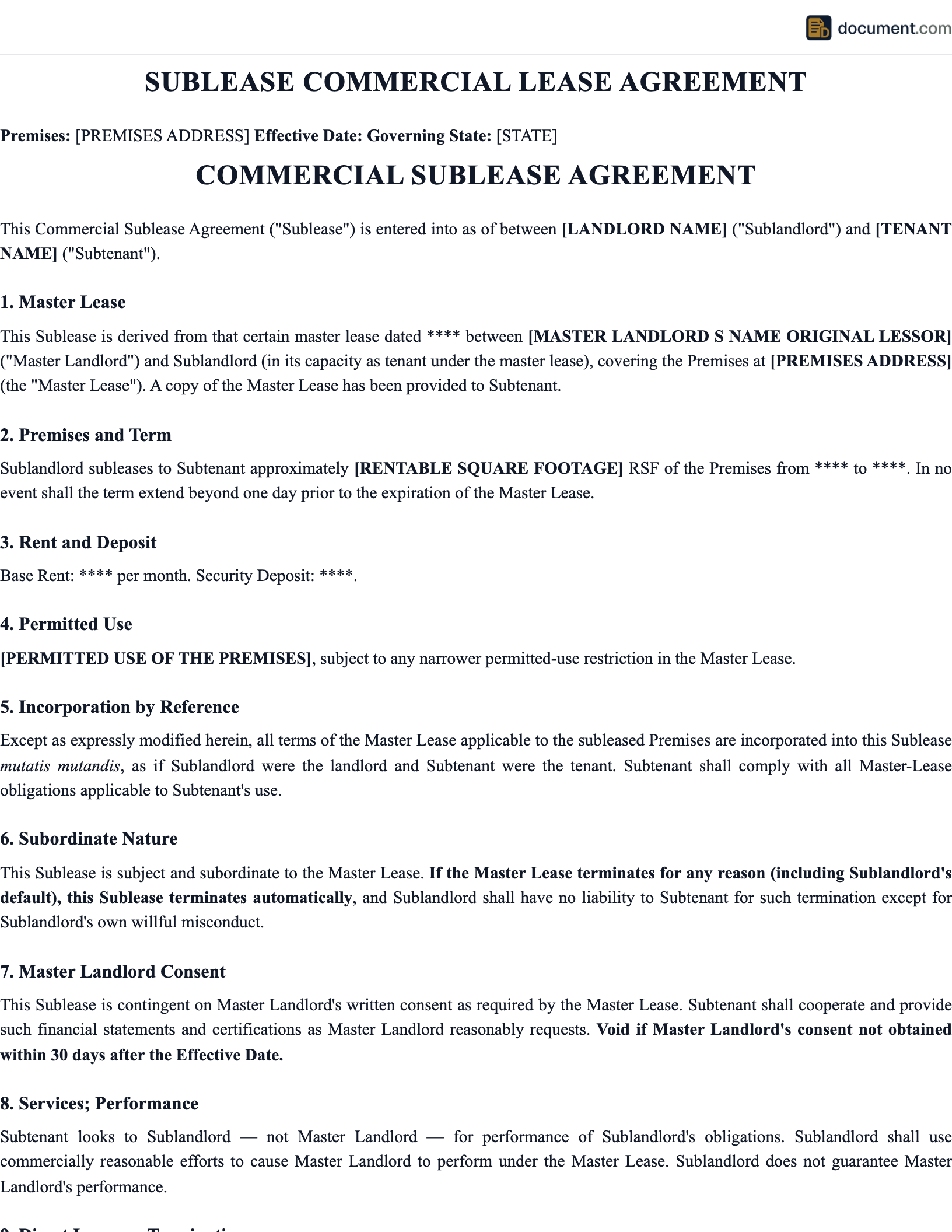



What Is an Office Sublease Agreement?
An office sublease agreement is a contract between an existing commercial tenant (the sublandlord) and a new occupant (the subtenant) that allows the subtenant to use all or part of the leased office space. The original tenant remains responsible to the landlord under the master lease, while the subtenant pays rent to the sublandlord and agrees to comply with the terms of both the sublease and the underlying master lease.
Office subleasing has become increasingly common as companies downsize, restructure, or shift to hybrid work models. Sublandlords benefit by offsetting lease obligations for space they no longer need, while subtenants gain access to office space at below-market rates, often with shorter terms and existing build-outs that eliminate the cost and time of tenant improvements.
The sublease must align with the master lease terms, as the sublandlord cannot grant the subtenant more rights than they hold. The master lease typically requires landlord consent for subleasing, which most leases state cannot be unreasonably withheld. Some master leases include recapture rights allowing the landlord to take back the space rather than approve the sublease, and profit-sharing clauses requiring the sublandlord to share any sublease premium with the landlord.
Subtenants should carefully review the master lease before signing a sublease, as the subtenant's rights are limited by the master lease terms. If the sublandlord defaults on the master lease, the subtenant may lose their space even if they are current on sublease rent. Some subtenants negotiate recognition agreements with the master landlord for additional protection.
Office Sublease Agreement Form Preview
Our office sublease agreement form includes all the fields required for a valid document. Below is a preview of the key sections. Your customized document will be tailored to your state's specific requirements.
OFFICE SUBLEASE AGREEMENT
Legal Document Template
SUBLANDLORD
Name: [Full Legal Name / Entity]
Master Lease Date: [Date]
Master Landlord: [Landlord Name]
SUBTENANT
Name: [Full Legal Name / Entity]
Address: [Current Address]
Tax ID: [EIN]
PREMISES
Building: [Address]
Suite: [Original Suite]
Sublease Area: [SF Being Subleased]
Floor Plan: [See Exhibit A]
FINANCIAL TERMS
Sublease Rent: $[Amount]/month
Master Lease Rent: $[Amount]/month
Security Deposit: $[Amount]
Term: [Start] to [End]
Key Provisions
An office sublease agreement requires several important provisions to be legally effective and protect all parties involved. Review each provision carefully.
Master Lease Compliance
Require the subtenant to comply with all relevant terms of the master lease, attach the master lease as an exhibit, and specify which master lease provisions apply to the subtenant.
Sublease Rent
Define the sublease rent amount, payment schedule, and any escalations. Address whether the subtenant pays the sublandlord directly or whether payments flow through to the master landlord.
Landlord Consent
Document the master landlord's written consent to the sublease, including any conditions imposed by the landlord and the process for obtaining consent.
Term and Termination
Set the sublease term, which cannot extend beyond the master lease term, and address termination provisions, renewal options, and what happens if the master lease terminates early.
Maintenance and Condition
Document the condition of the space at sublease commencement, allocate maintenance responsibilities between sublandlord and subtenant, and address restoration obligations.
Insurance and Indemnification
Require the subtenant to carry insurance meeting master lease requirements, name both the sublandlord and master landlord as additional insureds, and include mutual indemnification provisions.
When to Use An Office Sublease Agreement
Understanding when to use an office sublease agreement helps ensure you select the right document for your situation. Below are the most common use cases.
Corporate Downsizing
Companies that have reduced their workforce or adopted remote work policies and no longer need their full office space, seeking to sublease unused portions to offset lease costs.
Startup Space
Startups and small businesses that benefit from below-market sublease rates and existing build-outs, avoiding the cost and commitment of a direct lease.
Short-Term Needs
Businesses needing temporary office space for project teams, seasonal operations, or interim offices while permanent space is being prepared.
Space Optimization
Companies that have evolved their space needs and want to sublease specialized areas (conference floors, executive suites) while retaining their core office space.
How to Draft An Office Sublease Agreement
Drafting an office sublease agreement involves several steps to ensure the document is legally sound, complete, and enforceable in your state. Follow these steps for a thorough and professional document.
Gather Required Information
Collect all necessary details including party names, addresses, property or subject matter descriptions, financial terms, and any state-specific requirements for your jurisdiction.
Select Your State
Choose your state to ensure the document includes all required provisions, disclosures, and formatting requirements mandated by your jurisdiction's laws.
Complete All Sections
Fill in every section of the document carefully, including all parties, terms, conditions, and any special provisions relevant to your specific situation.
Review and Sign
Review the completed document for accuracy, have all parties sign, and arrange for notarization or witnesses if required by your state. Keep copies for all parties.
Distribute and Store
Provide signed copies to all parties involved. Store the original in a secure location and file any required copies with the appropriate government offices or recording agencies.
Legal Requirements
Legal requirements for an office sublease agreement vary by state. Each state has its own statutes governing this type of document, including specific provisions, disclosures, notice periods, and execution requirements. Selecting your state ensures your document meets all local requirements.
Important Legal Notice
This document template is provided for informational purposes and general guidance. While designed to comply with common legal requirements, laws vary by state and locality. For significant transactions or complex situations, consult with a licensed attorney in your jurisdiction to ensure full compliance with applicable laws.
- State Compliance: Each state has specific legal requirements that must be met for this document to be enforceable
- Proper Execution: The document must be properly signed by all parties, with notarization or witnesses as required by your state
- Required Disclosures: Many states mandate specific disclosures or addenda that must accompany this type of document
- Filing Requirements: Some states require filing or recording with government offices for the document to be fully effective
Office Sublease by State
Select your state for a office sublease agreement customized to your jurisdiction's specific legal requirements, disclosures, and formatting standards.
Sample Office Sublease Agreement
Below is a preview of our office sublease agreement template. Your customized document will include all fields and provisions required for your specific state and situation.
OFFICE SUBLEASE AGREEMENT
Template Preview
SUBLANDLORD
Name: [Full Legal Name / Entity]
Master Lease Date: [Date]
Master Landlord: [Landlord Name]
SUBTENANT
Name: [Full Legal Name / Entity]
Address: [Current Address]
Tax ID: [EIN]
PREMISES
Building: [Address]
Suite: [Original Suite]
Sublease Area: [SF Being Subleased]
Floor Plan: [See Exhibit A]
FINANCIAL TERMS
Sublease Rent: $[Amount]/month
Master Lease Rent: $[Amount]/month
Security Deposit: $[Amount]
Term: [Start] to [End]
Frequently Asked Questions
Common questions about creating and using an office sublease agreement, including legal requirements, costs, and best practices.
Create your Commercial Sublease Office Lease Agreement in under 10 minutes.
Answer a few questions and download a compliant, attorney-drafted document ready for your state.