
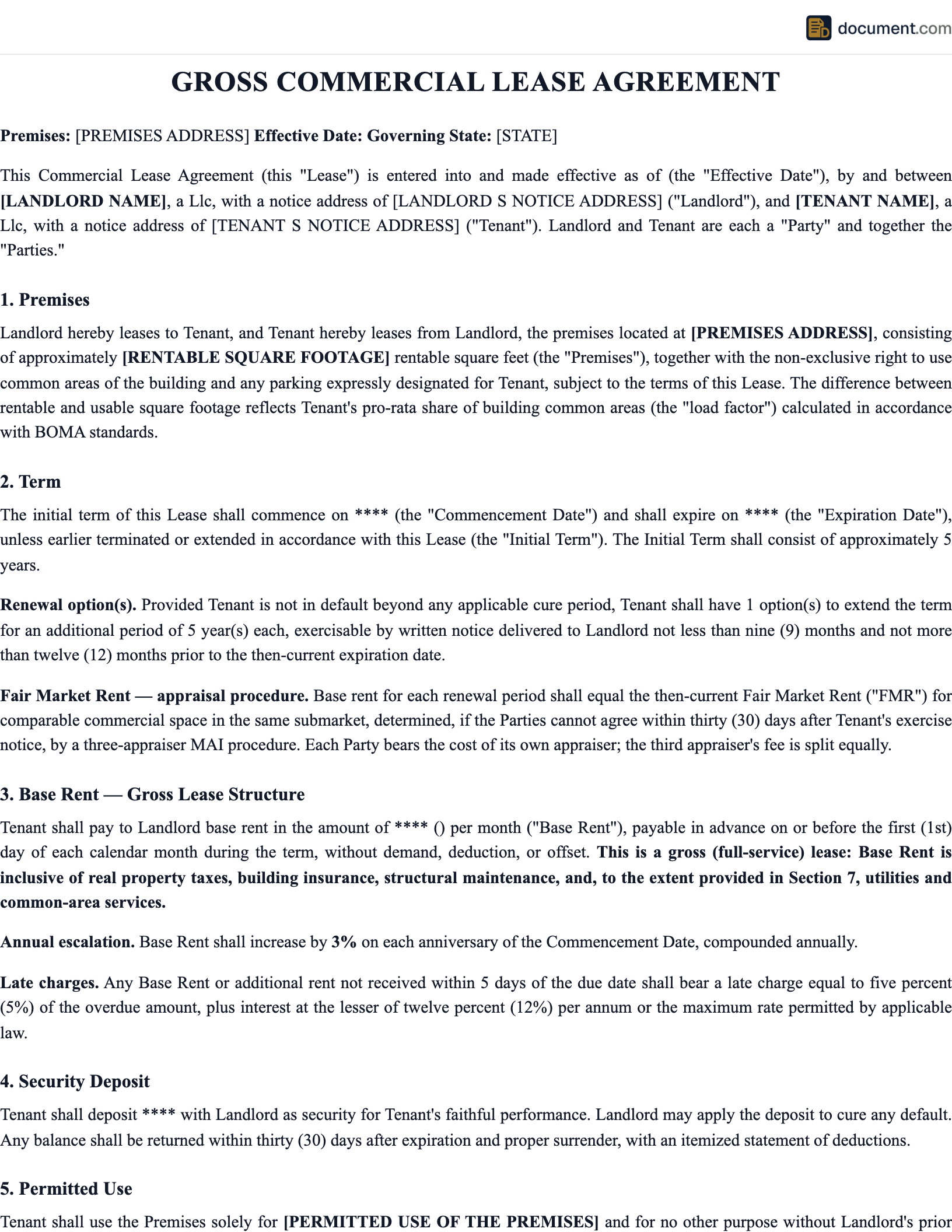



Utah Gross Commercial Lease Agreement Overview
A gross commercial lease in Utah is the standard structure for office and professional space in Salt Lake City, Provo, Ogden, and the surrounding Wasatch Front corridor. Under this arrangement the tenant pays a single monthly rent figure and the landlord absorbs most building operating costs, including property taxes, building insurance, and common area maintenance. This expense predictability is particularly attractive in Utah's office market, where property tax assessments have climbed steadily alongside Wasatch Front commercial values.
Utah does not impose a commercial rent tax or a state-level income tax surcharge on lease payments. Both landlord and tenant pay Utah's flat income tax rate on their respective business income. Because Utah contracts are governed primarily by the common law of contracts rather than a specialized commercial lease statute, every material economic term must be clearly spelled out in the lease itself. The expense stop, gross-up percentage, audit rights, and reconciliation schedule all need explicit language to be enforceable.
None
State rent tax
Contract
Governing law
High
Property tax state
4
Major office markets
Utah Requirements
Because Utah governs commercial leases through general contract law rather than a dedicated commercial landlord-tenant statute, the parties must define every economic and operational term in writing. Gaps in a Utah gross lease are resolved by courts using general contract principles, which rarely favor the drafter. The following provisions are critical for any Utah gross lease to be enforceable and financially clear.
Utah Property Tax Pass-Through Risk
Utah property taxes are assessed by county assessors and can increase significantly following a reassessment cycle. Salt Lake, Utah, Davis, and Weber counties have seen substantial commercial value increases in recent years. In a gross lease with an expense stop, tenants can face unexpected annual pass-through charges if property taxes spike above the base-year stop. Negotiate a cap on year-over-year expense increases to protect against sharp reassessments.
Key Lease Provisions
- Expense Inclusions: Define precisely which operating costs are covered by the gross rent and which, if any, are excluded or billed separately to the tenant
- Expense Stop or Base Year: Establish the per-square-foot dollar threshold or the base-year expense figure above which increases pass through to the tenant; the base year should be a full 12-month operating year
- Gross-Up Provision: Confirm that variable operating expenses are grossed up to 90 to 95 percent occupancy so the tenant does not benefit from a below-market vacancy situation in the building
- Annual Reconciliation: Require the landlord to deliver a detailed reconciliation statement within 90 to 120 days after each lease year ends, with an obligation to refund or credit overpayments promptly
- Audit Rights: Include a tenant right to audit the landlord's expense records within a defined period after receiving the reconciliation statement; require the landlord to pay audit costs if overcharges exceed a specified threshold
- Capital vs. Operating Distinction: Specify whether capital expenditures such as roof replacement or HVAC system overhauls may be amortized and passed through to tenants; Utah courts will not imply limitations that are not written into the lease
How to Structure a Utah Gross Commercial Lease
Structuring a gross lease in Utah requires careful negotiation of the expense components and the reconciliation mechanism. Getting these terms right at the outset avoids disputes at year-end reconciliation time.
Review Actual Historical Expense Data
Before agreeing to any expense stop or base-year figure, request the landlord's actual operating expense history for the building for the past two to three years. Utah property taxes and insurance costs have risen in the Wasatch Front market, so a base-year figure from a prior low-cost year can put tenants at a disadvantage from day one.
Negotiate the Expense Stop and Gross-Up Language
Lock in the expense stop or base-year amount and confirm that gross-up calculations apply only to variable operating expenses. The gross-up occupancy percentage is typically 90 to 95 percent and should be explicitly stated. For longer Utah office leases, also negotiate a cap on annual expense increase pass-throughs.
Confirm Capital Expense Treatment and Audit Rights
Specify whether capital improvements can be amortized and passed through. Add an explicit tenant audit right with a 60-day window after the annual reconciliation statement, and include a provision that the landlord pays audit costs if overcharges exceed five percent of the annual reconciliation amount.
Execute the Lease and Distribute Copies
Both landlord and tenant (or authorized representatives of each entity) must sign the lease. Utah commercial leases do not require notarization to be enforceable between the parties, but notarization is needed if the lease is to be recorded with the county recorder. Distribute a fully executed copy to each party.
Set Up an Annual Reconciliation Calendar
Mark the date by which the landlord must deliver the annual expense reconciliation statement and the deadlines for the tenant to object or request an audit. Tracking these dates prevents tenants from inadvertently waiving dispute rights under the lease's notice provisions.
Utah Gross Lease Costs
The cost structure of a Utah gross commercial lease is straightforward for the tenant: a flat monthly base rent covers most expenses. Annual reconciliation true-ups and potential attorney review are the primary variable costs to budget for.
| Fee / Cost | Amount |
|---|---|
| Base Rent (all-in) | Covers landlord operating expenses up to the expense stop; varies by Wasatch Front submarket and building class |
| Annual Expense Pass-Through (above stop) | Variable; depends on expense stop amount and actual Utah property tax / insurance increases for the year |
| Utah State Income Tax on Business Income | Flat rate applies to tenant business profits; no separate state tax on rent payments |
| Notarization (if lease recorded) | $5 - $25 per signature; required only if parties choose to record the lease with the county recorder |
| Attorney Review (recommended) | $400 - $1,000 for lease review; Salt Lake City commercial real estate attorneys commonly offer flat-fee review for standard office leases |
Sample Utah Gross Commercial Lease Agreement
Below is a preview of our Utah-specific template. Your customized document will include all fields and provisions required for filing in any Utah county.
GROSS COMMERCIAL LEASE AGREEMENT
STATE OF UTAH
Legal Document Template
LANDLORD
Name: [Full Legal Name]
Address: [Business Address]
Contact: [Phone/Email]
TENANT
Name: [Full Legal Name / Entity]
Address: [Current Address]
Tax ID: [EIN/SSN]
PREMISES
Address: [Property Address]
Suite: [Number]
Rentable SF: [Square Feet]
Usable SF: [Square Feet]
FINANCIAL TERMS
Base Rent: $[Amount]/month
Expense Stop: $[Amount]/SF
Security Deposit: $[Amount]
Escalation: [%]/year
Utah Gross Commercial Lease Agreement FAQ
Answers to common questions about filing an gross commercial lease agreement in Utah, including requirements, fees, and procedures.
Official Utah Resources
These official resources cover Utah property tax information, commercial leasing guidance, and state business registration requirements relevant to gross lease parties.
Utah State Tax Commission - Property Tax
Commercial property assessment and tax information
Utah Property Rights Ombudsman
Mediation and dispute resolution for Utah property matters
Utah Division of Corporations
Entity registration and good standing verification for lease parties
Utah Insurance Department
Commercial property and liability insurance requirements in Utah
Related Utah Commercial Lease Documents
Depending on the transaction, you may need additional documents alongside the gross lease. Utah commercial real estate transactions often involve lease amendments, guaranty agreements, and sublease arrangements.
Create your Utah Commercial Gross Lease Agreement in under 5 minutes.
Answer a few questions and download a Utah-compliant document, ready for the state agency.