



Colorado Gross Commercial Lease Agreement Overview
A gross commercial lease in Colorado allows tenants to pay a single all-inclusive rent while the landlord handles operating expenses out of that payment. This structure is widely used in Colorado's multi-tenant office buildings, particularly in Denver's CBD and the Denver Tech Center, and in smaller professional office parks throughout Boulder and Fort Collins. Tenants appreciate the simplicity; landlords manage expenses centrally and price the risk into the base rent.
Colorado commercial leases are governed by contract law, not a comprehensive commercial landlord-tenant statute, so the written terms matter enormously. Key negotiating points in a gross lease include the base year selection for expense stops, the definition of what is actually included in gross rent versus billed separately, gross-up provisions to account for building vacancy, and any caps on future expense pass-throughs. Colorado has no commercial rent tax, which simplifies the cost structure compared to states like Florida.
$13
Filing fee
Required
Notarization
0
Witnesses required
County
Filing office
Colorado Gross Lease Requirements
Colorado requires commercial leases of more than one year to be in writing under the state's statute of frauds. Beyond that threshold, gross lease drafting requirements focus on clearly defining the scope of what is included in base rent and what triggers tenant liability for increases above the expense stop.
Colorado Expense Stop Warning
The base year used for the expense stop is one of the most financially consequential terms in a Colorado gross lease. If the landlord uses a below-average expense year as the base, the tenant can end up paying unexpected expense overages much sooner than anticipated. Review at least two years of actual operating expense statements before agreeing to a base year.
Key Gross Lease Provisions
- Included Expenses: List every cost category covered by the gross rent, including property taxes, insurance, HVAC, janitorial, and management fees
- Expense Stop: Set the annual per-square-foot dollar threshold above which the tenant begins sharing in operating expense increases
- Gross-Up Clause: Require that variable expenses be grossed up to a specified occupancy percentage (typically 95 percent) when calculating the base year amount
- Exclusions from Operating Costs: Negotiate exclusions for capital improvements, landlord profit markups above market management fees, and costs attributable to other tenants
- Tenant's Pro-Rata Share: Define how the tenant's proportionate share is calculated, typically usable square footage divided by total building rentable area
How to Negotiate a Colorado Gross Commercial Lease
Getting a gross lease right in Colorado means paying attention to the details that make the all-in rent structure actually work as intended. Here is a practical approach for both landlords and tenants.
Obtain Historical Operating Expense Data
Request two to three years of actual building operating expense statements. This establishes whether the proposed base year is representative or unusually low, which directly affects your future exposure to overage payments.
Negotiate the Expense Inclusion List
Work through each line item with the landlord. Confirm whether utilities are included or separately metered. Clarify whether janitorial for your specific suite is covered or billed separately. Get the full list in writing rather than relying on general language like "all operating expenses."
Agree on Gross-Up and Base Year Mechanics
Establish the base year and whether variable expenses will be grossed up to 95 percent occupancy for the base year calculation. Document the formula clearly so both parties calculate overages the same way each year.
Define Exclusions and Audit Rights
Negotiate specific exclusions from the expense pool and secure annual audit rights. Colorado courts generally enforce commercial lease terms as written, so the time to protect yourself is during drafting, not after a dispute arises.
Execute and Distribute Copies
Both parties execute with authorized signatures. Provide fully executed originals to landlord and tenant. If the lease exceeds 10 years or if your lender requires it, consider recording with the Colorado County Clerk and Recorder.
Colorado Gross Lease Costs
Costs to consider when drafting and executing a gross commercial lease in Colorado. Attorney involvement is strongly recommended given the financial significance of expense stop and base year provisions.
| Cost Item | Typical Range |
|---|---|
| Attorney Review (Tenant) | $750 - $3,000 for standard commercial lease |
| Expense Stop Analysis | Included in attorney review or $300 - $600 standalone |
| Annual Overage Reconciliation Dispute | $500 - $2,000 if accountant review needed |
| Optional County Recording | $13 first page, $5 each additional page |
Sample Colorado Gross Commercial Lease Agreement
Below is a preview of our Colorado-specific template. Your customized document will include all fields and provisions required for filing in any Colorado county.
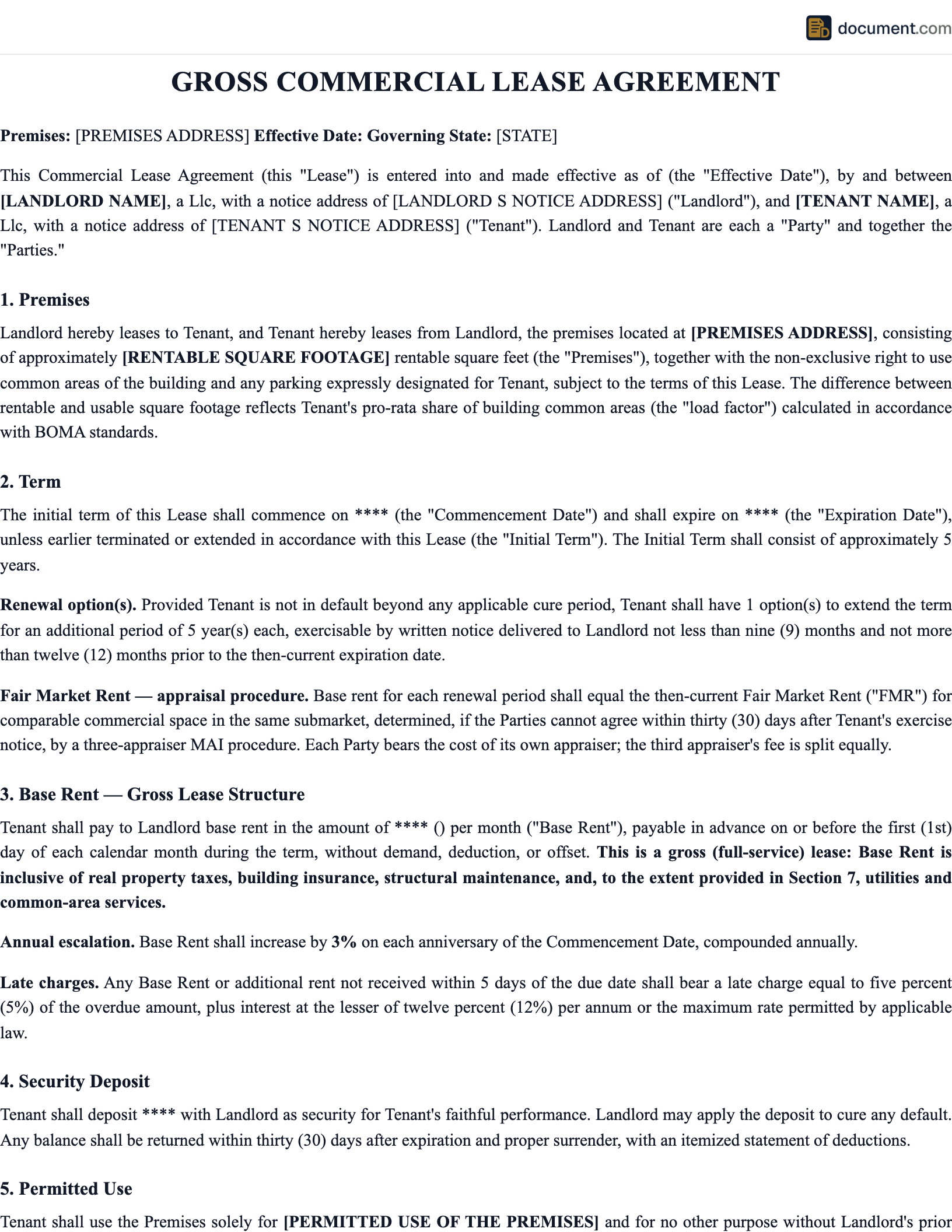
GROSS COMMERCIAL LEASE AGREEMENT
STATE OF COLORADO
Legal Document Template
LANDLORD
Name: [Full Legal Name]
Address: [Business Address]
Contact: [Phone/Email]
TENANT
Name: [Full Legal Name / Entity]
Address: [Current Address]
Tax ID: [EIN/SSN]
PREMISES
Address: [Property Address]
Suite: [Number]
Rentable SF: [Square Feet]
Usable SF: [Square Feet]
FINANCIAL TERMS
Base Rent: $[Amount]/month
Expense Stop: $[Amount]/SF
Security Deposit: $[Amount]
Escalation: [%]/year
Colorado Gross Commercial Lease Agreement FAQ
Answers to common questions about filing a gross commercial lease agreement in Colorado, including requirements, fees, and procedures.
Official Colorado Resources
Use these official state resources to verify requirements, find your local filing office, and access government forms for Colorado.
Related Colorado Documents
Depending on your situation, you may need additional documents alongside your Colorado gross commercial lease agreement.
Create your Colorado Commercial Gross Lease Agreement in under 5 minutes.
Answer a few questions and download a Colorado-compliant document, ready for the state agency.