



New Hampshire Gross Commercial Lease Agreement Overview
A New Hampshire gross commercial lease bundles operating expenses into the base rent, giving tenants a single monthly cost rather than separate charges for taxes, insurance, and maintenance. The landlord manages those costs from the rent received. This structure is common in New Hampshire office buildings in Portsmouth, Manchester, and Nashua, and in multi-tenant retail properties across the state. The all-in rent offers tenants budget predictability but typically carries a higher base rate than a comparable NNN lease because the landlord prices in a buffer for operating cost uncertainty, including New Hampshire's elevated municipal property taxes.
New Hampshire gross leases are governed by contract law. There is no state statute prescribing what must or cannot be included in a commercial gross lease structure. New Hampshire has no sales tax and no commercial rent tax, which simplifies the total cost picture for tenants. However, municipal property taxes are administered at the town and city level rather than by a state or county assessor, and New Hampshire towns set some of the highest property tax rates in the country. This means the property tax component embedded in a New Hampshire gross lease is typically substantial. Before accepting a gross lease rate, ask the landlord for the current municipal tax bill and operating expense history so you understand what is included in the all-in rent figure.
$26
Filing fee
Required
Notarization
0
Witnesses required
Register
Filing office
New Hampshire Gross Lease Requirements
New Hampshire gross leases are governed by the agreement itself rather than by a prescriptive commercial tenancy statute. The following requirements and best practices apply to New Hampshire gross commercial leases:
New Hampshire Property Tax and Expense Note
New Hampshire has no state sales tax and no commercial rent tax. However, municipal property taxes are a significant embedded cost in any New Hampshire gross lease base rent. New Hampshire property taxes are set by towns and cities rather than by a county or state authority, and rates vary considerably across municipalities. Before finalizing a gross lease rate, ask the landlord for the current annual municipal tax bill and two to three years of operating expense history. This data reveals whether the base rent accurately reflects current costs or whether the landlord has embedded a significant margin above actual expense levels.
Key Provisions
- Expense Inclusions: The lease should specify exactly which operating costs are bundled into the base rent; ambiguous expense inclusions create disputes about additional charges
- Expense Stop: Negotiate and document the expense stop threshold, base year, and method for calculating tenant cost-sharing above the stop; New Hampshire municipal property tax increases can drive meaningful supplemental charges in years of high assessment growth
- Capital Exclusion: Capital improvements including roof, HVAC, and structural repairs should be explicitly excluded from the operating expense pool; New Hampshire winter conditions create ongoing capital maintenance needs that should remain the landlord's responsibility
- Gross-Up Methodology: If the lease includes a gross-up clause, confirm the occupancy percentage used and whether it applies to variable or all operating costs
- Utility Responsibility: Clarify whether utilities are included in the gross rent or billed separately; New Hampshire heating costs can be significant and affect total occupancy cost materially
How to Execute a New Hampshire Gross Commercial Lease
Executing a New Hampshire gross commercial lease requires careful pre-signing review of the operating costs embedded in the base rent and the expense stop structure that governs supplemental charges.
Request the Landlord's Historical Operating Expense Data
Before finalizing the gross rent amount, ask the landlord for two to three years of actual operating expense statements. Request the current municipal tax bill separately to verify the property tax component. New Hampshire municipal assessments can change significantly in reassessment years.
Negotiate Expense Stop and Exclusions
Agree on the expense stop threshold, which expenses are excluded from the operating cost pool (capital improvements, management fees), how gross-up will be calculated, and whether winter maintenance costs such as snow removal and heating system maintenance are included or separate. New Hampshire winter costs can meaningfully affect CAM calculations.
Prepare a New Hampshire-Specific Gross Lease Form
Use a form that reflects the agreed expense structure and incorporates expense stop mechanics, exclusions, and utility responsibility provisions appropriate for the specific New Hampshire market. Have a New Hampshire commercial real estate attorney review the draft.
Execute the Agreement
Both parties sign. Confirm signatory authority for any entity party. New Hampshire commercial leases do not require notarization to be valid between the parties.
Retain Signed Copies for All Parties
Provide executed copies to the landlord and tenant. Store the signed agreement with the expense stop base-year statement, the current municipal tax bill, and the landlord's operating expense history for future reference during lease administration.
New Hampshire Gross Lease Costs
The following table outlines typical cost components for a New Hampshire gross commercial lease. The all-in base rent is the defining feature of the gross lease structure.
| Cost Item | Typical Range |
|---|---|
| Base Rent (All-In) | Market rate for the specific New Hampshire submarket; the gross rent embeds the landlord's municipal property taxes, insurance, and maintenance; verify current per-square-foot rates in Portsmouth, Manchester, Nashua, or the relevant NH submarket |
| Expense Stop Overage | Possible additional charge if operating costs exceed the base-year or dollar-amount expense stop; New Hampshire municipal tax increases can drive meaningful overages in years of significant assessment growth |
| Tenant-Excluded Utilities | If heating, electricity, or other utilities are billed separately rather than included in the gross rent, this is an additional monthly cost; New Hampshire heating costs can be significant in winter |
| Attorney Review (recommended) | $800 to $2,500; review of expense stop mechanics, capital exclusions, and gross-up provisions is particularly important given New Hampshire's high property tax environment |
| Commercial Rent Tax | None; New Hampshire does not impose a commercial rent tax on tenants |
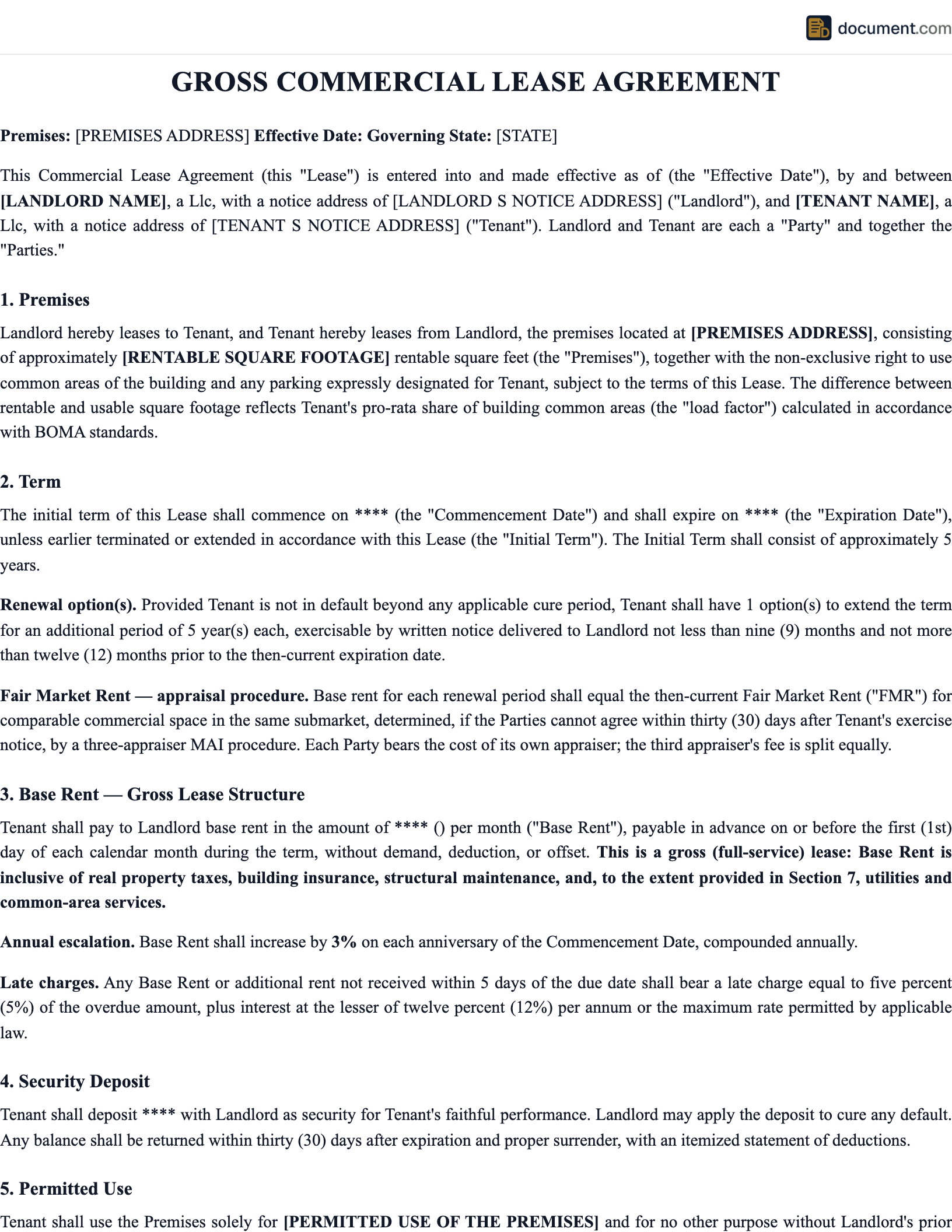
Sample New Hampshire Gross Commercial Lease Agreement
Below is a preview of our New Hampshire-specific template. Your customized document will include all fields and provisions required for filing in any New Hampshire county.
GROSS COMMERCIAL LEASE AGREEMENT
STATE OF NEW HAMPSHIRE
Legal Document Template
LANDLORD
Name: [Full Legal Name]
Address: [Business Address]
Contact: [Phone/Email]
TENANT
Name: [Full Legal Name / Entity]
Address: [Current Address]
Tax ID: [EIN/SSN]
PREMISES
Address: [Property Address]
Suite: [Number]
Rentable SF: [Square Feet]
Usable SF: [Square Feet]
FINANCIAL TERMS
Base Rent: $[Amount]/month
Expense Stop: $[Amount]/SF
Security Deposit: $[Amount]
Escalation: [%]/year
New Hampshire Gross Commercial Lease Agreement FAQ
Answers to common questions about filing a gross commercial lease agreement in New Hampshire, including requirements, fees, and procedures.
Official New Hampshire Resources
Use these official state resources to verify requirements, find your local filing office, and access government forms for New Hampshire.
Related New Hampshire Documents
Depending on your situation, you may need additional documents alongside your New Hampshire gross commercial lease agreement.
Create your New Hampshire Commercial Gross Lease Agreement in under 5 minutes.
Answer a few questions and download a New Hampshire-compliant document, ready for the state agency.