



Ohio Gross Commercial Lease Agreement Overview
A gross commercial lease is a structure where the tenant pays a flat rent and the landlord covers most or all of the building's operating expenses, including property taxes, insurance, and maintenance. Ohio's office markets, particularly downtown Columbus, Cleveland's central business district, and Cincinnati's Kenwood and downtown submarkets, commonly use gross or modified gross lease structures for multi-tenant professional office space. The predictability of a fixed rent payment appeals to small and mid-sized tenants who prefer to outsource building management complexity to the landlord.
Ohio commercial leases are governed by contract rather than statute. That means there is no default rule protecting tenants from expense pass-throughs or setting a minimum level of included services. Everything depends on what the lease says. The critical negotiating points in an Ohio gross lease are the expense stop or base year structure, the gross-up provision for partial-occupancy periods, which capital expenditures are excluded, and what happens when the tenant needs services outside of standard building hours.
Gross
Standard OH office format
Contract
Governs all terms
Base Year
Or expense stop
3 Cities
Columbus, Cleveland, Cincinnati
Ohio Gross Lease Requirements
Ohio gross leases have no statutory template. The parties negotiate every material term, including which expenses are included, how overages are calculated, and what tenant audit rights look like. The provisions below represent the most commercially significant issues to address before signing a gross lease for Ohio office or commercial space.
Expense Stop and Base Year Negotiation
The expense stop or base year mechanism is the most consequential provision in any Ohio gross lease. A low base year or a low expense stop shifts significant cost risk to the tenant as expenses grow over the lease term. Ohio tenants should request a gross-up of partial-year base period expenses and confirm that capital expenditures are excluded from the pass-through calculation.
Key Lease Provisions to Address
- Inclusions List: Define specifically what is included in the gross rent: property taxes, building insurance, common area maintenance, janitorial, utilities, and building management — and what is excluded
- Expense Stop or Base Year: Set the mechanism for limiting landlord expense exposure and document the gross-up methodology to prevent tenants from paying inflated pass-throughs during partial-occupancy base periods
- Capital Expenditure Exclusions: Confirm that major capital projects including roof, HVAC, and structural repairs are excluded from operating expense pass-throughs or, if amortized, limited to projects that reduce operating costs
- Audit Rights: Include the right to review supporting documentation for any expense overage charge, with a defined audit period, advance notice requirement, and a cost-shifting provision for material errors
- After-Hours Services: Specify the cost and procedures for HVAC, security access, and cleaning services outside standard building hours, which is especially relevant for Columbus and Cleveland professional services tenants with variable schedules
- Annual Escalation: State the base rent escalation rate and mechanism clearly, typically 2% to 3% per year or CPI-based with floor and ceiling, so the total occupancy cost trajectory is understood at signing
How to Negotiate an Ohio Gross Commercial Lease
Getting the economics right in an Ohio gross lease requires preparation before the landlord sends a first draft. Here is a practical sequence for tenants and landlords.
Request Multi-Year Operating Expense History
Ask the landlord for two to three years of actual operating expense data for the building, broken down by category. In Ohio, Franklin County and Cuyahoga County property tax records are publicly searchable, so tenants can verify tax pass-through amounts independently. This data is essential for evaluating whether the proposed base year or expense stop is reasonable given actual cost trends.
Confirm What the Gross Rent Includes and Excludes
Request a written list of all included and excluded services before the lease is drafted. Ohio office leases vary considerably: some include all utilities while others exclude electricity. Some include janitorial and parking while others charge separately. A precise inclusions list prevents disputes later and is the starting point for modeling your true occupancy cost.
Negotiate the Expense Stop, Gross-Up, and Capital Exclusions
Push for a gross-up of base year expenses to 95% occupancy so that the baseline reflects full building costs rather than the artificially low costs of a partially occupied building. Confirm that capital improvements, management fee percentages above market, and expenses benefiting only other tenants are excluded from any overage calculation. Also confirm that audit rights give you a real opportunity to verify charges.
Have an Ohio Commercial Real Estate Attorney Review the Draft
An Ohio attorney familiar with Columbus, Cleveland, or Cincinnati office markets should review the full lease. Focus on the expense overage calculation methodology, the after-hours service cost provisions, the default and cure language, and any personal guarantee requirement. Attorney review of an Ohio gross lease typically costs $500 to $2,000 depending on lease size and complexity.
Execute and Track Key Dates
Both parties sign. Set calendar reminders for the base year expense reconciliation deadline, any escalation notice dates, option exercise windows, and the lease expiration. Keep copies of all expense reconciliation statements, because audit rights typically apply for only a limited window after each statement is issued.
Ohio Gross Lease Costs
Cost ranges below reflect typical Ohio gross commercial lease transactions across the Columbus, Cleveland, and Cincinnati markets. Actual figures depend on building class, submarket, and lease terms.
| Fee / Cost | Amount |
|---|---|
| Gross Base Rent (Columbus Class A) | $24 - $38 per sq ft annually |
| Gross Base Rent (Cleveland / Cincinnati Class A) | $20 - $34 per sq ft annually |
| Gross Base Rent (Suburban / Class B) | $15 - $24 per sq ft annually |
| Operating Expense Overages | $2 - $5 per sq ft above expense stop (varies) |
| After-Hours HVAC | $25 - $75 per hour |
| Attorney Review | $500 - $2,000 |
Sample Ohio Gross Commercial Lease Agreement
Below is a preview of our Ohio-specific template. Your customized document will include all fields and provisions required for filing in any Ohio county.
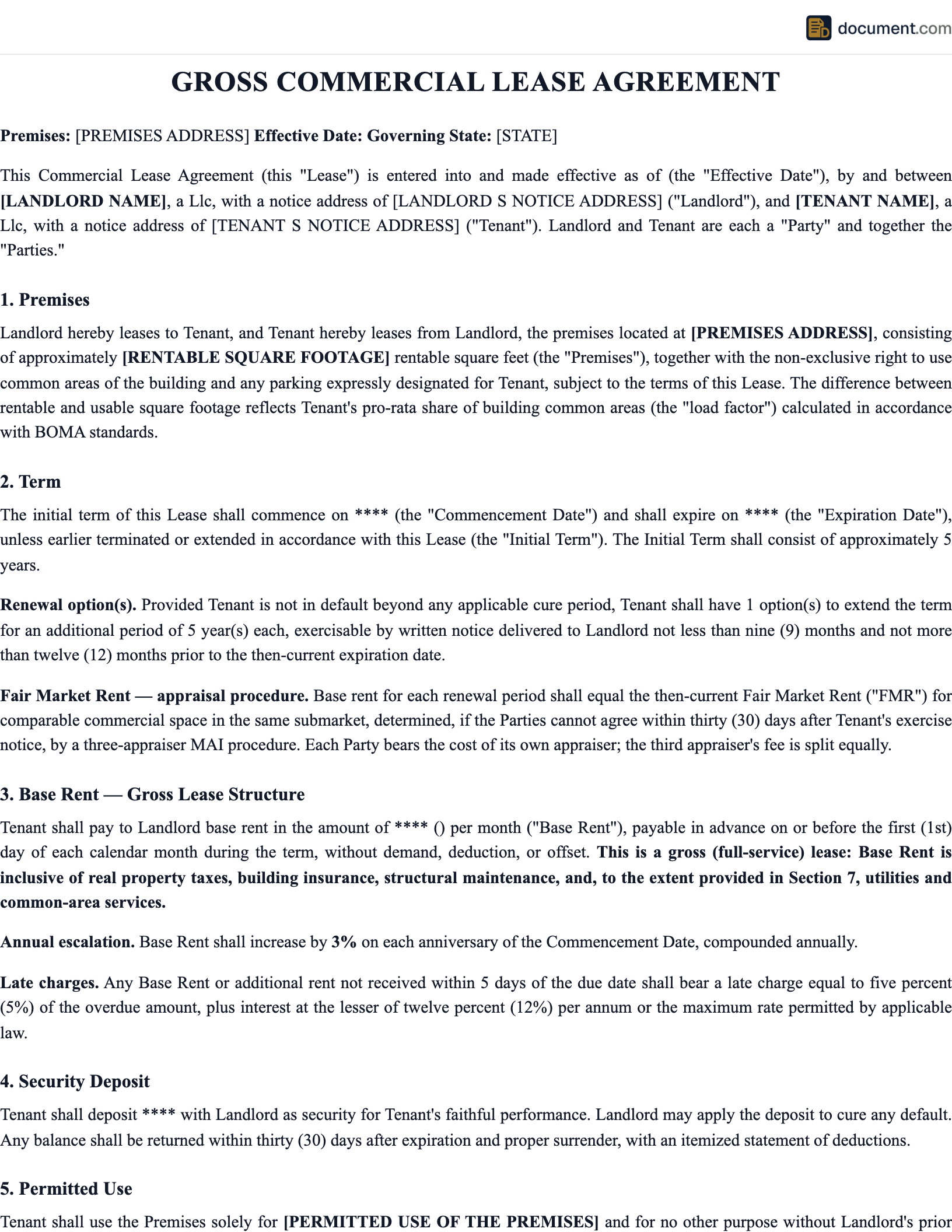
GROSS COMMERCIAL LEASE AGREEMENT
STATE OF OHIO
Legal Document Template
LANDLORD
Name: [Full Legal Name]
Address: [Business Address]
Contact: [Phone/Email]
TENANT
Name: [Full Legal Name / Entity]
Address: [Current Address]
Tax ID: [EIN/SSN]
PREMISES
Address: [Property Address]
Suite: [Number]
Rentable SF: [Square Feet]
Usable SF: [Square Feet]
FINANCIAL TERMS
Base Rent: $[Amount]/month
Expense Stop: $[Amount]/SF
Security Deposit: $[Amount]
Escalation: [%]/year
Ohio Gross Commercial Lease Agreement FAQ
Answers to common questions about filing an gross commercial lease agreement in Ohio, including requirements, fees, and procedures.
Official Ohio Resources
Use these official state resources to verify requirements, find your local filing office, and access government forms for Ohio.
Related Ohio Documents
Depending on your situation, you may need additional documents alongside your Ohio gross commercial lease agreement.
Create your Ohio Commercial Gross Lease Agreement in under 5 minutes.
Answer a few questions and download a Ohio-compliant document, ready for the state agency.