
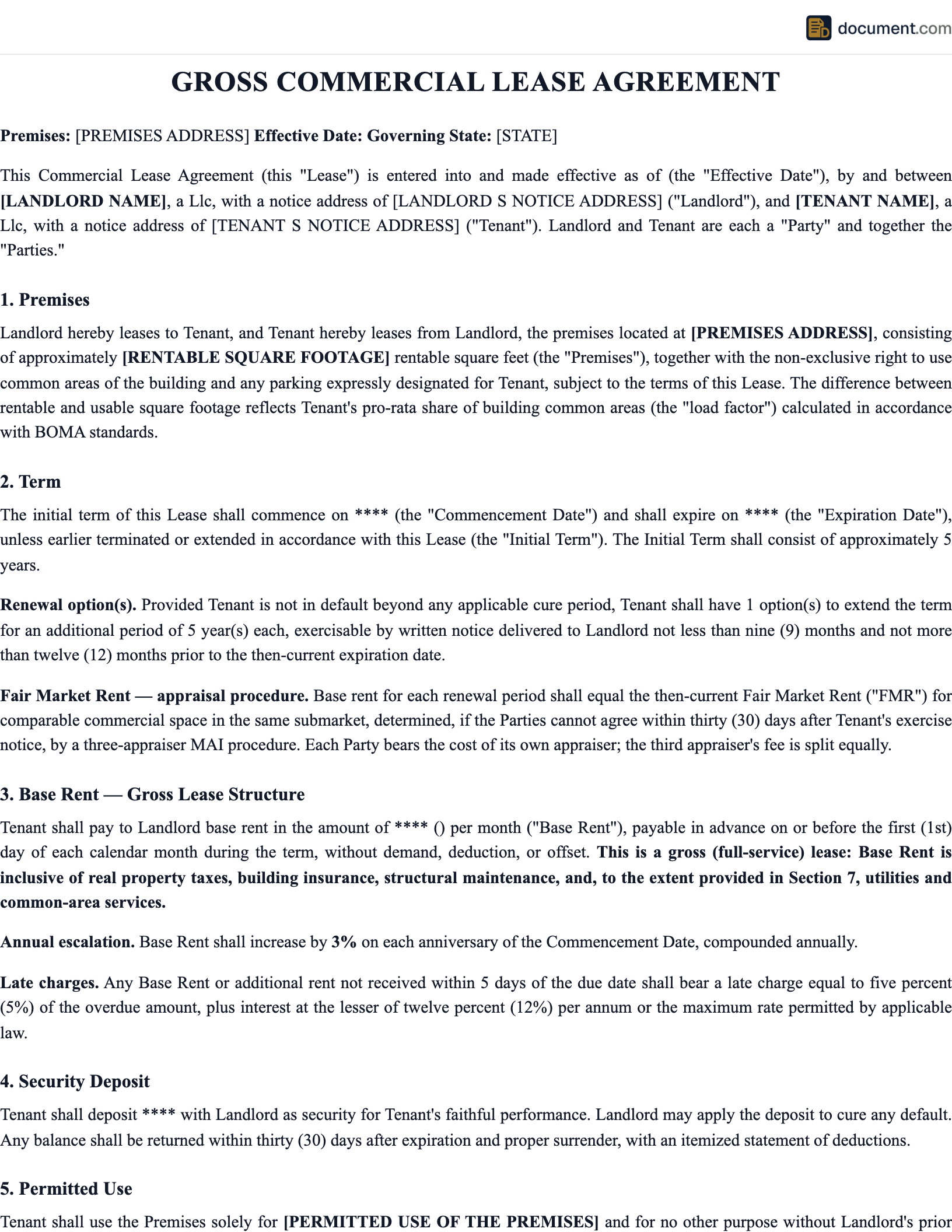



Massachusetts Gross Commercial Lease Agreement Overview
A Massachusetts gross commercial lease is an arrangement in which the tenant pays a single base rent and the landlord covers the building's operating expenses including property taxes, insurance, and maintenance. This structure is common for multi-tenant office buildings in Boston, Cambridge, and throughout suburban Massachusetts. The appeal for tenants is simplicity: one monthly payment rather than base rent plus itemized pass-throughs. The practical reality is more nuanced, since most Massachusetts gross leases include expense stops or base year mechanisms that shift cost increases above a certain baseline back to the tenant.
Massachusetts commercial gross leases are governed by contract law. The Boston and Cambridge office markets feature heavily negotiated lease forms, and the specific expense stop amount, base year selection, gross-up formula, and escalation rate all have significant financial implications over a multi-year lease term. Tenants considering a gross lease in Massachusetts should review the economics of the expense stop or base year carefully alongside the stated base rent, since the two together determine total occupancy cost.
$75
Filing fee
Required
Notarization
0
Witnesses required
Registry
Filing office
Massachusetts Gross Lease Requirements
The most important requirements for a Massachusetts gross commercial lease are not procedural but substantive: the lease must clearly define what is included in the gross rent, what expense stop or base year mechanism applies, and what happens as operating costs escalate over the lease term.
Massachusetts Gross Lease Note
Massachusetts commercial gross leases often include expense stops or base year pass-through mechanisms that can result in significant additional tenant costs over the lease term. Always request the building's actual current operating expense data and model projected costs before agreeing to an expense stop amount or base year.
Key Provisions to Address in a Massachusetts Gross Lease
- Expense Inclusions and Exclusions: Confirm what operating expenses are included in the gross rent and what items, if any, the tenant pays separately
- Expense Stop Amount: If an expense stop applies, ensure the stop amount reflects actual current costs so the tenant does not immediately face pass-through charges from day one
- Base Year Selection: If a base year mechanism applies, negotiate a base year that reflects normalized operating costs and confirm whether low-occupancy years will be grossed up
- Gross-Up Provisions: Understand how variable expenses are calculated if the building is not fully occupied, since gross-up provisions can result in pass-throughs that exceed actual current costs
- Audit Rights: Negotiate the right to audit expense documentation when an expense stop or base year mechanism creates potential pass-through obligations
- Escalation Rate: Understand whether annual rent escalations apply to base rent only or also to expense pass-throughs, and model the total cost impact over the full lease term
How to Draft and Execute a Massachusetts Gross Lease
A Massachusetts gross commercial lease is executed as a private contract between landlord and tenant. Here is how to approach the process effectively.
Request Current Building Operating Expense Data
Before negotiating the gross rent amount, request the building's current operating expense history. Understand the actual cost level relative to the proposed expense stop or base year to know how much cost risk you are taking on beyond the quoted rent.
Negotiate Expense Stop, Base Year, and Gross-Up Terms
These three provisions collectively determine how much of the building's operating cost increases fall on the tenant. Work to set the expense stop at or above current actual costs, select a base year that reflects normal occupancy and expense levels, and understand the gross-up formula used for partial occupancy periods.
Negotiate Included Services and Utilities
Confirm whether the gross rent includes utilities, janitorial, parking, and any building amenities or whether those items are the tenant's separate responsibility. In Boston and Cambridge office buildings, these distinctions affect total occupancy cost significantly.
Have a Massachusetts Commercial Attorney Review the Lease
Massachusetts gross leases can be complex documents. A Massachusetts commercial real estate attorney can identify unusual expense stop structures, unfavorable base year provisions, and escalation language that could substantially increase total lease costs beyond the stated base rent.
Execute the Lease and Retain Copies
Both parties sign the fully negotiated lease with all exhibits. Keep executed copies securely and calendar key dates including rent escalation dates and any notice requirement windows for the audit rights or expense challenge provisions in the lease.
Massachusetts Gross Lease Costs
The primary cost of a Massachusetts gross commercial lease is the base rent itself, but expense stop pass-throughs and base year escalations can add meaningful additional costs over time. Below are typical transaction costs.
| Cost Item | Typical Amount |
|---|---|
| Massachusetts Commercial Attorney (Lease Review) | $300 - $600 per hour; lease review for a mid-market office deal typically runs $1,500 - $4,000+ |
| Gross Base Rent (Boston/Cambridge) | Among the highest in the country; $50 - $120+ per square foot annually depending on class and submarket |
| Expense Stop Pass-Through Risk | Varies; in rising-cost markets, pass-throughs can add $5 - $15+ per square foot annually above the stop |
| Annual Base Rent Escalation | Typically 2 - 3 percent per year; compounding over a 5 or 10 year term increases total cost substantially |
Sample Massachusetts Gross Commercial Lease Agreement
Below is a preview of our Massachusetts-specific template. Your customized document will include all fields and provisions required for filing in any Massachusetts county.
GROSS COMMERCIAL LEASE AGREEMENT
STATE OF MASSACHUSETTS
Legal Document Template
LANDLORD
Name: [Full Legal Name]
Address: [Business Address]
Contact: [Phone/Email]
TENANT
Name: [Full Legal Name / Entity]
Address: [Current Address]
Tax ID: [EIN/SSN]
PREMISES
Address: [Property Address]
Suite: [Number]
Rentable SF: [Square Feet]
Usable SF: [Square Feet]
FINANCIAL TERMS
Base Rent: $[Amount]/month
Expense Stop: $[Amount]/SF
Security Deposit: $[Amount]
Escalation: [%]/year
Massachusetts Gross Commercial Lease Agreement FAQ
Answers to common questions about filing a gross commercial lease agreement in Massachusetts, including requirements, fees, and procedures.
Official Massachusetts Resources
Use these official state resources to verify requirements, find your local filing office, and access government forms for Massachusetts.
Related Massachusetts Documents
Depending on your situation, you may need additional documents alongside your Massachusetts gross commercial lease agreement.
Create your Massachusetts Commercial Gross Lease Agreement in under 5 minutes.
Answer a few questions and download a Massachusetts-compliant document, ready for the state agency.