
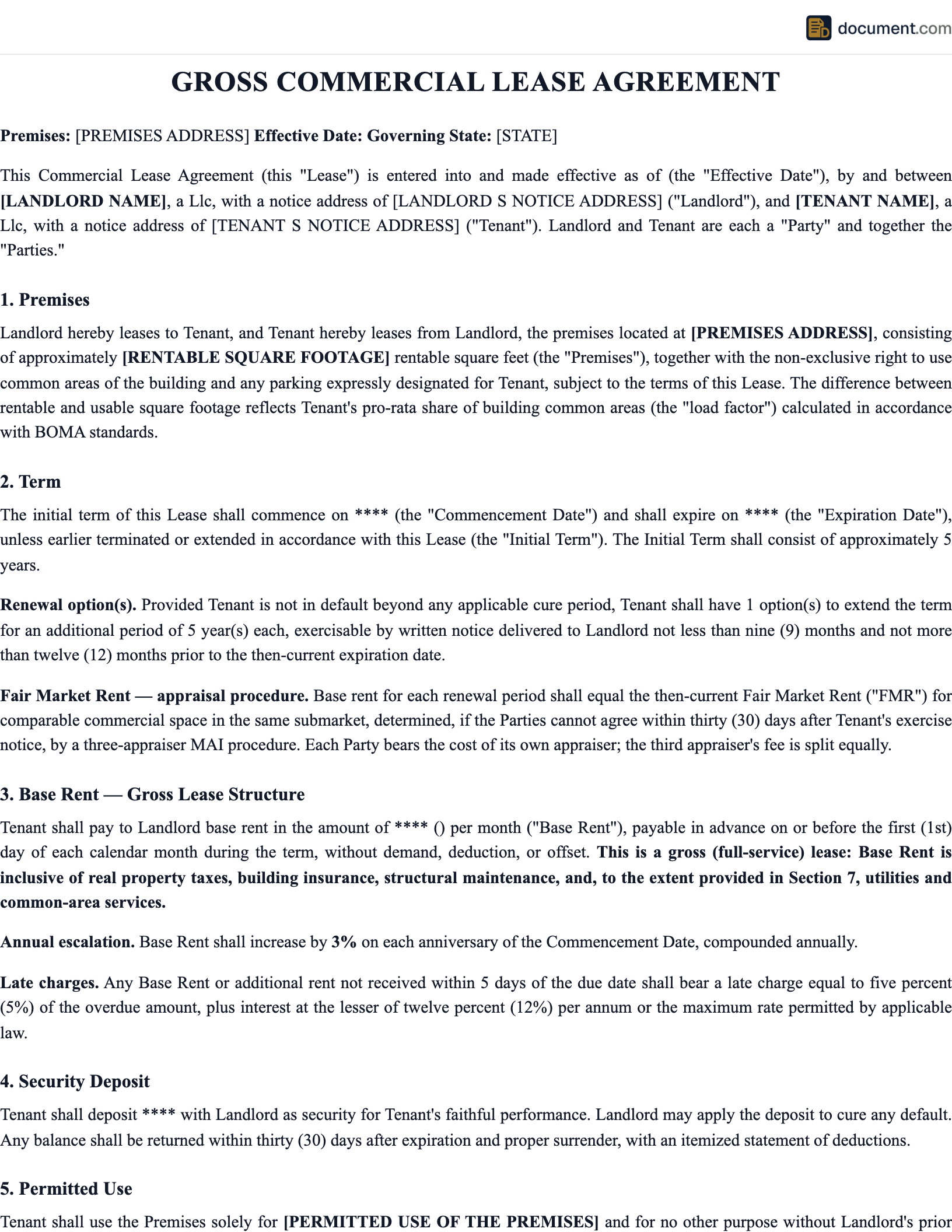



Montana Gross Commercial Lease Agreement Overview
A gross commercial lease simplifies the tenant's cost structure by having the landlord absorb operating expenses within the base rent. In Montana, this lease structure is common for office and some retail properties in Billings, Missoula, and Bozeman, where tenants want predictable monthly costs without the variability that comes with NNN pass-throughs. Montana has no statute that mandates a specific commercial lease form, so the terms are entirely negotiated.
Because Montana winters bring significant maintenance costs, landlords pricing a gross lease in this state build in a buffer for snow removal, HVAC servicing, and potential weather-related repairs. Tenants benefit from that bundled predictability but should understand the tradeoff: if the landlord's actual costs come in well below their estimates, the tenant still pays the full base rent. Expense stop provisions can shift that risk back when costs spike unexpectedly.
$12
Filing fee
Required
Notarization
0
Witnesses required
County
Filing office
Montana Gross Lease Requirements
Montana does not impose a specific statutory form for commercial gross leases. The key requirements come from careful lease drafting. The provisions below are the ones most frequently disputed or misunderstood in Montana gross lease negotiations.
Montana-Specific Note
Montana has no sales tax, so gross lease forms that reference sales tax on rent are not applicable here. Montana county property taxes vary by assessor jurisdiction and can affect the landlord's break-even on a gross lease, which may influence their willingness to negotiate the expense stop level. Request the building's historical operating expense data before finalizing base rent.
Key Provisions to Address in a Montana Gross Lease
- Expense Inclusions: Define precisely what operating costs the base rent covers, including taxes, insurance, maintenance, utilities, janitorial, and management fees
- Expense Stop: Establish the threshold above which tenants share in cost increases, and ensure it is set at a realistic current-year expense level
- Capital Exclusion: Exclude landlord capital improvements and building renovation costs from any tenant expense share obligation
- Gross-Up Methodology: If the lease allows gross-up for vacancy, specify the occupancy percentage used and whether it applies to all expense categories or only variable costs
- Snow and Weather Maintenance: Clarify whether winter maintenance costs like snow removal and ice dam repair are included in base rent or subject to the expense stop
How to Execute a Montana Gross Commercial Lease
Montana gross leases are private contracts between landlord and tenant. They do not need to be filed with a government office to be enforceable between the parties. The steps below focus on getting the financial structure right before signing.
Gather Historical Operating Data
Request two to three years of actual operating expenses for the building so you can evaluate whether the landlord's base rent adequately covers real costs or is likely to trigger expense stop overages
Negotiate Expense Stop and Exclusions
Set the expense stop at a defensible current-year level, negotiate capital improvement exclusions, and specify how Montana-specific costs like snow removal are treated
Draft the Lease with Montana-Specific Language
Use a form that addresses Montana's no-sales-tax environment, the county property tax pass-through if any, and the applicable gross-up methodology for multi-tenant properties
Execute the Lease
Both parties sign the final lease document. Notarization is not required for enforceability between the parties, though it is required if you plan to record the lease with the Montana county clerk and recorder
Retain Copies and Track Expense Notices
Keep a fully executed copy and calendar any expense stop adjustment notices the landlord is required to provide. Review actual operating expenses annually against the lease's inclusion and exclusion definitions
Montana Gross Lease Costs
Gross leases consolidate most costs into the base rent, but tenants should understand what is and is not covered. The table below outlines typical cost categories.
| Cost Item | Typical Treatment |
|---|---|
| Base Rent (all-in) | Includes landlord's estimate of taxes, insurance, and maintenance; verify what is bundled |
| Expense Stop Overage | Tenant's pro-rata share of operating costs above the agreed expense stop; can be significant in high-expense years |
| Tenant Utilities (if excluded) | Modified gross leases often exclude tenant utilities; confirm whether electric, gas, and internet are covered |
| Attorney Review (recommended) | $500 to $2,000 for a Montana commercial lease review; important for multi-year deals |
| Commercial Rent Tax | None in Montana; no state sales tax applies to commercial rent |
Sample Montana Gross Commercial Lease Agreement
Below is a preview of our Montana-specific template. Your customized document will include all fields and provisions required for filing in any Montana county.
GROSS COMMERCIAL LEASE AGREEMENT
STATE OF MONTANA
Legal Document Template
LANDLORD
Name: [Full Legal Name]
Address: [Business Address]
Contact: [Phone/Email]
TENANT
Name: [Full Legal Name / Entity]
Address: [Current Address]
Tax ID: [EIN/SSN]
PREMISES
Address: [Property Address]
Suite: [Number]
Rentable SF: [Square Feet]
Usable SF: [Square Feet]
FINANCIAL TERMS
Base Rent: $[Amount]/month
Expense Stop: $[Amount]/SF
Security Deposit: $[Amount]
Escalation: [%]/year
Montana Gross Commercial Lease Agreement FAQ
Answers to common questions about filing a gross commercial lease agreement in Montana, including requirements, fees, and procedures.
Official Montana Resources
Use these official state resources to verify requirements, find your local filing office, and access government forms for Montana.
Related Montana Documents
Depending on your situation, you may need additional documents alongside your Montana gross commercial lease agreement.
Create your Montana Commercial Gross Lease Agreement in under 5 minutes.
Answer a few questions and download a Montana-compliant document, ready for the state agency.