
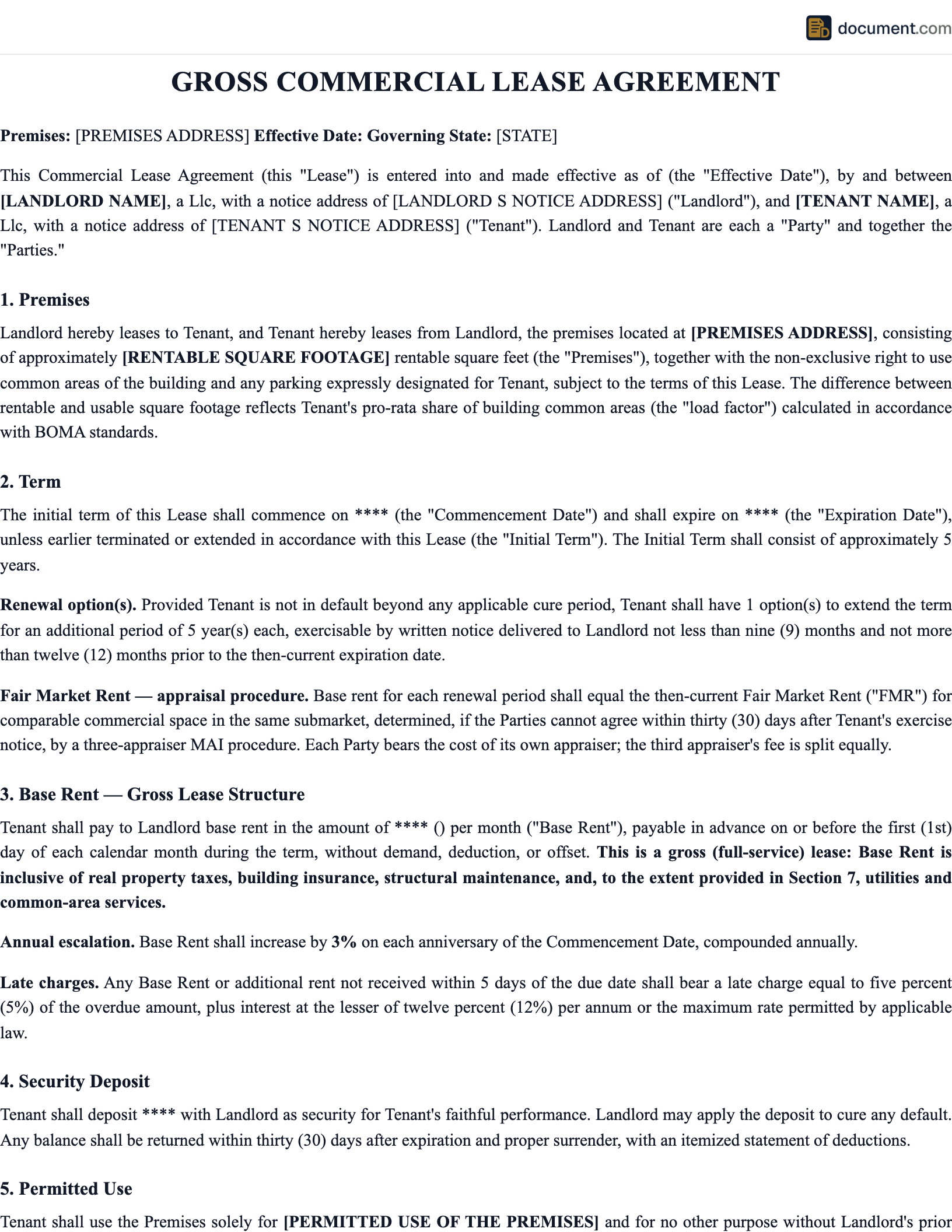



Oklahoma Gross Commercial Lease Agreement Overview
A gross commercial lease in Oklahoma puts the landlord in the position of managing and absorbing most property operating expenses, with the tenant paying a single flat rent. Oklahoma commercial leases are governed entirely by contract law, so the definition of what is and is not included in the gross rent determines the practical value of the lease structure for both sides.
Gross leases are most common in Oklahoma City and Tulsa office markets, where multi-tenant buildings and institutional landlords use full-service or modified gross structures to simplify the tenant rent obligation. Oklahoma's energy industry creates demand cycles in office leasing that affect both base rent levels and landlords' willingness to absorb expense risk. Tenants should pay close attention to expense stop and base year provisions, which can erode the cost certainty that makes a gross lease attractive.
$8
Filing fee
Required
Notarization
0
Witnesses required
County
Filing office
Oklahoma Requirements
Oklahoma gross leases are governed by contract law, not by commercial tenant protection statutes. The parties negotiate and define expense inclusions and exclusions, and those definitions control the relationship. The key provisions that matter most in an Oklahoma gross lease are the expense definition, any expense stop or base year provision, and the list of exclusions from the gross rent obligation.
Oklahoma Specific Note
Oklahoma has no statewide commercial rent tax, which is favorable for gross lease tenants. Property taxes vary by county and are assessed by individual county assessors across Oklahoma's 77 counties. In Oklahoma City and Tulsa, office gross lease landlords often use expense stop provisions to limit their exposure to property tax increases over multi-year lease terms. Tenants should negotiate base year definitions and expense cap provisions carefully.
Key Gross Lease Provisions for Oklahoma
- Expense Inclusions: Define precisely which operating costs are included in base rent, covering taxes, insurance, maintenance, utilities, and management fees
- Expense Stop: If present, define the threshold above which tenants share in operating cost increases, including how the stop is calculated and when it resets
- Base Year: Specify which year's operating costs establish the baseline for expense stop calculations; negotiate a gross-up provision for partial-occupancy years
- Exclusions List: Identify what is explicitly excluded from the gross rent obligation, such as capital improvements, management fees above a capped percentage, and tenant-caused expenses
- Landlord Repair Obligations: Define the landlord's maintenance responsibilities including roof, structure, HVAC, and common areas
How to File in Oklahoma
An Oklahoma gross commercial lease is a private contract that takes effect upon execution by both parties. The steps below describe the standard process for drafting, negotiating, executing, and optionally recording the lease.
Draft the Expense Inclusion and Exclusion Sections
Identify every operating expense category and specify clearly whether each is included in base rent, excluded, or subject to an expense stop; ambiguity in this section creates disputes throughout the lease term
Negotiate Base Year and Expense Stop Terms
If the lease includes an expense stop, agree on the base year and gross-up methodology; ensure the base year reflects typical occupancy and not an artificially low-cost period
Review Landlord Repair and Maintenance Obligations
Confirm the landlord's responsibility for roof, structure, HVAC, common areas, and parking; in Oklahoma, severe weather including hail and tornados makes structural and roof repair clauses especially important
Execute the Lease
Both parties sign the final agreed lease; leases exceeding one year must be in writing under Oklahoma's statute of frauds to be enforceable
Record with County Clerk if Appropriate
Long-term leases may be recorded with the county clerk to give constructive notice to third parties; if recording, notarize signatures and pay the applicable county recording fee
Oklahoma Fees & Costs
Typical costs associated with an Oklahoma gross commercial lease, including any recording costs if the parties elect to record the lease for constructive notice.
| Fee / Cost | Amount |
|---|---|
| County Clerk Recording Fee (if recorded) | $18 first page, $2 per additional page |
| Monthly Base Rent (gross) | Negotiated; includes most operating expenses |
| Annual Expense Stop Overage (if applicable) | Tenant's pro-rata share of costs above the stop threshold |
| Tenant Utilities (if excluded from gross) | Varies; confirm which utilities are tenant responsibility |
| Attorney Review (recommended) | $300 - $750 for lease review by a commercial real estate attorney |
Sample Oklahoma Gross Commercial Lease Agreement
Below is a preview of our Oklahoma-specific template. Your customized document will include all fields and provisions required for filing in any Oklahoma county.
GROSS COMMERCIAL LEASE AGREEMENT
STATE OF OKLAHOMA
Legal Document Template
LANDLORD
Name: [Full Legal Name]
Address: [Business Address]
Contact: [Phone/Email]
TENANT
Name: [Full Legal Name / Entity]
Address: [Current Address]
Tax ID: [EIN/SSN]
PREMISES
Address: [Property Address]
Suite: [Number]
Rentable SF: [Square Feet]
Usable SF: [Square Feet]
FINANCIAL TERMS
Base Rent: $[Amount]/month
Expense Stop: $[Amount]/SF
Security Deposit: $[Amount]
Escalation: [%]/year
Oklahoma Gross Commercial Lease Agreement FAQ
Answers to common questions about filing an gross commercial lease agreement in Oklahoma, including requirements, fees, and procedures.
Official Oklahoma Resources
Use these official state resources to verify requirements, find your local filing office, and access government forms for Oklahoma.
Related Oklahoma Documents
Depending on your situation, you may need additional documents alongside your Oklahoma gross commercial lease agreement.
Create your Oklahoma Commercial Gross Lease Agreement in under 5 minutes.
Answer a few questions and download a Oklahoma-compliant document, ready for the state agency.