



Texas Gross Commercial Lease Agreement Overview
A gross commercial lease is the standard lease structure for office and professional space in Texas. The tenant pays one all-in monthly rent that covers the landlord's property taxes, insurance, and operating costs for the building. Texas office markets in Dallas, Houston, Austin, and San Antonio primarily use gross or modified gross lease structures for professional office space, while industrial and retail properties more commonly use NNN or percentage structures.
The economics of a Texas gross lease hinge on how operating expenses are handled above the baseline level. Because Texas has no state income tax, local governments rely heavily on property taxes, and commercial assessments have increased substantially across all four major Texas metros. A full gross lease gives the tenant expense certainty, but landlords price that certainty into the rent. A gross lease with an expense stop or base year pass-through gives the tenant a lower initial rate but exposes them to property tax and operating cost increases above the stop. Understanding which structure a given lease uses, and what it means in dollar terms, is essential before signing any Texas gross lease.
None
State rent tax
Contract
Law governs
High
Property tax state
4 Major
Office markets
Texas Requirements
Texas gross leases are governed entirely by contract. There is no Texas statute that defines what a gross lease must include or how expenses must be allocated. The lease document itself controls all obligations, and poorly drafted expense provisions are the most common source of Texas commercial lease disputes. The following elements should be addressed clearly in any Texas gross lease.
Texas Property Tax Exposure in Gross Leases
Texas property taxes are assessed annually by county appraisal districts and levied by multiple taxing entities. Because these taxes are unusually high relative to most states, any gross lease that passes through expense increases above a base year or stop amount can expose the tenant to significant annual increases. Ask the landlord for three years of actual property tax bills before agreeing to any base year or stop amount in a Texas office gross lease.
Key Lease Provisions
- Expense Inclusions: Define exactly what the all-in rent covers; confirm that property taxes for all Texas taxing entities, building insurance, CAM, and utilities are included; list any exclusions explicitly
- Expense Stop or Base Year: If the lease includes pass-throughs above a stop or base year, define the stop amount precisely; for a base year lease, confirm what year is used and whether it has been or will be fully occupied and fully taxed
- Gross-Up Provision: Include a gross-up to 90 or 95 percent occupancy for variable operating expenses so that the tenant is not charged more than their proportionate fair share when the building has vacancy
- Annual Reconciliation: Require the landlord to deliver an annual expense reconciliation within a defined period after year end, showing actual expenses compared to the stop or base year
- Audit Rights: Include tenant audit rights exercisable within a defined window after delivery of the reconciliation statement; include cost-shifting if the audit reveals a material overcharge
- Capital vs Operating Distinction: Exclude capital improvements from the expense pass-through or, if included, amortize them over the useful life of the improvement rather than expensing them in the year incurred
How to File in Texas
Negotiating a Texas gross commercial lease requires understanding the full expense picture before accepting any base year or stop amount. The following steps guide the process from initial review to execution.
Review Actual Expense History
Request two to three years of actual property tax bills, insurance statements, and operating expense reconciliations for the Texas property before agreeing to any base year stop. Texas property taxes have increased sharply in Dallas, Austin, and Houston, and the stop amount set in year one will define the tenant's exposure for the full lease term. Do not rely on the landlord's projections alone.
Negotiate the Expense Stop and Gross-Up
If the lease uses an expense stop or base year, confirm the stop amount, what it covers, and how it is calculated. Negotiate a gross-up provision requiring expenses to be calculated as if the building were 90 to 95 percent occupied. For Texas office buildings with significant vacancy, this provision can meaningfully reduce pass-through costs during the early lease years.
Confirm Capital Expense Treatment and Audit Rights
Exclude capital improvements from operating expenses or require that they be amortized over their useful life rather than expensed in the year incurred. Negotiate annual audit rights exercisable within 90 to 180 days after the landlord delivers the annual expense reconciliation. Include a provision requiring the landlord to credit any overcharge against future rent and cover the audit cost if the discrepancy exceeds a threshold.
Execute the Lease
Both parties sign the finalized lease. Texas commercial leases do not require notarization between the parties, but notarization is needed if the lease is recorded. Distribute originals to landlord and tenant. Provide copies to any lender with a security interest in the property. If the lease is based on a Texas Association of Realtors form, have a Texas commercial attorney review the TAR provisions before executing, as the standard form is landlord-favorable.
Set Up Reconciliation Calendar
Mark the dates for monthly rent payments and the expected annual reconciliation delivery. In Texas, property tax assessment notices typically arrive in April or May, and landlords often pass through increases in the year-end reconciliation. Review the reconciliation against the actual tax bills when it arrives and exercise audit rights within the defined window if the numbers do not align with the historical records you collected before signing.
Texas Fees & Costs
A Texas gross lease has a simple payment structure: one all-in rent payment. The table below identifies the actual cost components that flow through the all-in rate and the transaction costs at signing.
| Fee / Cost | Amount |
|---|---|
| All-In Base Rent | Fixed monthly rate covering landlord's property taxes, insurance, and operating costs; Texas office markets price a risk premium into the gross rate to account for the state's high property taxes |
| Expense Pass-Throughs Above Stop | Applicable only if lease uses base year or expense stop structure; tenant pays their pro rata share of actual expenses above the stop, billed annually through reconciliation |
| State Income or Rent Tax | None; Texas has no state income tax and no commercial rent tax |
| Notarization (if recorded) | $5 to $25 per signature; required if lease or memorandum of lease is recorded with the county clerk |
| Attorney Review | $500 to $1,500 for lease review; recommended for Texas office leases exceeding 3 years or 5,000 square feet given TAR form's landlord-favorable defaults |
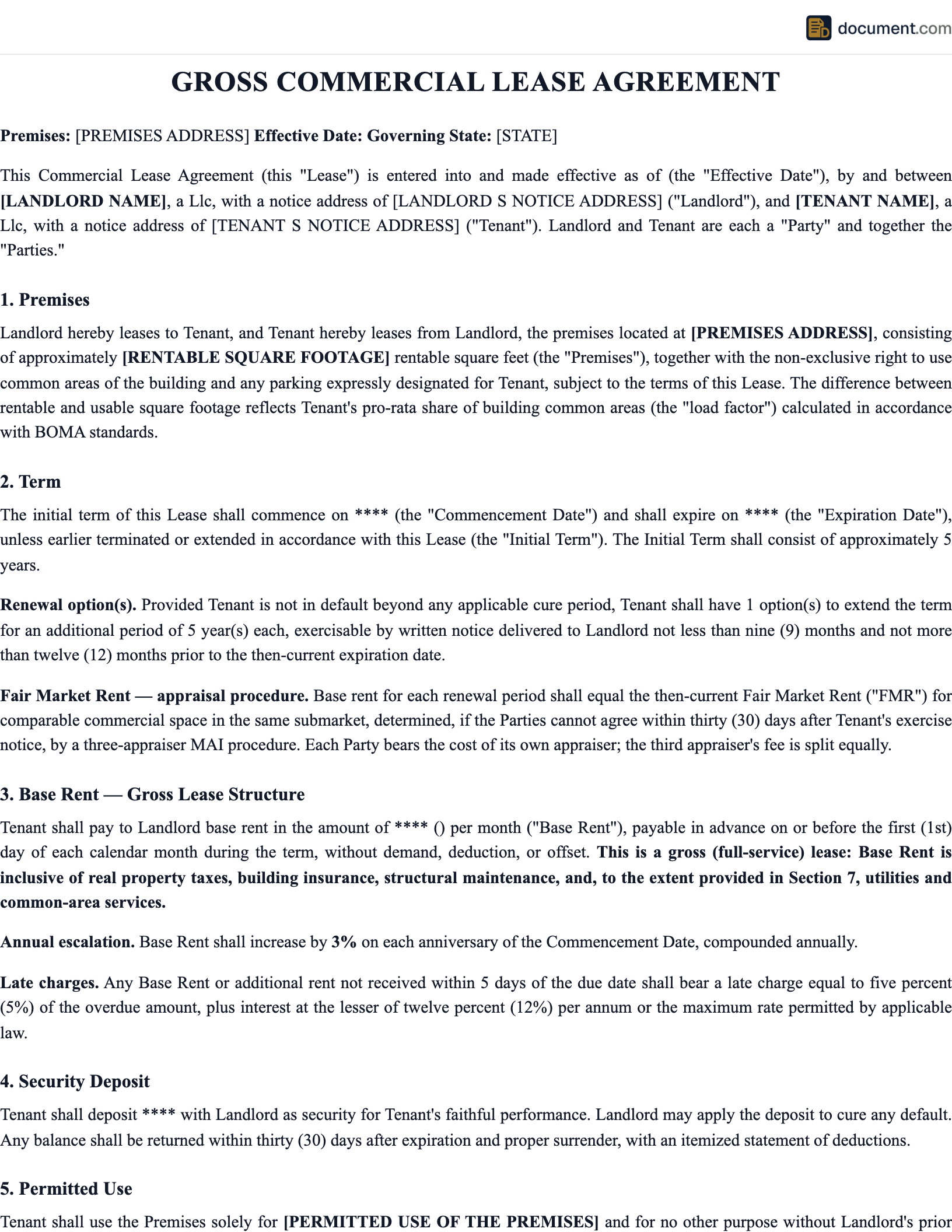
Sample Texas Gross Commercial Lease Agreement
Below is a preview of our Texas-specific template. Your customized document will include all fields and provisions required for filing in any Texas county.
GROSS COMMERCIAL LEASE AGREEMENT
STATE OF TEXAS
Legal Document Template
LANDLORD
Name: [Full Legal Name]
Address: [Business Address]
Contact: [Phone/Email]
TENANT
Name: [Full Legal Name / Entity]
Address: [Current Address]
Tax ID: [EIN/SSN]
PREMISES
Address: [Property Address]
Suite: [Number]
Rentable SF: [Square Feet]
Usable SF: [Square Feet]
FINANCIAL TERMS
Base Rent: $[Amount]/month
Expense Stop: $[Amount]/SF
Security Deposit: $[Amount]
Escalation: [%]/year
Texas Gross Commercial Lease Agreement FAQ
Answers to common questions about filing a gross commercial lease agreement in Texas, including requirements, fees, and procedures.
Official Texas Resources
Use these official state resources to verify requirements, find your local filing office, and access government forms for Texas.
Related Texas Documents
Depending on your situation, you may need additional documents alongside your Texas gross commercial lease agreement.
Create your Texas Commercial Gross Lease Agreement in under 5 minutes.
Answer a few questions and download a Texas-compliant document, ready for the state agency.