



South Dakota Gross Commercial Lease Agreement Overview
A gross commercial lease in South Dakota puts the landlord in charge of property operating expenses, which the landlord covers out of the base rent the tenant pays. For tenants, the appeal is simplicity: one monthly payment covers the space, and you are not getting a separate bill every October when the county property tax statement arrives. For landlords, a gross lease requires careful rent-setting to make sure the base rent actually covers the operating cost exposure.
South Dakota's gross lease market is concentrated in office and professional space in Sioux Falls and Rapid City, where the state's business-friendly environment and lack of state income tax attract a steady pipeline of tenants. Operating expenses in those markets have increased alongside commercial growth, making expense stop provisions and base year selection important negotiating points. South Dakota has no commercial rent tax, so there is no additional tax layer on top of the lease economics.
$30
Filing fee
Required
Notarization
0
Witnesses required
Register
Filing office
South Dakota Requirements
South Dakota commercial leases are contracts, and the parties have broad latitude to structure the expense allocation as they see fit. The key is being explicit. A lease that says the landlord covers operating expenses but does not define which expenses are included leaves room for disputes over insurance premiums, management fees, and capital repairs.
South Dakota Specific Note
South Dakota has no state income tax and no commercial rent tax, which simplifies the tax picture for gross lease economics. Property taxes assessed by county directors of equalization are the main operating expense variable. If the lease base year is set in a low-tax year, the tenant's pass-through exposure in later years can be higher than expected.
Key Gross Lease Provisions for South Dakota
- Expense Inclusions List: Identify each category of operating expense the landlord covers, including property tax, insurance, and CAM
- Expense Stop: Set the threshold above which operating cost increases are passed through to the tenant on a pro-rata basis
- Base Year Selection: Define the base year clearly, as it determines the tenant's pass-through exposure in all subsequent years
- Gross-Up Provision: Address how operating expenses are calculated if the building is partially vacant to prevent distorted allocations
- Audit Rights: Tenant right to review operating expense records within 60 to 90 days of receiving the annual reconciliation statement
How to Negotiate a South Dakota Gross Lease
Negotiating a gross commercial lease in South Dakota is about understanding the expense structure before you commit to a rent figure. Here is the practical sequence.
Get the Landlord's Expense History
Request two years of actual operating expense statements, including property tax bills, insurance invoices, and maintenance records. This tells you whether the landlord's gross rent figure reasonably covers their real costs or leaves them underwater.
Negotiate Inclusions and the Expense Stop
Define exactly which costs the landlord covers in the base rent. Negotiate the expense stop level and the base year carefully. In South Dakota, property taxes are relatively stable but rising assessments in Sioux Falls and Rapid City can erode a tenant's expected cost certainty over a long lease term.
Address the Gross-Up and Audit Rights
Confirm how operating expenses are calculated during periods of partial vacancy, and negotiate your right to audit the landlord's expense records if expenses are ever passed through above the stop.
Execute the Lease
Both parties sign the final lease. South Dakota does not require notarization for the lease to be enforceable between the parties, though some lenders require notarization for leases that will be recorded against the property.
Distribute Copies
Each party keeps a fully executed original. Set a calendar reminder for the annual expense reconciliation period so you can review any pass-throughs above the stop and exercise audit rights within the window specified in the lease.
South Dakota Gross Lease Costs
Typical cost items for a South Dakota gross commercial lease. Actual amounts vary by property, market, and transaction complexity.
| Fee / Cost | Amount |
|---|---|
| Base Rent (all-in) | Negotiated; covers landlord's operating expenses |
| Expense Pass-Throughs Above Stop | Pro-rata share of costs exceeding the expense stop |
| State Commercial Rent Tax | None (South Dakota does not tax commercial rent) |
| Notarization (if recording required) | $5 - $25 per signature |
| Attorney Review (recommended) | $250 - $750 for commercial lease review |
Sample South Dakota Gross Commercial Lease Agreement
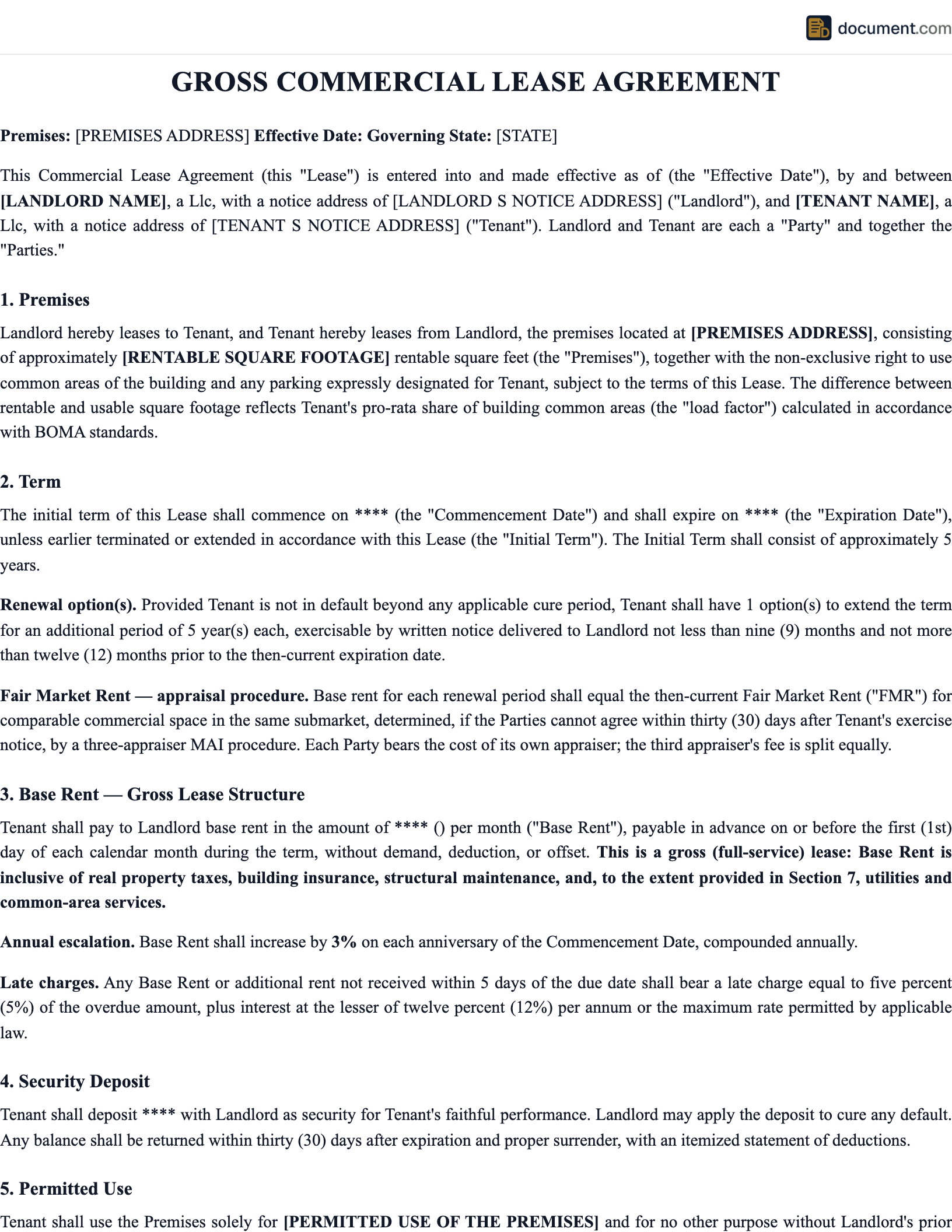
Below is a preview of our South Dakota-specific template. Your customized document will include all fields and provisions required for filing in any South Dakota county.
GROSS COMMERCIAL LEASE AGREEMENT
STATE OF SOUTH DAKOTA
Legal Document Template
LANDLORD
Name: [Full Legal Name]
Address: [Business Address]
Contact: [Phone/Email]
TENANT
Name: [Full Legal Name / Entity]
Address: [Current Address]
Tax ID: [EIN/SSN]
PREMISES
Address: [Property Address]
Suite: [Number]
Rentable SF: [Square Feet]
Usable SF: [Square Feet]
FINANCIAL TERMS
Base Rent: $[Amount]/month
Expense Stop: $[Amount]/SF
Security Deposit: $[Amount]
Escalation: [%]/year
South Dakota Gross Commercial Lease Agreement FAQ
Answers to common questions about filing a gross commercial lease agreement in South Dakota, including requirements, fees, and procedures.
Official South Dakota Resources
Use these official state resources to verify requirements, find your local filing office, and access government forms for South Dakota.
Related South Dakota Documents
Depending on your situation, you may need additional documents alongside your South Dakota gross commercial lease agreement.
Create your South Dakota Commercial Gross Lease Agreement in under 5 minutes.
Answer a few questions and download a South Dakota-compliant document, ready for the state agency.