



Florida Gross Commercial Lease Overview
A Florida gross commercial lease bundles property taxes, building insurance, and operating expenses into a single all-inclusive base rent. The landlord absorbs operating costs within the expense stop and the tenant's monthly obligation remains fixed unless actual expenses exceed the stop amount. Gross leases are the standard structure in Florida's multi-tenant office market, appearing throughout Miami-Dade, Broward, Palm Beach, the Orlando metro, and the Tampa Bay and Jacksonville business corridors.
Two Florida-specific issues significantly affect gross lease negotiations. The first is Florida's documentary stamp tax on commercial leases, which applies at $0.35 per $100 of total base rent for the full term. In a gross lease, the all-in base rent is a larger number than in a comparable net lease, which means the stamp tax base is higher. The second is Florida's volatile property insurance market, particularly for buildings in coastal counties. Landlords absorbing insurance premiums in a gross lease take on insurance cost risk directly; tenants in buildings with expense stops need to understand how catastrophic premium increases affect the expense stop overage calculation.
$10
Filing fee
Required
Notarization
2
Witnesses required
County
Filing office
Florida Gross Lease Requirements
Florida commercial leases are governed by contract law, with no mandatory gross lease provisions under Florida statutes. Florida courts enforce written lease terms between sophisticated commercial parties as written, including expense stop provisions, base year mechanics, and exclusion lists.
Insurance Market Volatility Affects Florida Base Year Risk
Florida's property insurance market has experienced significant premium increases, particularly for buildings in hurricane-prone coastal counties. If the base year used for a gross lease expense stop falls in a period of unusually low insurance premiums, the tenant's expense stop overage obligation in subsequent years may be larger than anticipated. Florida gross lease tenants should review the building's insurance program and premium history before agreeing to a specific base year.
Key Florida Gross Lease Provisions
- Expense Stop and Base Year: Specify the base year or stop amount, include a gross-up clause at 95 percent occupancy, and define the annual reconciliation process and tenant audit window
- Expense Inclusions: List the specific expense categories covered in the base rent, including property taxes, building insurance, common area maintenance, and management fees
- Exclusions List: Negotiate and document excluded costs including capital expenditures, depreciation, costs from landlord negligence, and above-market management fees
- Gross-Up Provision: Include a gross-up clause that calculates variable expenses at 95 percent occupancy to prevent the tenant from absorbing vacant space costs
- Audit Rights: Negotiate an explicit right to audit expense records within 90 to 180 days of receiving the annual statement, since Florida courts will not imply audit rights
How to Negotiate a Florida Gross Lease
Florida gross lease negotiations focus on the expense stop structure, base year selection, insurance inclusion, and audit rights. These steps walk through the negotiation process for a Florida multi-tenant commercial building.
Review Building Expense History and Insurance Program
Request two to three years of actual building operating expense statements from the landlord, with specific attention to the insurance premium line. For Florida coastal buildings, ask about the current wind, flood, and casualty insurance program, the insurer's rating, and any premium changes over the past three years. A rising premium trajectory means the base year stop is more likely to be exceeded in future years.
Negotiate the Expense Stop, Base Year, and Gross-Up
Confirm that the base year represents a full, normal operating year. If the landlord proposes a base year with below-average occupancy or recently reduced insurance coverage, negotiate a floor on the base year amount. Verify that the gross-up clause applies to all variable expenses at 95 percent occupancy. For Florida office buildings with current vacancy, this provision can significantly affect the overage calculation.
Build the Exclusion List and Audit Rights
Draft a specific list of excluded cost categories. Standard Florida gross lease exclusions include capital expenditures, depreciation, landlord income taxes, costs from the landlord's negligence, leasing commissions and other tenant's TI costs, and insurance proceeds already received for covered losses. Negotiate explicit audit rights with a defined window after the annual statement, a cost-shifting provision for material discrepancies, and specific documentation requirements for the landlord's expense submissions.
Address Utility and Janitorial Arrangements
Confirm exactly which utility services are included in the gross rent and whether submetering applies for above-standard consumption. Clarify whether janitorial service within the leased premises is provided and what the standard cleaning schedule covers. Address after-hours HVAC access and the rate formula for after-hours requests. Florida's climate means HVAC costs are higher than in cooler states, making the HVAC service scope an important negotiating point.
Execute with Florida Formalities
For recorded leases, Florida requires notarization and two witnesses. Both parties should execute the lease with original signatures before a notary with the required witnesses present. If recording with the county clerk, confirm the current per-page recording fee. Each party should retain a fully executed original of the lease and all exhibits for the full lease term plus three years.
Florida Gross Lease Transaction Costs
Florida gross lease transactions include the documentary stamp tax on the total base rent for the full term, in addition to attorney fees and annual reconciliation costs. Budget all of these items before finalizing negotiations.
| Fee / Cost | Amount |
|---|---|
| Documentary Stamp Tax on Lease | $0.35 per $100 of total base rent for full term |
| Attorney Review (Tenant) | $750 – $3,500 (higher for South Florida markets) |
| Annual Expense Stop Overage Audit | $500 – $2,000 |
| Optional County Comptroller Recording | $10 first page |
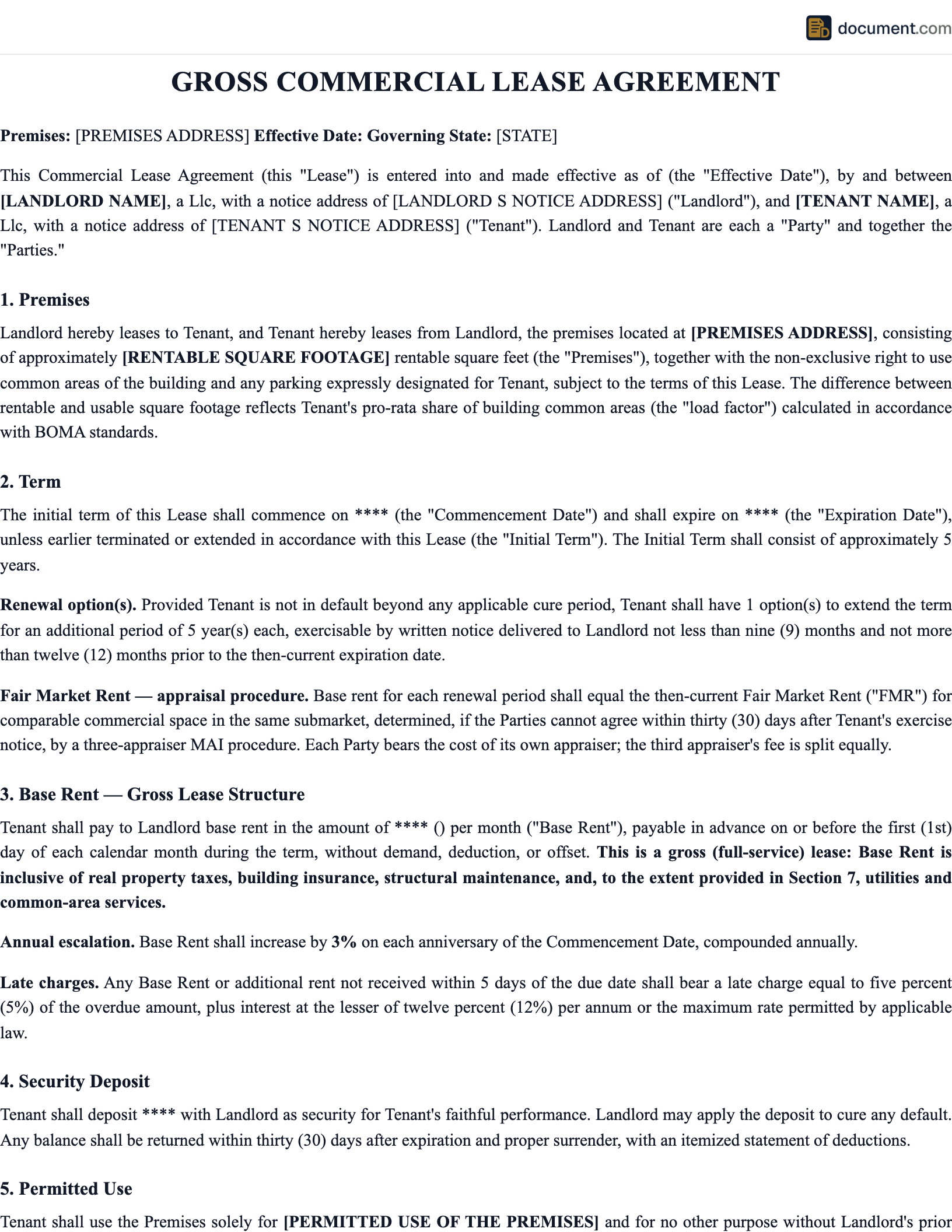
Sample Florida Gross Commercial Lease Agreement
Below is a preview of our Florida-specific template. Your customized document will include all fields and provisions required for filing in any Florida county.
GROSS COMMERCIAL LEASE AGREEMENT
STATE OF FLORIDA
Legal Document Template
LANDLORD
Name: [Full Legal Name]
Address: [Business Address]
Contact: [Phone/Email]
TENANT
Name: [Full Legal Name / Entity]
Address: [Current Address]
Tax ID: [EIN/SSN]
PREMISES
Address: [Property Address]
Suite: [Number]
Rentable SF: [Square Feet]
Usable SF: [Square Feet]
FINANCIAL TERMS
Base Rent: $[Amount]/month
Expense Stop: $[Amount]/SF
Security Deposit: $[Amount]
Escalation: [%]/year
Florida Gross Commercial Lease Agreement FAQ
Answers to common questions about filing a gross commercial lease agreement in Florida, including requirements, fees, and procedures.
Official Florida Resources
Use these official state resources to verify requirements, find your local filing office, and access government forms for Florida.
Related Florida Documents
Depending on your situation, you may need additional documents alongside your Florida gross commercial lease agreement.
Create your Florida Commercial Gross Lease Agreement in under 5 minutes.
Answer a few questions and download a Florida-compliant document, ready for the state agency.