



Indiana Gross Commercial Lease Agreement Overview
A gross commercial lease in Indiana gives the tenant one flat monthly rent payment while the landlord handles the operating expenses. Property taxes, building insurance, structural maintenance, and common area costs come out of what the landlord receives from the tenant's rent. This structure is common in Indiana multi-tenant office buildings and smaller commercial properties in Indianapolis, Carmel, Fishers, Fort Wayne, and other Indiana markets where landlords prefer to manage costs centrally.
Indiana is a relatively favorable commercial lease state. There is no real property transfer tax, no commercial rent tax, and a circuit breaker property tax cap that limits commercial taxes to 3 percent of assessed value annually. These features reduce the landlord's baseline operating cost and make expense stop negotiations more predictable for tenants, since the range of possible tax increases is bounded by the circuit breaker mechanism.
No state
Transfer or rent tax
3% cap
Property tax circuit breaker
Common
Expense stop included
Base year
Expense benchmark
Indiana Gross Lease Requirements
Indiana gross commercial leases are governed by contract law under Indiana Code. There is no specific statute mandating what an Indiana gross commercial lease must contain, so the expense coverage framework is entirely negotiated. The following provisions determine whether the lease provides real gross-lease protection or exposes the tenant to significant operating expense overages.
Indiana Expense Stop and Base Year Note
Most Indiana gross commercial leases use a base year expense stop, not a truly flat rent. The base year should reflect normal operating conditions at full or near-full occupancy. Request a gross-up provision that adjusts the base year to a 95 percent occupancy level if the building had significant vacancies in that year. This prevents an artificially low expense stop from creating unexpected overages in future years.
Key Lease Provisions
- Expense Inclusions and Exclusions: List all operating expenses the landlord covers from the base rent; specify tenant-paid exclusions such as interior utilities, janitorial, and any tenant-specific costs
- Expense Stop or Base Year: Define the base year and the stop threshold; specify the reconciliation process for overage payments and the annual statement delivery deadline
- Gross-Up Provision: Require that variable operating costs be grossed up to 95 percent occupancy in the base year to prevent an understated stop from inflating future tenant expense overages
- Escalation Clause: State the rent escalation structure, whether fixed annual percentage, CPI-based, or stepped; model both rent escalation and expense overage projections together
- Structural Responsibility: Confirm that the landlord is responsible for the roof, structural systems, and building envelope; set a response timeline for repair requests
How to Prepare an Indiana Gross Commercial Lease
Drafting a gross commercial lease for an Indiana property requires working through the expense coverage structure before finalizing the base rent. These steps walk through the key decisions.
Confirm What Gross Rent Includes
Get a written list from the landlord of all expenses covered by the base rent. Request two to three years of operating expense history to understand the actual cost level you are basing the expense stop on. Indiana's circuit breaker caps property taxes at 3 percent of assessed value, which makes the tax component more predictable than in many other states.
Negotiate the Expense Stop and Base Year
Agree on a base year that reflects normal occupancy. Request a gross-up provision if the base year was below 90 percent occupancy. Set the expense stop at a level that realistically represents the landlord's current operating costs rather than a number artificially suppressed by low-occupancy conditions in the selected base year.
Address Escalation and Renewals
Define how base rent escalates annually. Fixed 2 to 3 percent annual increases are standard in Indianapolis commercial markets. Address any renewal option rent at this stage so both parties understand the long-term economics of the deal.
Confirm Structural Repair Obligations
Under an Indiana gross lease the landlord retains structural repair, roof, and building system obligations. Confirm these assignments are in the lease body and set a landlord response time for repair requests. Specify tenant remedies if the landlord fails to make required repairs within the defined period.
Execute and Retain Copies
Both parties sign the completed lease. Distribute executed copies to all parties. For leases over five years, consider recording a memorandum of lease at the Indiana county recorder's office. Indiana has no real property transfer tax, so recording costs are limited to modest per-page recorder fees.
Indiana Gross Lease Fees & Costs
Typical costs associated with an Indiana gross commercial lease. Expense stop overages are the main variable item beyond base rent.
| Cost Item | Typical Amount |
|---|---|
| Base Rent | Negotiated; varies by Indiana submarket and building class |
| Expense Stop Overages | Pro-rata share of operating costs above base year stop |
| Tenant-Paid Utilities | Electric, gas, and data services typically excluded from gross rent |
| Attorney Review | $300 - $1,500 depending on lease length and complexity |
| Memorandum of Lease Recording (optional) | Indiana county recorder per-page fees; no transfer tax |
Sample Indiana Gross Commercial Lease Agreement
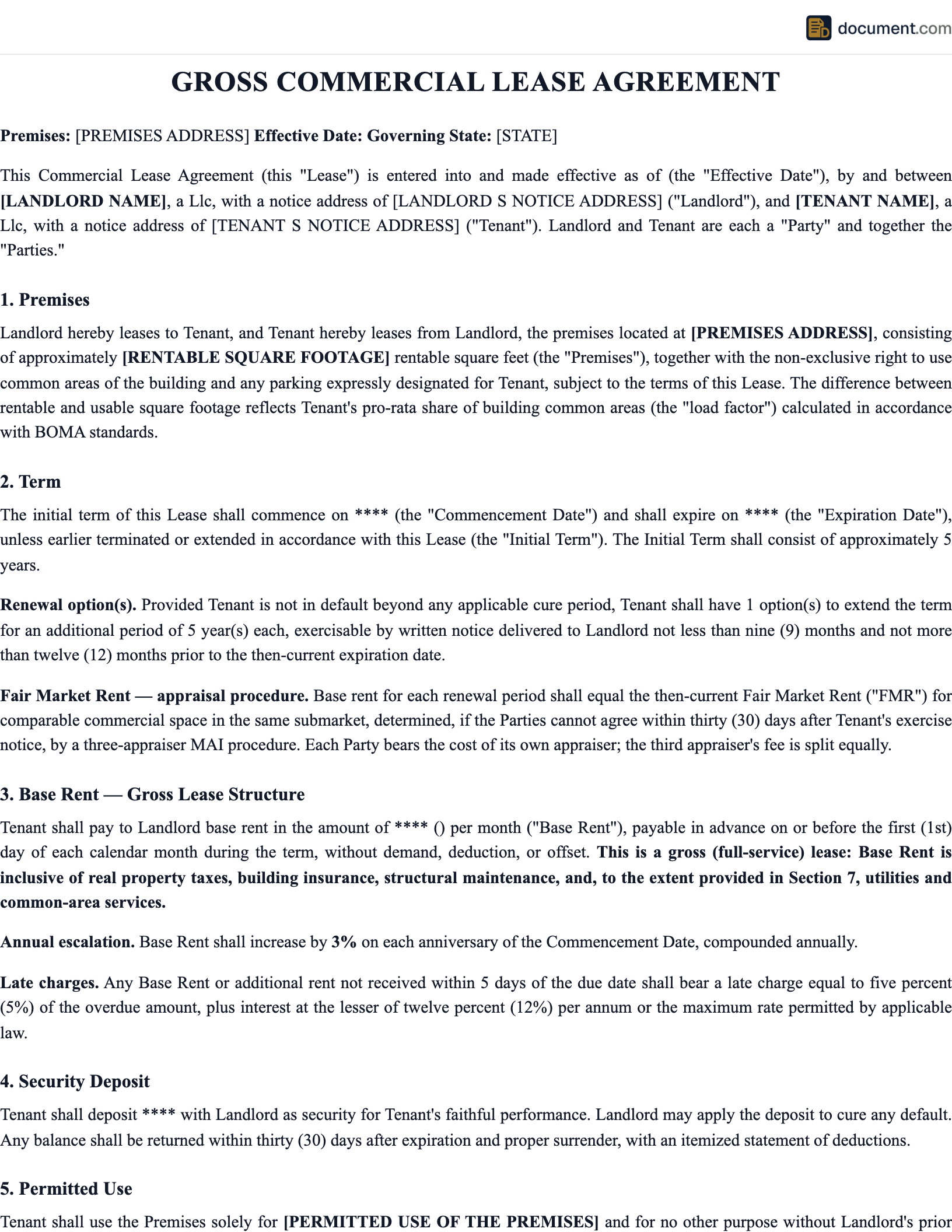
Below is a preview of our Indiana-specific template. Your customized document will include all fields and provisions required for filing in any Indiana county.
GROSS COMMERCIAL LEASE AGREEMENT
STATE OF INDIANA
Legal Document Template
LANDLORD
Name: [Full Legal Name]
Address: [Business Address]
Contact: [Phone/Email]
TENANT
Name: [Full Legal Name / Entity]
Address: [Current Address]
Tax ID: [EIN/SSN]
PREMISES
Address: [Property Address]
Suite: [Number]
Rentable SF: [Square Feet]
Usable SF: [Square Feet]
FINANCIAL TERMS
Base Rent: $[Amount]/month
Expense Stop: $[Amount]/SF
Security Deposit: $[Amount]
Escalation: [%]/year
Indiana Gross Commercial Lease Agreement FAQ
Answers to common questions about filing an gross commercial lease agreement in Indiana, including requirements, fees, and procedures.
Official Indiana Resources
Use these official state resources to verify requirements, find your local filing office, and access government forms for Indiana.
Related Indiana Documents
Depending on your situation, you may need additional documents alongside your Indiana gross commercial lease agreement.
Create your Indiana Commercial Gross Lease Agreement in under 5 minutes.
Answer a few questions and download a Indiana-compliant document, ready for the state agency.