



Georgia Gross Commercial Lease Agreement Overview
A Georgia commercial gross lease gives the tenant a single base rent obligation that covers most or all operating costs for the building. The landlord manages expenses and absorbs cost fluctuations up to any agreed expense stop level. For tenants who want predictable occupancy costs without the complexity of CAM reconciliations and property tax pass-throughs, a gross lease provides a simpler financial structure than a triple-net arrangement.
Georgia's most active gross lease markets are in the Atlanta metropolitan area. The Buckhead submarket and the Midtown Atlanta office corridor are home to many Class A and Class B office buildings operating under gross or modified gross lease structures. The Perimeter Center and Cumberland/Galleria submarkets also use gross lease structures extensively for multi-tenant office users. Georgia enforces commercial lease terms as written contracts, and expense stop mechanics in particular can produce significant financial obligations for tenants if the base year is not negotiated carefully.
$10
Filing fee
Required
Notarization
0
Witnesses required
Superior
Filing office
Georgia Gross Lease Requirements
Georgia enforces commercial gross leases as written contracts. The expense stop mechanism is the most financially significant provision and should be defined precisely to avoid disputes. Georgia's contract law does not imply terms that the parties failed to include, so every detail of the expense allocation must be stated explicitly.
Base Year Selection Is Critical
The base year expense stop defines how much landlord cost increases flow back to the tenant as pass-throughs. In Atlanta's office market, a base year with low actual occupancy will produce an artificially low expense stop, meaning the tenant will pay more in pass-throughs than expected. Always request actual operating expense data for the base year and negotiate a gross-up to a minimum occupancy level of 90 to 95 percent if the building was not substantially occupied during the base year.
Key Lease Provisions
- Expense Stop Definition: The specific dollar-per-square-foot annual operating expense amount the landlord absorbs, with explicit identification of which cost categories are included in the stop calculation
- Base Year and Gross-Up: The designated base year and a gross-up provision projecting expenses as if the building were at least 90 to 95 percent occupied, to prevent an artificially low expense stop baseline
- Pass-Through Inclusions and Exclusions: What operating costs are included in the expense pool subject to the stop calculation, and explicit exclusions for capital improvements, landlord personal expenses, and non-recurring extraordinary costs
- Audit Rights: The tenant's right to review operating expense records for lease years where pass-through obligations were billed, with a lookback window and cost-allocation rule for audits that reveal material overbillings
- Utilities and Janitorial: Whether the tenant pays utilities and janitorial separately or whether those costs are included in the gross rent, and how after-hours utility usage is billed
How to Negotiate a Georgia Gross Lease
Negotiating a Georgia commercial gross lease is primarily about defining the expense stop mechanics and protecting the tenant from unexpected pass-through obligations. These steps reflect how experienced Georgia commercial real estate attorneys approach gross lease transactions.
Review Building Operating Expense History
Request the landlord's actual per-square-foot operating expenses for the most recent two to three years. Look at how Georgia county property taxes have trended and whether the building has had any large non-recurring expenses. Understanding the actual cost history helps you assess whether the proposed expense stop is at a realistic level or set artificially low to shift more pass-through risk to you.
Negotiate the Expense Stop and Base Year
Agree on the base year, the gross-up percentage, and the method for calculating the expense stop. If the landlord insists on a base year in which the building had low occupancy, push for a gross-up to at least 90 percent of rentable square footage. Confirm that the expense stop calculation includes all building operating costs the landlord would incur at normal occupancy levels, not just the costs attributable to occupied spaces.
Define Exclusions and Secure Audit Rights
Negotiate a list of excluded expenses that do not count toward the expense stop calculation. Standard Georgia gross lease exclusions include capital improvements, mortgage debt service, leasing commissions, management fees above a reasonable cap, and costs covered by insurance proceeds. Secure an audit right with a clear process for verifying reconciliation statements and a rule assigning audit costs to the landlord if the tenant discovers an overbilling above a defined threshold.
Address Utilities and Janitorial
Confirm whether utilities and janitorial are included in the gross rent or whether the tenant pays them separately. Georgia office tenants in Atlanta's larger buildings often find that electricity is either submetered and billed separately or included in a full-service gross rent. Clarify how after-hours HVAC and electricity are billed and whether the tenant is subject to any cap on after-hours requests.
Execute and Retain Copies
Execute the lease with authorized signatures from both parties. Georgia commercial leases exceeding one year should be in writing under the state's statute of frauds. Retain fully executed originals for both parties. Recording with the clerk of superior court is optional for a lease but may be appropriate for a long-term transaction.
Georgia Gross Lease Transaction Costs
Below are the typical costs associated with negotiating and executing a Georgia commercial gross lease. Actual amounts depend on the market and lease complexity.
| Fee / Cost | Typical Amount |
|---|---|
| Attorney (Tenant), lease negotiation | $750 - $3,500 |
| Expense Stop Analysis and Base Year Review | $300 - $700 |
| Annual Expense Audit (if exercised) | $500 - $2,000 |
| Optional Clerk of Superior Court Recording | $25 |
Sample Georgia Gross Commercial Lease Agreement
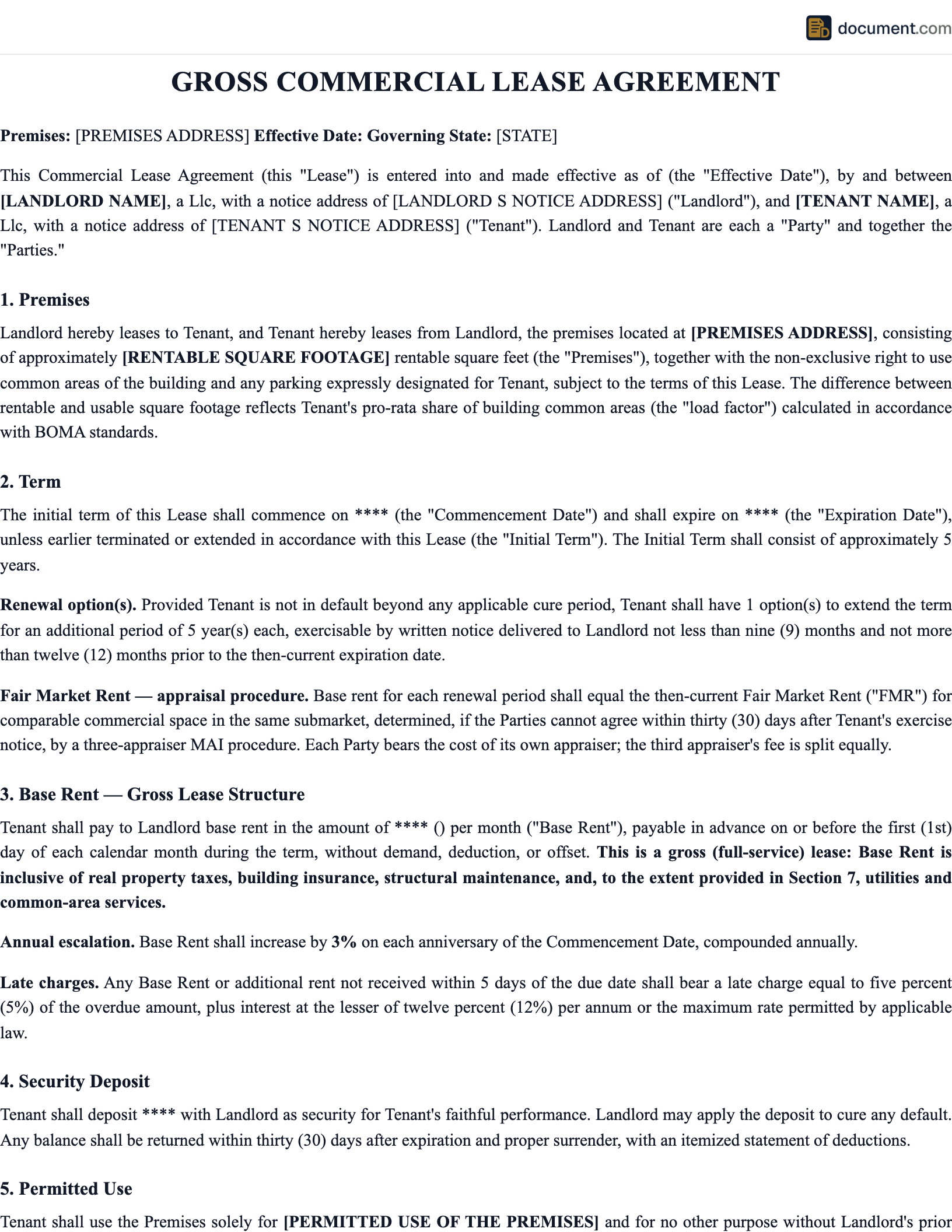
Below is a preview of our Georgia-specific template. Your customized document will include all fields and provisions required for filing in any Georgia county.
GROSS COMMERCIAL LEASE AGREEMENT
STATE OF GEORGIA
Legal Document Template
LANDLORD
Name: [Full Legal Name]
Address: [Business Address]
Contact: [Phone/Email]
TENANT
Name: [Full Legal Name / Entity]
Address: [Current Address]
Tax ID: [EIN/SSN]
PREMISES
Address: [Property Address]
Suite: [Number]
Rentable SF: [Square Feet]
Usable SF: [Square Feet]
FINANCIAL TERMS
Base Rent: $[Amount]/month
Expense Stop: $[Amount]/SF
Security Deposit: $[Amount]
Escalation: [%]/year
Georgia Gross Commercial Lease Agreement FAQ
Answers to common questions about filing a gross commercial lease agreement in Georgia, including requirements, fees, and procedures.
Official Georgia Resources
Use these official state resources to verify requirements, find your local filing office, and access government forms for Georgia.
Related Georgia Documents
Depending on your situation, you may need additional documents alongside your Georgia gross commercial lease agreement.
Create your Georgia Commercial Gross Lease Agreement in under 5 minutes.
Answer a few questions and download a Georgia-compliant document, ready for the state agency.