



Missouri Gross Commercial Lease Agreement Overview
Missouri commercial real estate centers on the St. Louis and Kansas City metro markets, each with distinct submarkets and leasing conventions. A gross commercial lease in Missouri means the landlord covers property taxes, building insurance, and common area maintenance from a flat base rent. Tenants pay a single monthly amount without separate pass-through invoices, which simplifies budgeting especially for smaller businesses leasing office or retail space in markets like Clayton, Chesterfield, or Kansas City's Country Club Plaza area.
One issue worth knowing before signing any Missouri commercial lease is the St. Louis situation. St. Louis City and St. Louis County are separate political jurisdictions with different tax rates and assessors. A building located "in St. Louis" may actually be in the city (with its own higher commercial rates) or in one of the many St. Louis County municipalities. Similarly, Kansas City straddles the Missouri-Kansas state line, and some properties with KC addresses are legally in Kansas. Missouri contract law governs the gross lease itself, but confirming the exact jurisdiction of the property affects property taxes that ultimately flow into a landlord's operating cost base.
$24
Filing fee
Required
Notarization
0
Witnesses required
Recorder
Filing office
Missouri Requirements
Missouri gross commercial leases are governed by contract law rather than a specific commercial lease statute. The terms negotiated and written into the lease are the terms that control. Before signing, tenants should understand exactly what is included in the gross rent, what is excluded, and how costs above an expense stop are handled.
Missouri Specific Note
Confirm whether the property is in St. Louis City, a St. Louis County municipality, or Kansas City proper versus a Kansas-side KC address. These distinctions affect property tax rates that feed into the landlord's operating costs and ultimately how expense stop provisions will play out over a multi-year lease term.
Key Gross Lease Provisions for Missouri
- Operating expense inclusions: The lease should define what the gross rent covers. A true gross lease includes taxes, insurance, CAM, and utilities. A modified gross lease typically excludes some items (often janitorial or utilities), and those carve-outs should be explicit.
- Expense stop amount: Many Missouri office leases include an expense stop based on actual first-year costs or a negotiated per-square-foot figure. Costs above the stop pass through to the tenant annually. Understand the stop level before committing.
- Base year selection: If the lease uses a base year mechanism, verify the base year is not artificially low. A below-market base year means the tenant absorbs more expense growth than the parties likely intended.
- Gross-up for partial occupancy: If the building is not fully occupied, the landlord may gross up variable expenses to reflect what costs would be at full occupancy. This protects tenants from paying proportionately more in a building that is only partially leased.
- Audit rights: For leases with expense stop pass-throughs, include the right to audit the landlord's operating expense records within 12 months of receiving the annual reconciliation statement.
- Escalation clause: Annual rent increases in Missouri gross leases are typically fixed-percentage (2 to 3 percent) or CPI-based. Confirm what index applies and whether there is a cap on CPI adjustments in years of high inflation.
How to File in Missouri
Filing a gross commercial lease agreement in Missouri involves preparing the document, getting it properly executed, and filing it with the appropriate county office. Follow these steps.
Confirm the Property Jurisdiction
Before reviewing lease terms, verify whether the property is in St. Louis City, a St. Louis County municipality, or a Kansas City address that is actually in Kansas. This affects property tax rates, which feed into the landlord's operating cost base and any expense stop reconciliation.
Request the Building's Actual Expense History
Ask the landlord for two or three years of actual operating expense data. Review property taxes, insurance, maintenance, and any management fees to understand what gross rent needs to cover and where an expense stop could be set realistically.
Negotiate the Expense Stop, Base Year, and Gross-Up
Work through the financial provisions carefully. In St. Louis and Kansas City office markets, expense stops are a common point of negotiation. Confirm gross-up language for any partial-occupancy period, and make sure exclusions from operating expenses (capital items, management fee caps) are spelled out explicitly.
Have a Missouri Commercial Real Estate Attorney Review the Lease
Missouri attorneys familiar with St. Louis or Kansas City commercial markets will recognize landlord-favorable provisions that deviate from local practice. Given that Missouri attorney rates are generally moderate compared to coastal markets, legal review is a practical investment on any multi-year lease.
Execute the Lease and Track Critical Dates
Sign the lease with all parties and retain fully executed originals. Set calendar reminders for annual escalation dates, option exercise windows, and renewal notice deadlines. Missouri gross leases do not need to be recorded, but organized recordkeeping protects both parties throughout the lease term.
Missouri Fees & Costs
Below is a breakdown of the typical costs associated with filing this document in Missouri. Actual fees may vary by county.
| Fee / Cost | Amount |
|---|---|
| Missouri Attorney (hourly) | $200 - $400 per hour |
| Gross Base Rent (annual per sqft) | $14 - $30/sqft (St. Louis and KC, varies by class) |
| Expense Stop Pass-Through Risk | $2 - $7/sqft annually above the stop |
| Annual Rent Escalation | Typically 2 - 3% per year or CPI-based |
Sample Missouri Gross Commercial Lease Agreement
Below is a preview of our Missouri-specific template. Your customized document will include all fields and provisions required for filing in any Missouri county.
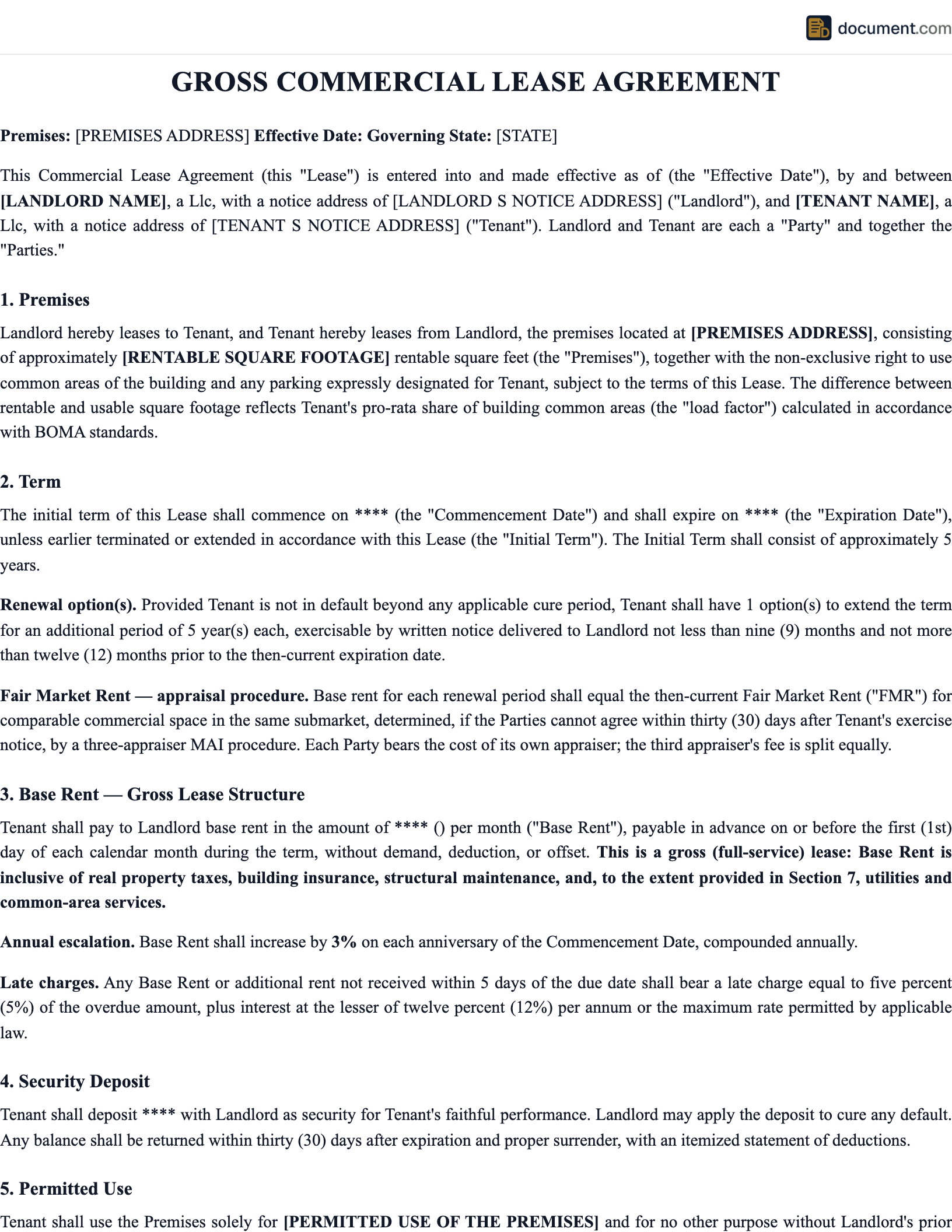
GROSS COMMERCIAL LEASE AGREEMENT
STATE OF MISSOURI
Legal Document Template
LANDLORD
Name: [Full Legal Name]
Address: [Business Address]
Contact: [Phone/Email]
TENANT
Name: [Full Legal Name / Entity]
Address: [Current Address]
Tax ID: [EIN/SSN]
PREMISES
Address: [Property Address]
Suite: [Number]
Rentable SF: [Square Feet]
Usable SF: [Square Feet]
FINANCIAL TERMS
Base Rent: $[Amount]/month
Expense Stop: $[Amount]/SF
Security Deposit: $[Amount]
Escalation: [%]/year
Missouri Gross Commercial Lease Agreement FAQ
Answers to common questions about filing a gross commercial lease agreement in Missouri, including requirements, fees, and procedures.
Official Missouri Resources
Use these official state resources to verify requirements, find your local filing office, and access government forms for Missouri.
Related Missouri Documents
Depending on your situation, you may need additional documents alongside your Missouri gross commercial lease agreement.
Create your Missouri Commercial Gross Lease Agreement in under 5 minutes.
Answer a few questions and download a Missouri-compliant document, ready for the state agency.