
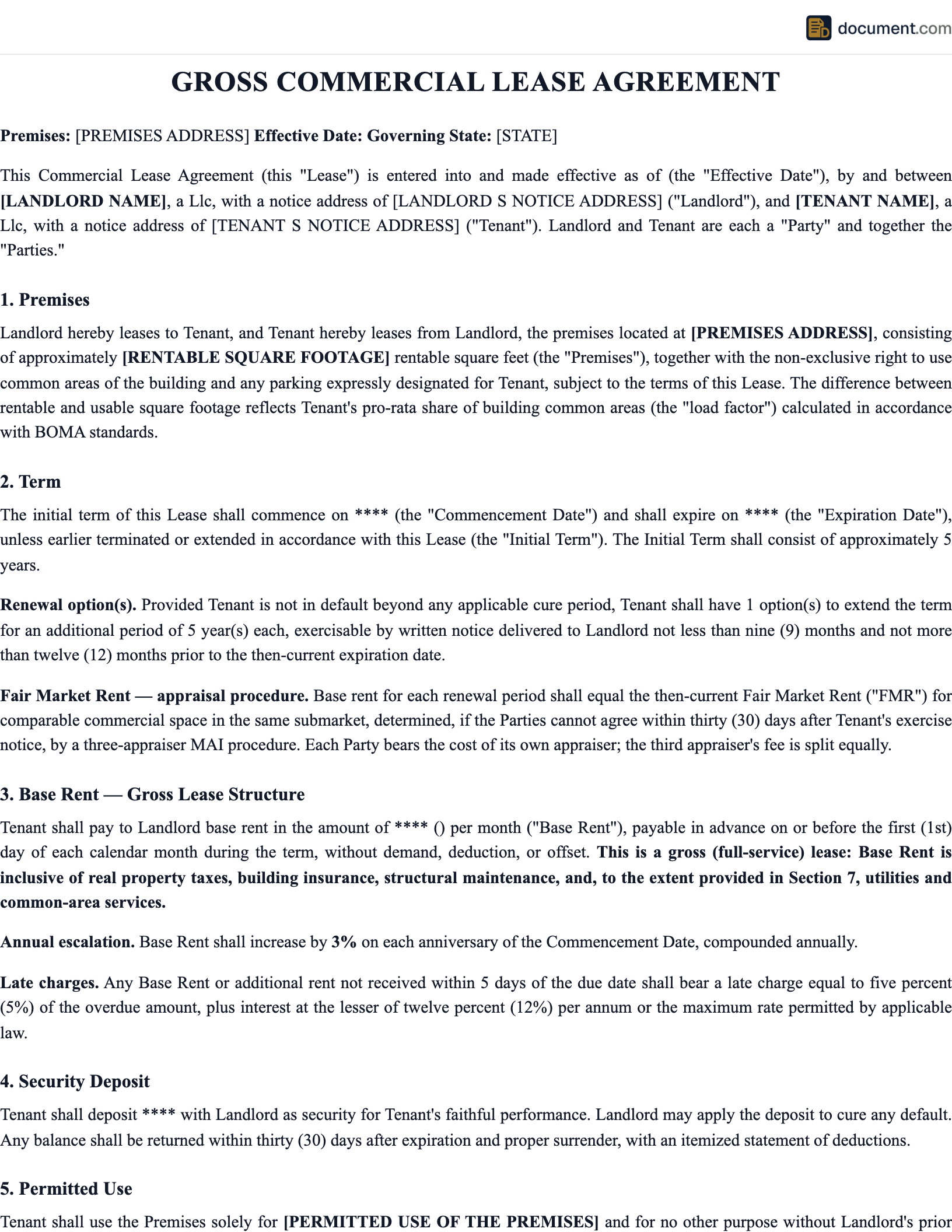



Iowa Gross Commercial Lease Agreement Overview
A gross commercial lease simplifies the tenant's monthly obligations by wrapping property taxes, insurance, and maintenance into a single rent payment. The landlord manages the property and absorbs operating cost fluctuations, at least up to the expense stop. Iowa commercial landlords frequently use this structure for office and smaller retail properties where they want to maintain control of vendor relationships and building standards.
Iowa does not impose a commercial rent tax, so the gross rent the tenant sees on paper is what they pay. Iowa's property tax rollback system can affect how much the landlord's actual tax obligation changes year to year. For long-term leases, landlords often use an expense stop or base year mechanism to share significant tax increases with the tenant rather than absorb the full exposure themselves.
No state
Commercial rent tax
Common
Expense stop provision
Base year
Expense benchmark
Rollback
Iowa tax factor
Iowa Requirements
An Iowa gross commercial lease is a private contract governed by Iowa contract law. There is no state form to file and no recording requirement. The provisions below are the substantive lease terms that determine cost allocation and protect both parties over the lease term.
Iowa Property Tax Rollback and Expense Stop Interaction
Iowa assesses commercial property at 90% of actual value and applies an annual rollback factor. If the expense stop in your gross lease is based on actual taxes paid in the base year, and the rollback shifts favorably in later years, the tenant may not see the benefit. Conversely, if taxes rise above the expense stop, the tenant owes overages. Confirm how the expense stop is defined and whether it accounts for Iowa's rollback system.
Key Lease Provisions
- Expense Inclusions and Exclusions: List every operating expense the landlord covers and exclude capital items, management fees above market rate, and costs covered by insurance. Clarity here prevents disputes when an unexpected expense arises.
- Expense Stop and Base Year: Define the expense stop amount and the base year on which it is calculated. Negotiate the base year to a period with typical expense levels, not an unusual low-expense year that would trigger overage payments sooner.
- Gross-Up Provision: If the building is not fully occupied during the base year, a gross-up clause adjusts expenses as if it were 95% or 100% occupied. This prevents tenants from benefiting from an artificially low expense base.
- Rent Escalation: Specify the annual rent increase mechanism, whether a fixed percentage, CPI-linked, or tied to operating cost changes. Iowa gross leases commonly use fixed annual bumps of 2% to 3%.
- Structural Responsibility: Confirm the landlord covers the roof, foundation, and major building systems. The tenant typically handles interior maintenance and ordinary wear and tear repairs.
How to File in Iowa
Preparing an Iowa gross commercial lease requires agreeing on expense allocation before putting language in a document. These five steps cover the substance of the process.
Clarify Expense Inclusions and Exclusions
Agree on which operating expenses the landlord covers under the gross rent and which the tenant pays separately. At minimum, confirm the treatment of property taxes, insurance, snow removal (a significant Iowa cost), and building maintenance. Document the list before drafting begins.
Negotiate the Expense Stop and Base Year
If the lease includes an expense stop, negotiate the base year to reflect a normal operating year. Confirm how Iowa's property tax rollback is handled in the base year calculation so neither party is surprised when the rollback shifts in future years.
Address Escalation and Structural Responsibility
Set the annual rent escalation mechanism. Most Iowa gross leases use fixed bumps of 2% to 3% per year. Confirm the landlord's responsibility for the roof, foundation, and major systems, and set a timeline for repairs so the tenant knows what to expect.
Draft and Review the Lease
Use an Iowa-specific template and have both parties review the full text, particularly the expense allocation exhibit, the escalation schedule, and any gross-up provisions. Iowa commercial real estate attorneys typically offer flat-fee lease reviews.
Execute and Retain Copies
Both parties sign the executed lease. Iowa commercial leases do not require recording, but for long-term leases, parties may choose to record a memorandum of lease at the county recorder to put the leasehold in the public record without disclosing financial terms.
Iowa Fees & Costs
Below is a breakdown of the typical costs associated with filing this document in Iowa. Actual fees may vary by county.
| Fee / Cost | Amount |
|---|---|
| Base Rent | Negotiated all-inclusive rate; covers most operating expenses up to the expense stop |
| Expense Stop Overages | Tenant pays pro-rata share of operating costs above the base year expense stop, including Iowa property tax increases above the rollback baseline |
| Tenant Utilities | Electricity, gas, and internet typically excluded from gross rent and paid directly by the tenant |
| Attorney Review | $500 to $1,500 for flat-fee Iowa commercial lease review |
| Memorandum of Lease Recording (optional) | $15 for first page at county recorder; no transfer tax on leasehold recording |
Sample Iowa Gross Commercial Lease Agreement
Below is a preview of our Iowa-specific template. Your customized document will include all fields and provisions required for filing in any Iowa county.
GROSS COMMERCIAL LEASE AGREEMENT
STATE OF IOWA
Legal Document Template
LANDLORD
Name: [Full Legal Name]
Address: [Business Address]
Contact: [Phone/Email]
TENANT
Name: [Full Legal Name / Entity]
Address: [Current Address]
Tax ID: [EIN/SSN]
PREMISES
Address: [Property Address]
Suite: [Number]
Rentable SF: [Square Feet]
Usable SF: [Square Feet]
FINANCIAL TERMS
Base Rent: $[Amount]/month
Expense Stop: $[Amount]/SF
Security Deposit: $[Amount]
Escalation: [%]/year
Iowa Gross Commercial Lease Agreement FAQ
Answers to common questions about filing an gross commercial lease agreement in Iowa, including requirements, fees, and procedures.
Official Iowa Resources
Use these official state resources to verify requirements, find your local filing office, and access government forms for Iowa.
Related Iowa Documents
Depending on your situation, you may need additional documents alongside your Iowa gross commercial lease agreement.
Create your Iowa Commercial Gross Lease Agreement in under 5 minutes.
Answer a few questions and download a Iowa-compliant document, ready for the state agency.