



New Jersey Gross Commercial Lease Agreement Overview
A gross commercial lease in New Jersey gives the tenant a single all-in monthly rent that covers base rent and most or all of the building's operating expenses. The landlord receives a fixed payment and absorbs the cost of property taxes, insurance, and maintenance from that amount. New Jersey has no dedicated commercial lease statute, so the scope of what the gross rent covers and any exceptions are determined entirely by the language of the written agreement. Courts enforce gross leases as written.
New Jersey's heavy municipal property tax burden is the defining factor in gross lease pricing across the state. Landlords must build current and projected tax costs into the gross rent figure, which means tenants in high-assessment municipalities pay a premium for the predictability a gross structure provides. Primary gross lease markets in New Jersey include the Northern New Jersey office corridors along Routes 3, 17, and I-287, waterfront office space in Jersey City and Hoboken, the Route 1 technology corridor, and suburban office parks in the Parsippany and Iselin areas.
$15
Filing fee
Required
Notarization
0
Witnesses required
County
Filing office
New Jersey Gross Lease Requirements
New Jersey has no commercial lease statute, so a gross lease's enforceability depends entirely on the written agreement. The key provisions to get right are: what the gross rent covers, any exceptions or pass-throughs, how expense stops work if included, capital expenditure treatment, and rent escalation methodology.
New Jersey Property Taxes Are Set by Municipality
New Jersey property taxes are levied at the municipal level, not by the county, and effective rates vary dramatically across the state. When evaluating a gross lease, ask the landlord to disclose the current annual property tax bill and the municipality's recent assessment history. Tax increases following reassessments can affect gross lease renewal pricing significantly, and landlords in high-tax municipalities are more likely to include escalation clauses or expense stops in their gross lease structures.
Key Gross Lease Provisions
- Expense inclusions and exclusions: Define precisely what the gross rent covers and what the tenant remains responsible for; utilities are commonly excluded even in full-service gross structures
- Expense stop: If included, define the stop as a fixed dollar amount or base-year cost; in New Jersey, an expense stop tied to property taxes can become a meaningful pass-through in years following municipal reassessments
- Capital expenditure exclusions: Confirm that the tenant is not contributing to roof replacement, elevator overhauls, or major structural capital items through either direct charges or amortization provisions hidden in the lease
- Gross-up clause: Multi-tenant New Jersey office buildings typically include a gross-up clause adjusting expenses to reflect full occupancy; confirm the occupancy threshold used (usually 95 percent) and how it is calculated
- Rent escalation: Fixed annual escalations or CPI adjustments are standard in New Jersey gross leases; confirm the escalation rate and any caps so you can model total occupancy cost over the full lease term
How to Execute a New Jersey Gross Commercial Lease
Entering into a gross commercial lease in New Jersey requires understanding the embedded cost structure before negotiating. Follow these steps.
Request the Landlord's Expense History
Before negotiating a gross rent figure, ask the landlord for the current property tax bill, the prior two years of insurance premiums, and a CAM expense statement. In New Jersey, where municipal property taxes can be substantial, this baseline data is essential to evaluate whether the proposed gross rent is fairly priced relative to actual underlying costs.
Negotiate Expense Stops and Escalations
Confirm whether the lease includes an expense stop and, if so, what triggers tenant responsibility for cost increases. Negotiate any annual rent escalation cap. For Northern New Jersey office leases, clarify whether the gross-up clause applies and at what occupancy threshold. These terms affect the total cost of occupancy over the full lease term significantly.
Draft the Lease with New Jersey-Specific Terms
Use a New Jersey commercial gross lease template that clearly defines what is included in base rent, any expense stop provisions, capital expenditure treatment, rent escalation methodology, and governing law. Specify the New Jersey county where the property is located and include the appropriate county superior court as the venue for disputes.
Execute the Agreement
Both parties sign. Commercial leases in New Jersey are binding without notarization between the parties; notarization is only required for recording purposes. Each party retains an original or complete copy. If either party is a business entity, verify signing authority before execution.
Retain Copies and Monitor Escalation Dates
Keep fully executed copies for both parties. Calendar upcoming rent escalation dates so increases are applied correctly and on time. If the lease includes expense stop provisions, track relevant expense categories annually so you are prepared for any pass-through adjustments when they arise.
New Jersey Gross Lease Costs
Gross lease costs in New Jersey reflect a single all-in rent that bundles most operating expenses. The breakdown below shows the components typically embedded in or excluded from the gross rent structure.
| Fee / Cost | Amount |
|---|---|
| Base Rent (All-In, Northern NJ Suburban Office) | $20 to $35 per SF annually; includes property taxes, insurance, and CAM; New Jersey municipal property taxes are among the highest nationally and are a major embedded cost factor |
| Expense Stop Overage (if applicable) | Tenant's share of operating cost increases above the stop threshold; property tax increases following municipal reassessments are the most common trigger in New Jersey gross leases |
| Tenant-Excluded Utilities | Electricity, gas, and telecommunications are typically metered and billed directly to the tenant even in full-service gross lease structures |
| Attorney Review and Lease Drafting | $800 to $2,500 depending on lease length and complexity; advisable given New Jersey's property tax environment and the importance of understanding expense stop and gross-up provisions |
| Recording Fee (if memorandum is recorded) | Optional; recording fees at the NJ county clerk vary by county; worth considering for long-term leases or locations with significant tenant improvements |
Sample New Jersey Gross Commercial Lease Agreement
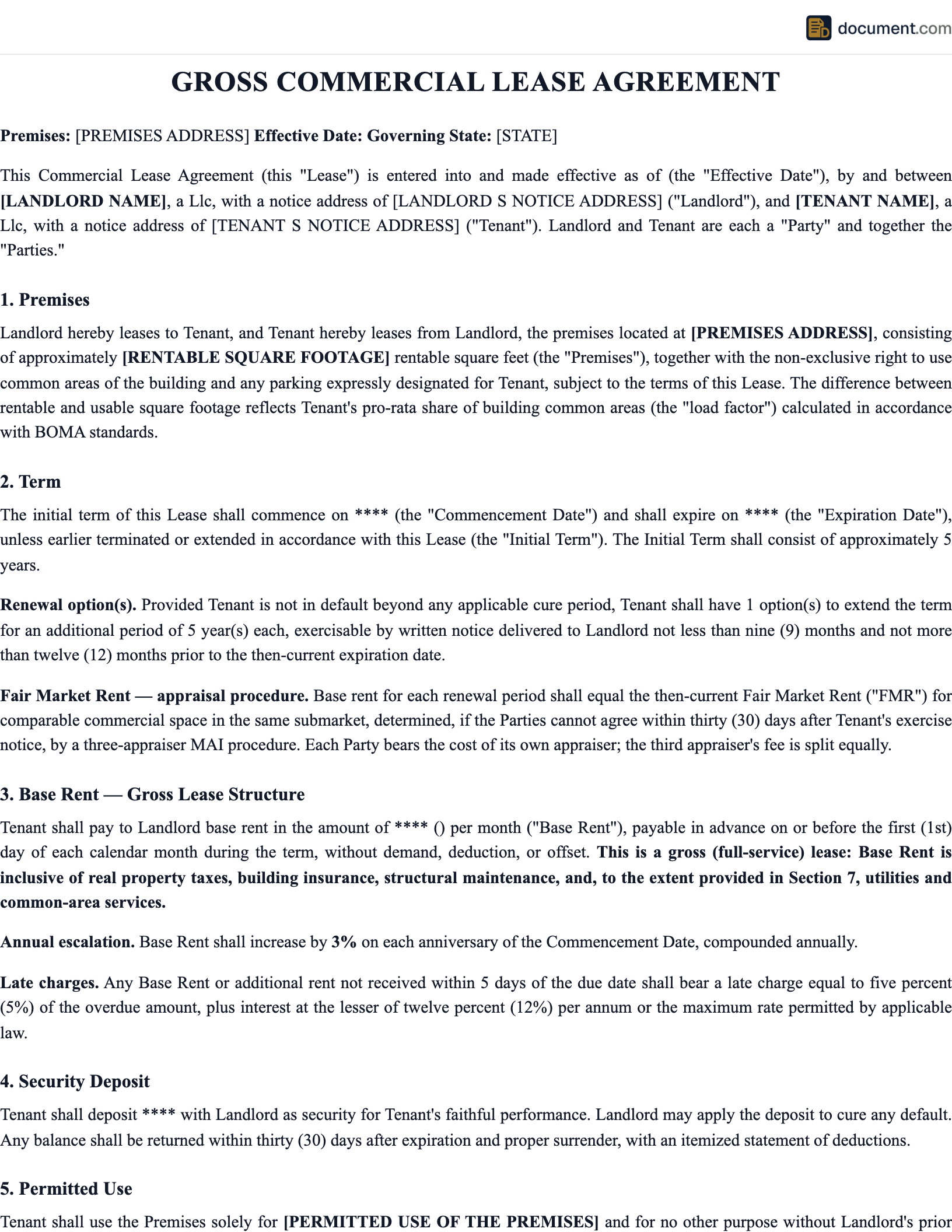
Below is a preview of our New Jersey-specific template. Your customized document will include all fields and provisions required for filing in any New Jersey county.
GROSS COMMERCIAL LEASE AGREEMENT
STATE OF NEW JERSEY
Legal Document Template
LANDLORD
Name: [Full Legal Name]
Address: [Business Address]
Contact: [Phone/Email]
TENANT
Name: [Full Legal Name / Entity]
Address: [Current Address]
Tax ID: [EIN/SSN]
PREMISES
Address: [Property Address]
Suite: [Number]
Rentable SF: [Square Feet]
Usable SF: [Square Feet]
FINANCIAL TERMS
Base Rent: $[Amount]/month
Expense Stop: $[Amount]/SF
Security Deposit: $[Amount]
Escalation: [%]/year
New Jersey Gross Commercial Lease Agreement FAQ
Answers to common questions about filing a gross commercial lease agreement in New Jersey, including requirements, fees, and procedures.
Official New Jersey Resources
Use these official state resources to verify requirements, find your local filing office, and access government forms for New Jersey.
Related New Jersey Documents
Depending on your situation, you may need additional documents alongside your New Jersey gross commercial lease agreement.
Create your New Jersey Commercial Gross Lease Agreement in under 5 minutes.
Answer a few questions and download a New Jersey-compliant document, ready for the state agency.