



New York Gross Commercial Lease Agreement Overview
Gross commercial leases are common in New York office markets, particularly in Manhattan where full-service or modified gross structures dominate Class A and Class B office buildings. The landlord bundles property taxes, insurance, and building operating costs into a single rent figure, giving tenants the budget predictability they need for planning occupancy costs. In New York, the detail of the lease governs how well that predictability holds up over a long lease term.
New York gross leases almost always include expense stops and base year provisions that transfer above-baseline operating cost increases to the tenant. Given New York City's historically rising operating costs, the expense stop mechanism can erode the cost certainty a gross lease is supposed to provide. Tenants should review prior-year operating cost data, negotiate a fair base year, and cap controllable expense increases to protect their cost position over the full lease term.
$55
Filing fee
Required
Notarization
0
Witnesses required
County
Filing office
New York Gross Lease Requirements
New York gross commercial leases are governed by contract law. No statute mandates a particular gross lease structure or protects commercial tenants from above-stop expense pass-throughs. The base year, expense stop, inclusions, and exclusions are entirely negotiated, which is why understanding what you are agreeing to before signing matters enormously in New York.
NYC Commercial Rent Tax in Gross Leases
The NYC commercial rent tax applies to the tenant's annual base rent in qualifying Manhattan locations. For gross leases where the rent is already higher than in other structures due to bundled expenses, this tax adds meaningfully to total occupancy cost. Tenants in Manhattan gross leases should confirm whether the commercial rent tax applies to their situation and budget accordingly.
Key Provisions for New York Gross Leases
- Inclusions and Exclusions Schedule: Get a detailed list of what operating expenses are and are not included in the gross rent
- Expense Stop and Base Year: Confirm the stop amount, base year selection, and which expense categories are subject to the stop mechanism
- Controllable Expense Cap: Negotiate an annual cap on increases in controllable operating costs such as management fees and cleaning
- Audit Rights: Include the right to audit above-stop expense pass-through calculations within a defined window after receiving the annual statement
- Real Estate Tax Certiorari Rights: Negotiate the right to participate in tax certiorari proceedings to challenge assessed values passed through above the stop
- Gross-Up Provision: Ensure variable expenses are grossed up to a full-occupancy baseline for the purpose of base year and above-stop calculations
How to Negotiate a New York Gross Commercial Lease
Getting the gross lease structure right in New York requires careful diligence and a methodical negotiation approach. These steps will help you protect your cost position.
Request Multi-Year Operating Cost History
Ask for three to five years of actual operating cost data to understand the trajectory and identify categories that tend to increase quickly in this building
Negotiate the Base Year and Expense Stop
Push for a base year that reflects normal full-occupancy operations. Negotiate the stop amount and confirm which expense categories are included and excluded from the calculation
Confirm NYC Commercial Rent Tax Applicability
If the space is in a qualifying Manhattan location, confirm your annual gross rent triggers the commercial rent tax and model that cost separately from the gross lease expense pass-throughs
Retain a New York Commercial Lease Attorney
New York institutional landlords use complex, landlord-favorable forms. An attorney experienced in New York commercial leasing can identify and close the gaps in the gross lease structure
Execute and Archive Records
Sign the final lease with all attachments. Keep detailed records of the base year operating costs so you can accurately audit future expense stop calculations
New York Fees & Costs
Below is a breakdown of the typical costs associated with filing this document in New York. Actual fees may vary by county.
| Fee / Cost | Amount |
|---|---|
| Gross Base Rent | Manhattan Class A: $70 - $150+ per sq ft full-service annually; Brooklyn, Queens, Westchester, and upstate substantially lower |
| NYC Commercial Rent Tax (qualifying Manhattan) | Approximately 3.9% of annual gross rent for qualifying tenants south of 96th Street |
| Operating Expense Overages Above Stop | Varies; NYC Class A office overages can be $5 - $20+ per sq ft annually depending on building and base year |
| Attorney Fees | $1,500 - $6,000+ for New York commercial gross lease review; institutional NYC leases require extensive negotiation |
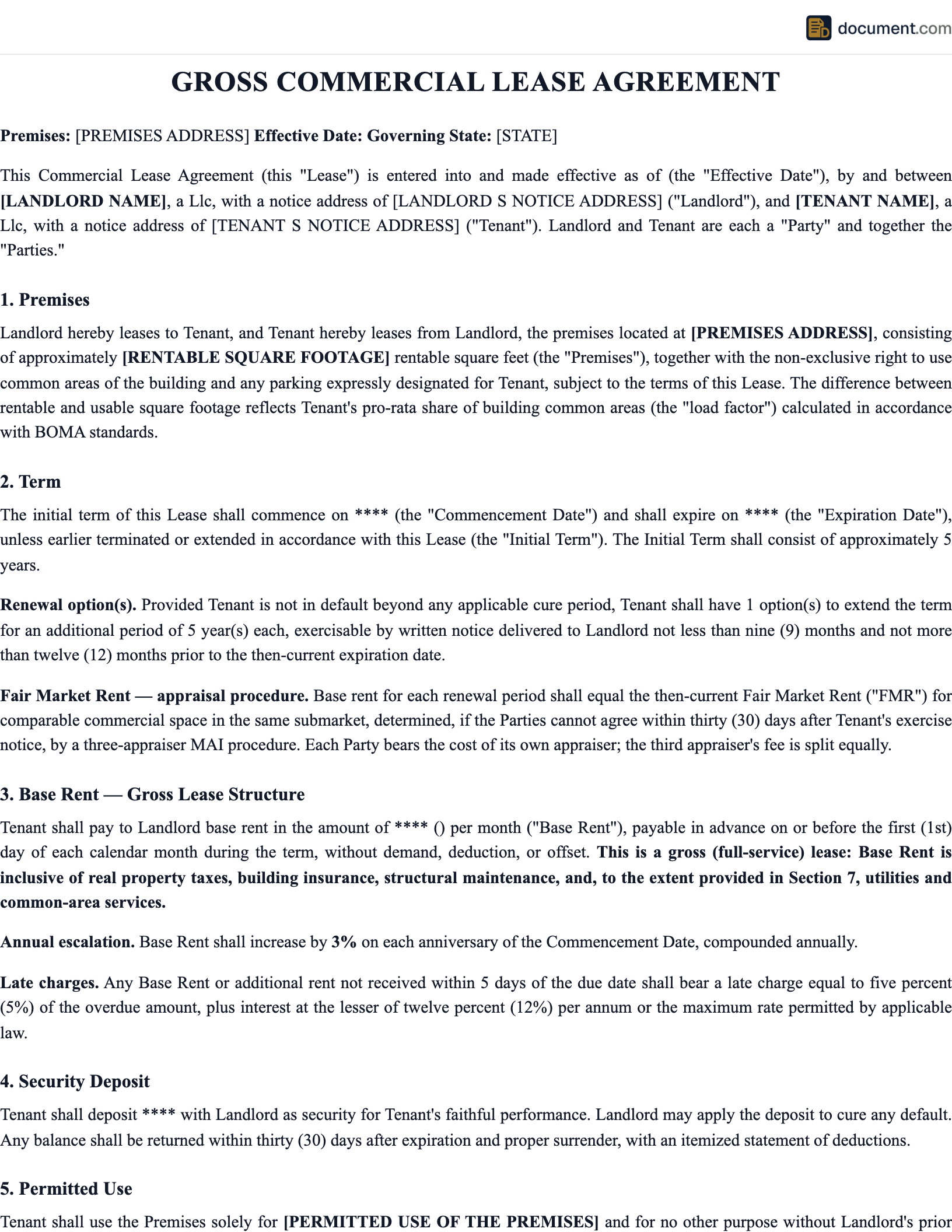
Sample New York Gross Commercial Lease Agreement
Below is a preview of our New York-specific template. Your customized document will include all fields and provisions required for filing in any New York county.
GROSS COMMERCIAL LEASE AGREEMENT
STATE OF NEW YORK
Legal Document Template
LANDLORD
Name: [Full Legal Name]
Address: [Business Address]
Contact: [Phone/Email]
TENANT
Name: [Full Legal Name / Entity]
Address: [Current Address]
Tax ID: [EIN/SSN]
PREMISES
Address: [Property Address]
Suite: [Number]
Rentable SF: [Square Feet]
Usable SF: [Square Feet]
FINANCIAL TERMS
Base Rent: $[Amount]/month
Expense Stop: $[Amount]/SF
Security Deposit: $[Amount]
Escalation: [%]/year
New York Gross Commercial Lease Agreement FAQ
Answers to common questions about filing a gross commercial lease agreement in New York, including requirements, fees, and procedures.
Official New York Resources
Use these official state resources to verify requirements, find your local filing office, and access government forms for New York.
Related New York Documents
Depending on your situation, you may need additional documents alongside your New York gross commercial lease agreement.
Create your New York Commercial Gross Lease Agreement in under 5 minutes.
Answer a few questions and download a New York-compliant document, ready for the state agency.