
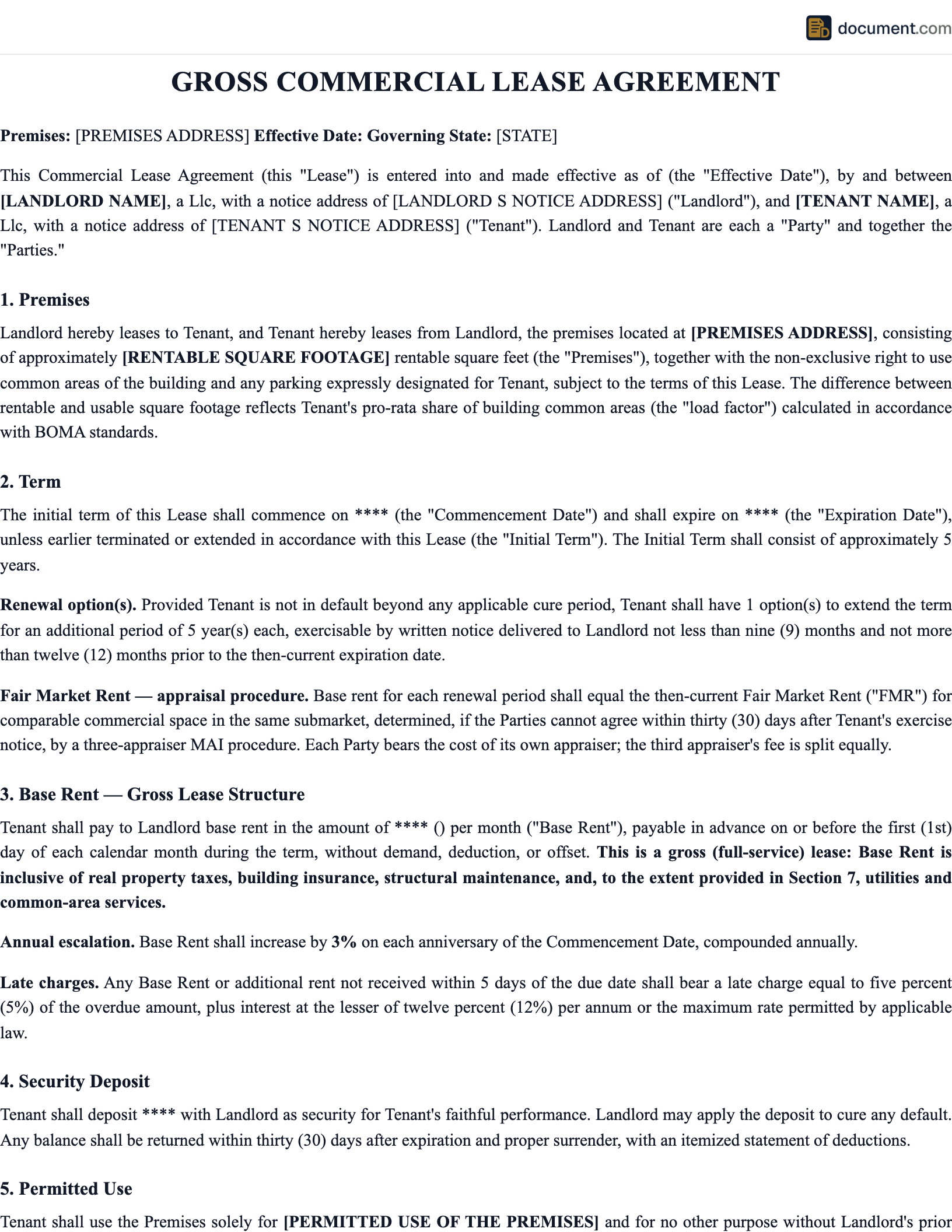



North Carolina Gross Commercial Lease Agreement Overview
A gross commercial lease in North Carolina bundles property taxes, insurance, and operating expenses into a single rent payment. The landlord absorbs those costs rather than billing the tenant separately each month. This structure appeals to tenants who want predictable occupancy costs and minimal administrative burden, and it is most common in North Carolina's office and professional-services markets, particularly in Charlotte, Raleigh, Durham, and their surrounding suburbs.
The simplicity of a gross lease is often more apparent than real. Many gross leases in North Carolina include expense stop provisions, base year calculations, and controllable expense caps that can shift meaningful costs back to the tenant if operating expenses rise above the baseline. Understanding what the landlord is absorbing versus what will eventually pass through is the essential analysis before signing a North Carolina gross commercial lease.
$26
Filing fee
Required
Notarization
0
Witnesses required
Register
Filing office
North Carolina Gross Lease Requirements
North Carolina gross commercial leases are governed by general contract principles. There are no specific commercial lease statutes requiring particular lease provisions, so the negotiated language controls everything.
Expense Stop and Base Year Negotiation in North Carolina
Many North Carolina gross leases include an expense stop clause that causes the lease to function more like a modified gross lease after the first year. The base year operating expense level becomes the landlord's responsibility, and any expenses above that level pass through to the tenant. Negotiating the base year carefully, including gross-up provisions and exclusions for capital expenses and management fee increases, directly affects the true economics of the lease.
Key Lease Provisions
- Inclusions List: Define exactly which operating expenses are included in the gross rent so there is no ambiguity about what the landlord covers versus what remains the tenant's separate obligation
- Expense Stop and Base Year: If an expense stop applies, negotiate the base year carefully and include a gross-up provision so the baseline reflects full-occupancy expenses
- Capital Expenditure Exclusions: Explicitly exclude capital improvements from operating expenses or limit pass-throughs to the annual amortized portion with a useful-life cap
- Audit Rights: Include the right to audit the landlord's operating expense calculations annually, with a time window for disputes and a remediation procedure
- After-Hours Services: Confirm whether HVAC, security, and other services outside standard building hours are included in rent or billed separately as add-ons
- Annual Rent Escalation: Specify whether increases are fixed percentage, CPI-based, or tied to operating cost growth; if CPI-based, negotiate a cap on annual increases
How to Execute a North Carolina Gross Lease
Signing a gross commercial lease in North Carolina involves more than accepting the landlord's form. These steps will help you understand the economics and protect your position before committing.
Get Historical Operating Expense Records
Request the last two to three years of actual operating expense statements from the landlord. This tells you what the base year expenses look like and how fast they have been growing, which is critical for modeling the expense stop impact over the lease term.
Negotiate Inclusions, Exclusions, and the Expense Stop
Work with the landlord to define what is included in the gross rent, what is excluded, and at what level an expense stop kicks in. Push for a gross-up provision, exclusion of capital expenditures, and a cap on management fee pass-throughs in any operating expense calculation.
Confirm After-Hours Service Costs
Many North Carolina office buildings bill after-hours HVAC separately from the gross rent. If your business operates outside standard building hours, get the hourly or per-zone rate in writing and factor it into your occupancy cost projections.
Have a North Carolina Commercial Lease Attorney Review
Commercial gross lease language in NC varies significantly from building to building. An attorney familiar with the Charlotte or Research Triangle market can identify problematic expense definitions, inadequate exclusions, and missing audit rights that would otherwise be costly to discover after signing.
Execute and Set Up Calendar Reminders
Both parties sign and exchange fully executed copies. Set up calendar reminders for annual escalation dates, operating expense reconciliation windows, and audit rights deadlines so you do not miss time-limited remedies under the lease.
North Carolina Fees & Costs
Below is a breakdown of the typical costs associated with filing this document in North Carolina. Actual fees may vary by county.
| Fee / Cost | Amount |
|---|---|
| Gross Base Rent | Charlotte Class A office: $26-$40/sq ft; Research Triangle: $22-$35/sq ft; suburban markets: $18-$26/sq ft annually |
| Operating Expense Overages | If an expense stop applies, tenant pays overage above the base year level; typically $2-$6/sq ft in later lease years depending on cost growth |
| After-Hours HVAC | Typically billed separately at $25-$75/hour or per zone; confirm the rate in writing before signing if your business operates outside standard hours |
| Parking | Often excluded from gross rent in urban locations; Charlotte and Raleigh structured parking can run $75-$175/space per month |
| Attorney Review | $500-$2,000 for North Carolina gross commercial lease review; longer or higher-value leases typically require more negotiation time |
Sample North Carolina Gross Commercial Lease Agreement
Below is a preview of our North Carolina-specific template. Your customized document will include all fields and provisions required for filing in any North Carolina county.
GROSS COMMERCIAL LEASE AGREEMENT
STATE OF NORTH CAROLINA
Legal Document Template
LANDLORD
Name: [Full Legal Name]
Address: [Business Address]
Contact: [Phone/Email]
TENANT
Name: [Full Legal Name / Entity]
Address: [Current Address]
Tax ID: [EIN/SSN]
PREMISES
Address: [Property Address]
Suite: [Number]
Rentable SF: [Square Feet]
Usable SF: [Square Feet]
FINANCIAL TERMS
Base Rent: $[Amount]/month
Expense Stop: $[Amount]/SF
Security Deposit: $[Amount]
Escalation: [%]/year
North Carolina Gross Commercial Lease Agreement FAQ
Answers to common questions about filing a gross commercial lease agreement in North Carolina, including requirements, fees, and procedures.
Official North Carolina Resources
Use these official state resources to verify requirements, find your local filing office, and access government forms for North Carolina.
Related North Carolina Documents
Depending on your situation, you may need additional documents alongside your North Carolina gross commercial lease agreement.
Create your North Carolina Commercial Gross Lease Agreement in under 5 minutes.
Answer a few questions and download a North Carolina-compliant document, ready for the state agency.