
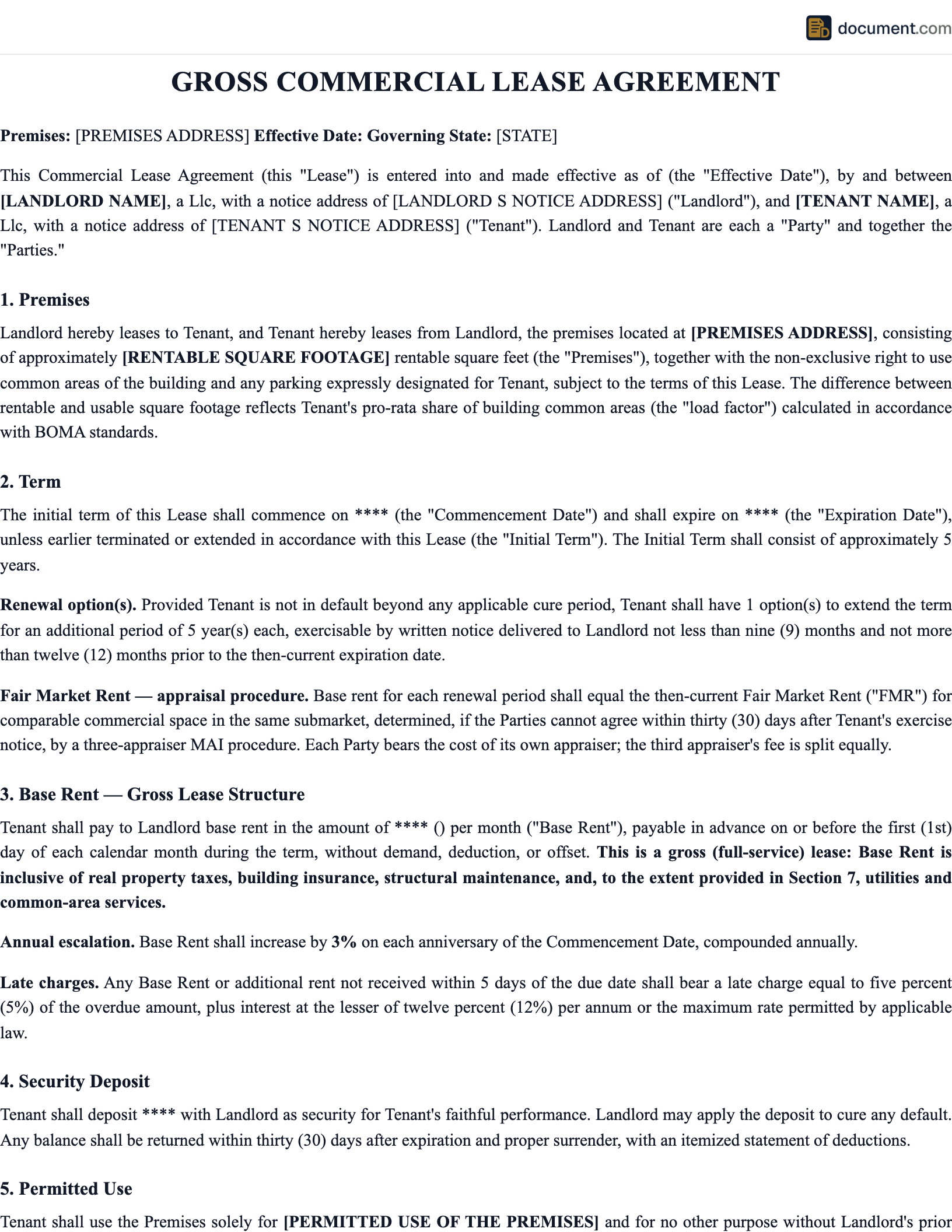



Delaware Gross Commercial Lease Overview
A Delaware gross commercial lease bundles property taxes, building insurance, and operating expenses into a single all-inclusive base rent. The landlord absorbs those costs directly and the tenant pays one predictable monthly amount. Gross leases are the standard structure in Delaware's multi-tenant office market, particularly in Wilmington's downtown business district and the Route 202 corridor in northern New Castle County.
Delaware's legal environment is uniquely commercial-contract-focused. The Court of Chancery, which handles most significant commercial disputes in the state, applies sophisticated contract interpretation and enforces terms as written with minimal implied obligations. A Delaware gross lease that uses vague expense stop language, fails to define the base year, or omits a gross-up clause will be enforced as written by a court that understands the practical effect of those omissions. Delaware has no sales tax and no commercial rent tax, keeping the gross lease structure clean compared to neighboring states.
$33
Filing fee
Required
Notarization
0
Witnesses required
Recorder
Filing office
Delaware Gross Lease Requirements
Delaware commercial leases are governed by contract law. The state has no comprehensive commercial lease statute imposing mandatory tenant protections, so the rights and obligations of each party are almost entirely determined by the lease document itself. The Court of Chancery enforces written commercial contracts between sophisticated parties with minimal implied obligations.
Base Year Selection Matters in Delaware
In a Delaware base year gross lease, the first year's actual operating expenses set the ceiling on what the landlord absorbs in all future years. If that base year falls during a period of unusually low occupancy, recently reduced assessments, or deferred maintenance, the base will be artificially low and the tenant will owe expense overages in every subsequent year. Review at least two years of building expense history before agreeing to a specific base year.
Key Delaware Gross Lease Provisions
- Expense Stop and Base Year: Define the expense stop amount or base year, include a gross-up clause at 95 percent occupancy, and specify the annual reconciliation process
- Operating Expense Inclusions: List specific expense categories covered by the base rent: property taxes, property insurance, landscaping, security, common area utilities, and management fees
- Negotiated Exclusions: Identify excluded costs explicitly: capital expenditures, depreciation, ground lease payments, costs caused by landlord's negligence, and non-building-level costs
- Pro-Rata Share Definition: State the tenant's square footage, total rentable square footage, and the formula for calculating the tenant's proportionate expense share
- Audit Rights: Include an explicit right for the tenant to audit expense records within 90 to 180 days of receiving the annual statement, since Delaware courts will not imply this right
How to Negotiate a Delaware Gross Lease
Delaware gross lease negotiations focus on the expense stop structure, exclusion list, and audit rights because those provisions determine whether the tenant's cost is truly fixed or potentially open-ended. Work through these steps before signing.
Review Historical Expense Data
Request two to three years of actual building operating expense statements from the landlord. Identify which costs are tracked as operating expenses, how property taxes are categorized, and whether any unusual expenses inflated or deflated the historical numbers. For a building with significant vacancy history, ask the landlord to show what expenses would have been at 95 percent occupancy so you can evaluate the gross-up clause properly.
Negotiate Expense Inclusions, Exclusions, and Gross-Up
Build a specific list of included and excluded expense categories. Standard Delaware office gross lease exclusions include capital expenditures, depreciation, ground lease payments, management fees above market, costs for other tenants' buildouts, and costs from landlord negligence. Confirm that the gross-up provision covers all variable expenses at 95 percent and not just utilities. Delaware courts enforce the list as written, so vague language favors whichever party benefits from ambiguity.
Agree on Base Year and Reconciliation Mechanics
Confirm that the base year reflects a representative operating year. Set the annual reconciliation deadline, the format of supporting documentation the landlord must provide, and the tenant's audit window. If the landlord cannot agree on a base year with a full year of operating history, negotiate a floor on what the base year amount can be to prevent an artificially low starting point.
Address Utilities, Janitorial, and After-Hours Services
Confirm exactly what utility services are included in the gross rent. If the tenant has above-standard utility consumption, address whether submetering or a direct billing arrangement applies. Specify the building standard hours for HVAC service and the cost for after-hours HVAC requests. Clarify whether janitorial service within the leased premises is included or the tenant's responsibility.
Execute and Retain Copies
Both parties should execute the lease with original signatures. Delaware commercial leases do not require notarization to be enforceable between the parties, but notarization and filing with the county Recorder of Deeds protects the tenant against subsequent encumbrances on the property. Each party should retain a fully executed original of the lease and all exhibits.
Delaware Gross Lease Transaction Costs
Delaware gross lease negotiations typically involve attorney review focused on the expense stop structure and exclusion list rather than NNN reconciliation complexity. Budget accordingly for legal fees, particularly for Wilmington office market deals where rent levels make the financial stakes of lease terms higher.
| Fee / Cost | Amount |
|---|---|
| Attorney Review (Tenant) | $750 – $3,500 |
| Expense Stop and Base Year Analysis | $300 – $700 (financial consultant) |
| Annual Expense Overage Audit | $500 – $2,000 |
| Optional Recorder of Deeds Filing | $33 base (varies by county) |
Sample Delaware Gross Commercial Lease Agreement
Below is a preview of our Delaware-specific template. Your customized document will include all fields and provisions required for filing in any Delaware county.
GROSS COMMERCIAL LEASE AGREEMENT
STATE OF DELAWARE
Legal Document Template
LANDLORD
Name: [Full Legal Name]
Address: [Business Address]
Contact: [Phone/Email]
TENANT
Name: [Full Legal Name / Entity]
Address: [Current Address]
Tax ID: [EIN/SSN]
PREMISES
Address: [Property Address]
Suite: [Number]
Rentable SF: [Square Feet]
Usable SF: [Square Feet]
FINANCIAL TERMS
Base Rent: $[Amount]/month
Expense Stop: $[Amount]/SF
Security Deposit: $[Amount]
Escalation: [%]/year
Delaware Gross Commercial Lease Agreement FAQ
Answers to common questions about filing a gross commercial lease agreement in Delaware, including requirements, fees, and procedures.
Official Delaware Resources
Use these official state resources to verify requirements, find your local filing office, and access government forms for Delaware.
Related Delaware Documents
Depending on your situation, you may need additional documents alongside your Delaware gross commercial lease agreement.
Create your Delaware Commercial Gross Lease Agreement in under 5 minutes.
Answer a few questions and download a Delaware-compliant document, ready for the state agency.