
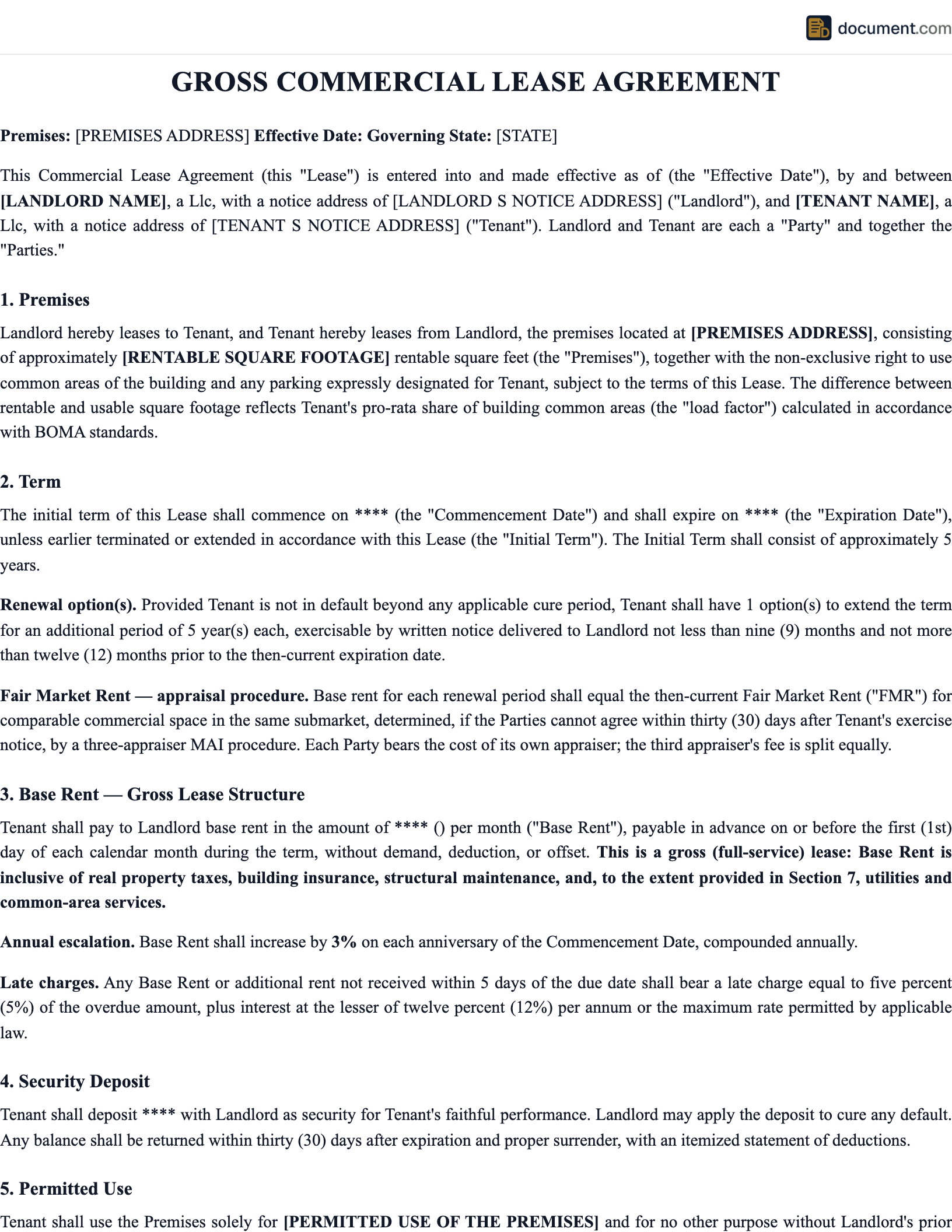



Louisiana Gross Commercial Lease Agreement Overview
Louisiana gross commercial leases are governed by the Civil Code rather than common law, which makes them meaningfully different from gross leases in every other state. Articles 2668 through 2729 of the Louisiana Civil Code establish baseline obligations for lessor and lessee, some of which apply even if the lease does not address them. A gross lease in Louisiana must be drafted with these code provisions in mind, not just standard commercial lease practice from common-law states.
In a Louisiana gross lease, the landlord covers parish-assessed property taxes, building insurance, and maintenance in the base rent. The lessor's privilege under the Civil Code also applies, giving the landlord an automatic statutory lien on tenant movables for unpaid rent, regardless of whether the lease is gross or NNN. New Orleans and Baton Rouge are the main commercial markets, and gross leases are relatively common in smaller retail and office spaces throughout both metros. Flood insurance is a particularly important cost consideration in New Orleans and low-lying areas of Jefferson Parish.
$55
Filing fee
Required
Notarization
2
Witnesses required
Clerk
Filing office
Louisiana Gross Lease Requirements
Louisiana gross leases must comply with the Civil Code lease provisions, and several statutory obligations apply automatically regardless of what the lease says. The lessor's privilege is the most important example: it gives the landlord a lien on tenant movables without any written agreement. Beyond the Civil Code baseline, the parties can and should define all expense inclusions, exclusions, and any expense stop provisions with precision.
Louisiana Specific Note
Louisiana is the only state where commercial leases are governed by the Civil Code rather than common law. A gross lease drafted by a common-law attorney without Louisiana-specific knowledge may miss the lessor's privilege, recordation requirements, and Civil Code baseline obligations. Flood insurance must be addressed explicitly in any New Orleans or coastal Louisiana gross lease where the property is in a flood zone.
Key Louisiana Gross Lease Terms
- Civil Code Compliance: Review lease terms against Louisiana Civil Code Articles 2668-2729 for baseline obligations
- Lessor's Privilege: Address whether the landlord will subordinate the automatic statutory privilege for tenants with significant movables
- Expense Inclusions: List all costs covered in the gross rent, including parish taxes, insurance, and maintenance
- Flood Insurance: Specify whether flood insurance is embedded in the gross rent or handled separately
- Recordation: For leases of one year or more, record a memorandum with the parish clerk of court
How to Execute a Louisiana Gross Lease
Louisiana's civil law framework adds steps beyond what is required in other states. Here is a practical sequence for executing a Louisiana gross commercial lease.
Engage a Louisiana-Licensed Attorney
Louisiana's civil law framework requires a Louisiana-licensed attorney for any commercial gross lease. Civil Code obligations and the automatic lessor's privilege are issues that common-law practitioners from other states routinely miss.
Negotiate Expense Inclusions and Privilege Terms
Agree on all costs embedded in the gross rent, including parish taxes and flood insurance. If the tenant has significant equipment on-site, negotiate a written subordination or waiver of the lessor's privilege.
Execute Before a Notary With Two Witnesses
For authentic act execution required for recording, both parties sign before a Louisiana notary public and two disinterested witnesses. Retain original executed copies for both landlord and tenant.
Record a Memorandum With the Parish Clerk
File a memorandum of lease with the parish clerk of court to provide constructive notice. Record the memorandum rather than the full lease to keep rent and financial terms out of the public record.
Review Annual Expense Components
If the gross lease includes an expense stop, track actual parish tax bills and insurance premiums annually to monitor whether the stop threshold is being approached. Flood insurance premiums in New Orleans can fluctuate significantly.
Louisiana Gross Lease Costs
Typical occupancy costs for a Louisiana gross commercial lease. Flood insurance and parish property taxes are Louisiana-specific cost factors that should be factored into gross rent pricing.
| Cost Item | Typical Range |
|---|---|
| Gross Rent (retail/office, New Orleans area) | $14 - $30 per sq ft per year |
| Tenant-Direct Utilities (if excluded from gross) | $1.50 - $4.00 per sq ft per year |
| Expense Stop Overage (if applicable) | Varies by base year and parish tax assessments |
| Louisiana-Licensed Attorney Review | $1,000 - $3,500 |
Sample Louisiana Gross Commercial Lease Agreement
Below is a preview of our Louisiana-specific template. Your customized document will include all fields and provisions required for filing in any Louisiana county.
GROSS COMMERCIAL LEASE AGREEMENT
STATE OF LOUISIANA
Legal Document Template
LANDLORD
Name: [Full Legal Name]
Address: [Business Address]
Contact: [Phone/Email]
TENANT
Name: [Full Legal Name / Entity]
Address: [Current Address]
Tax ID: [EIN/SSN]
PREMISES
Address: [Property Address]
Suite: [Number]
Rentable SF: [Square Feet]
Usable SF: [Square Feet]
FINANCIAL TERMS
Base Rent: $[Amount]/month
Expense Stop: $[Amount]/SF
Security Deposit: $[Amount]
Escalation: [%]/year
Louisiana Gross Commercial Lease Agreement FAQ
Answers to common questions about filing a gross commercial lease agreement in Louisiana, including requirements, fees, and procedures.
Official Louisiana Resources
Use these official state resources to verify requirements, find your local filing office, and access government forms for Louisiana.
Related Louisiana Documents
Depending on your situation, you may need additional documents alongside your Louisiana gross commercial lease agreement.
Create your Louisiana Commercial Gross Lease Agreement in under 5 minutes.
Answer a few questions and download a Louisiana-compliant document, ready for the state agency.