



West Virginia Gross Commercial Lease Agreement Overview
A gross commercial lease in West Virginia bundles most or all operating expenses into the base rent. The tenant pays one predictable monthly amount and the landlord handles property taxes, building insurance, and common area maintenance from that rent. This simplicity makes gross leases appealing for smaller tenants and office users who prefer to avoid the accounting complexity of NNN leases. West Virginia's commercial office markets in Charleston, Morgantown, and Huntington use gross leases across a range of property types.
West Virginia commercial leases are governed by contract law. The lease document defines what is and is not included in the gross rent, and tenants should read those provisions carefully rather than assuming all expenses are covered. Many West Virginia gross leases include expense stop provisions that pass through operating costs above a defined threshold, creating partial tenant liability despite the gross structure.
All-in
Rent structure
Expense stop
Key provision
Base year
Expense benchmark
Contract
Governs all terms
West Virginia Gross Lease Requirements
West Virginia commercial leases are primarily contract documents. There is no specialized commercial landlord-tenant statute that sets mandatory terms for gross leases. The parties negotiate and document the expense structure in the lease, and West Virginia courts interpret the resulting language literally. Getting the expense inclusion and exclusion provisions right from the start prevents disputes that could have been avoided with clearer drafting.
West Virginia Expense Stop Note
Many West Virginia gross leases include expense stop provisions that pass through operating cost increases above a defined base year amount. Tenants negotiating a gross lease in West Virginia should confirm whether an expense stop applies, what the base year is, which expense categories are subject to the stop, and whether utilities are included or excluded from the gross rent calculation.
Key West Virginia Gross Lease Provisions
- Expense Inclusions: Define which operating expenses (taxes, insurance, CAM, utilities, janitorial) are covered in the base rent versus excluded as direct tenant obligations
- Expense Stop Provision: If an expense stop applies, the base year must be defined, the stop amount calculated, and the pass-through mechanism explained clearly in the lease
- Base Year Selection: The base year should reflect normal operating conditions; a year with unusually low expenses creates a low stop that results in earlier and larger overages for the tenant
- Gross-Up Provision: In a multi-tenant West Virginia building, request a gross-up that adjusts expense calculations to reflect full occupancy, preventing low-occupancy years from distorting the base year expense level
- Audit Rights: Negotiate the right to audit landlord expense calculations if an overage billing is issued, with a defined 60-day window after receiving the annual reconciliation statement
How to Negotiate and Execute a West Virginia Gross Lease
Negotiating a West Virginia gross lease requires understanding what is and is not in the base rent, and documenting the agreed expense structure in the lease with precision. These five steps guide the process.
Confirm What Is Included in the Gross Rent
Ask the landlord to provide a written list of expenses covered in the base rent and any exclusions. In West Virginia, many smaller landlords use simple gross lease forms where everything is included, while larger institutional properties use gross leases with expense stops and exclusions. Understand which structure you are dealing with before negotiating base rent
Negotiate the Expense Stop and Base Year
If an expense stop applies, push for a base year that reflects full building occupancy under normal operating conditions. Negotiate which expense categories are subject to the stop and whether capital expenditures are excluded. A well-negotiated expense stop structure limits potential overage billings throughout the lease term
Verify Utility and Maintenance Inclusions
Confirm whether utilities are included in the gross rent or paid directly by the tenant. Also confirm maintenance obligations for HVAC, interior finishes, and common areas. These distinctions affect total occupancy cost and should be resolved before the lease is drafted
Have a West Virginia Attorney Review the Lease
A West Virginia commercial real estate attorney should review the expense inclusions, exclusions, and expense stop provisions to confirm they match the negotiated intent. Attorney review is particularly important in West Virginia because the commercial lease statute provides minimal tenant protection and courts interpret lease language literally
Execute and Track Any Expense Overages
Both parties sign the lease. If the lease includes an expense stop with overage provisions, keep a copy of the base year expense statement and track annual landlord billings against it. Verify any overage charges within the audit window specified in the lease
West Virginia Gross Lease Costs
The main cost under a West Virginia gross lease is the all-inclusive base rent. Additional costs depend on what exclusions the lease contains. The table below covers the primary cost items for West Virginia gross lease tenants.
| Cost Item | Typical Range |
|---|---|
| Base Rent (gross, West Virginia office) | $12 - $28 per sq ft per year |
| Expense Overage (above expense stop) | Varies; depends on base year and expense stop amount |
| Utilities (if separately metered and excluded) | $1.50 - $4 per sq ft per year |
| Security Deposit | 1 - 2 months' base rent (negotiated) |
| Attorney Review (West Virginia) | $750 - $2,500 |
Sample West Virginia Gross Commercial Lease Agreement
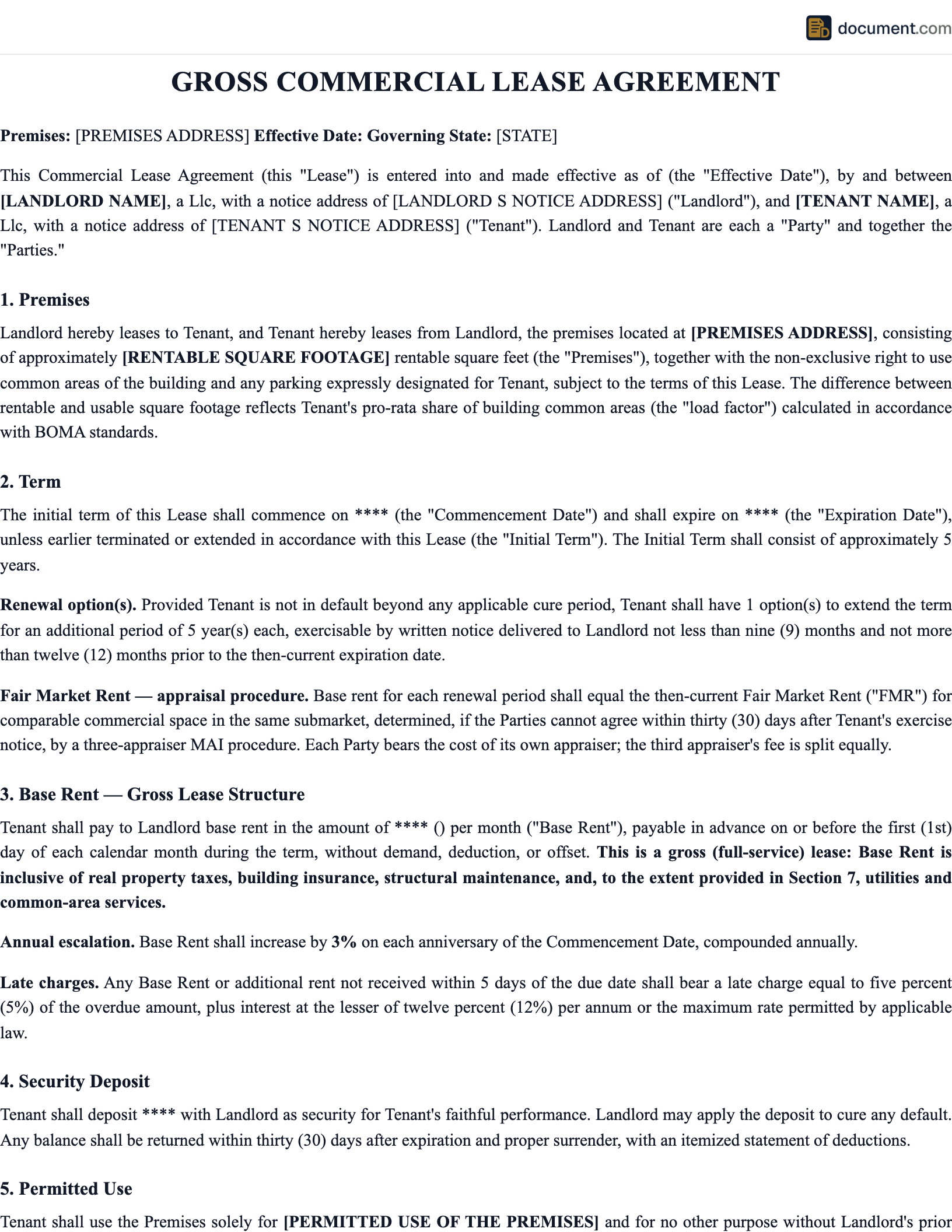
Below is a preview of our West Virginia-specific template. Your customized document will include all fields and provisions required for filing in any West Virginia county.
GROSS COMMERCIAL LEASE AGREEMENT
STATE OF WEST VIRGINIA
Legal Document Template
LANDLORD
Name: [Full Legal Name]
Address: [Business Address]
Contact: [Phone/Email]
TENANT
Name: [Full Legal Name / Entity]
Address: [Current Address]
Tax ID: [EIN/SSN]
PREMISES
Address: [Property Address]
Suite: [Number]
Rentable SF: [Square Feet]
Usable SF: [Square Feet]
FINANCIAL TERMS
Base Rent: $[Amount]/month
Expense Stop: $[Amount]/SF
Security Deposit: $[Amount]
Escalation: [%]/year
West Virginia Gross Commercial Lease Agreement FAQ
Answers to common questions about filing a gross commercial lease agreement in West Virginia, including requirements, fees, and procedures.
Official West Virginia Resources
Use these official state resources to verify requirements, find your local filing office, and access government forms for West Virginia.
Related West Virginia Documents
Depending on your situation, you may need additional documents alongside your West Virginia gross commercial lease agreement.
Create your West Virginia Commercial Gross Lease Agreement in under 5 minutes.
Answer a few questions and download a West Virginia-compliant document, ready for the state agency.