



Wisconsin Gross Commercial Lease Agreement Overview
A gross commercial lease in Wisconsin gives tenants the simplicity of a single monthly payment that covers rent and, in theory, most or all operating expenses. Rather than tracking separate bills for property taxes, insurance, and maintenance, the tenant writes one check and the landlord handles the rest. This structure is common in Wisconsin multi-tenant office buildings, neighborhood retail centers, and medical office parks where landlords want to control the building environment and tenants want predictable costs.
In practice, Wisconsin gross leases nearly always include an expense stop or base year mechanic that transfers some cost risk back to the tenant over time. When operating expenses exceed the stated baseline, the tenant pays their proportionate share of the overage. Understanding how the expense stop works, which year is used as the base, and what items are excluded from the all-in rent is essential before signing. Wisconsin commercial leases are governed by contract, and negotiating these details upfront determines how much protection the tenant actually has.
All-in
Rent structure
Expense stop
Cost protection method
Base year
Sets cost benchmark
Contract
Governs all terms
Wisconsin Gross Lease Requirements
Wisconsin gross leases are governed entirely by contract. There is no state statute mandating what a gross lease must include, which means the protections you have depend on what you negotiate and document before execution.
Wisconsin Expense Stop Note
Most Wisconsin gross leases contain an expense stop or base year provision that shifts a portion of operating cost increases to the tenant. Review this language carefully before signing. A base year set at artificially low expense levels, or an expense stop defined without exclusions for capital items, can result in significant unexpected costs over a multi-year lease term.
Key Gross Lease Provisions
- Expense Inclusions: The lease should specify which operating costs are included in the flat rent, such as property taxes, building insurance, HVAC maintenance, landscaping, and common area utilities
- Expense Stop: If the lease contains an expense stop, confirm it is based on actual audited expenses rather than landlord projections, and that capital replacements and above-market management fees are excluded from the calculation
- Base Year Selection: Negotiate a base year that reflects a fully occupied, normally operating building. A depressed base year, such as one with unusually low expenses or partial occupancy, can accelerate the tenant's exposure to overage charges
- Gross-Up Provision: Understand how the landlord grosses up variable expenses for occupancy. Confirm the gross-up applies only to variable costs and uses a reasonable occupancy assumption, typically 95 percent
- Audit Rights: Include a right to audit the landlord's expense records within a defined period after receiving any annual expense statement or true-up bill
How to Negotiate and Execute a Wisconsin Gross Commercial Lease
A Wisconsin gross lease negotiation involves more than agreeing on a monthly rent number. The following steps outline how to protect yourself through the process.
Request Historical Expense Data
Ask the landlord for actual operating expense statements for the past two to three years. This reveals what costs are running at the property and helps you evaluate whether the proposed expense stop or base year is favorable or problematic.
Negotiate the Expense Stop and Base Year
Confirm the base year reflects a fully occupied building with normal expense levels. Negotiate exclusions for capital items, above-market management fees, and non-recurring costs. Push for audit rights so you can verify the landlord's expense calculations each year.
Clarify What Is and Is Not Included
Walk through the expense section of the lease and identify any costs the landlord has excluded from the all-in rent. In-suite janitorial, after-hours HVAC, and above-standard utilities are commonly carved out. Understand your full cost picture before agreeing to the rent number.
Have a Wisconsin Attorney Review the Draft
A Wisconsin commercial real estate attorney can review the expense definitions, gross-up methodology, and escalation provisions before you sign. Multi-year leases in markets like Madison, Milwaukee, or Green Bay involve significant financial commitments where small differences in lease language can compound over time.
Execute and Track Expense Reconciliations
Once the lease is signed, keep track of any expense reconciliation statements you receive. If the landlord bills an expense stop overage, request documentation supporting the charges and exercise your audit rights if the amounts seem inconsistent with prior years.
Wisconsin Gross Lease Fees & Costs
Wisconsin gross lease costs include the all-in base rent plus any items the landlord has carved out of the gross structure. The ranges below reflect typical Wisconsin commercial office and retail markets.
| Cost Item | Typical Range |
|---|---|
| Base Rent (gross, all-inclusive) | $12 to $28 per sq ft annually (office and retail; varies by market) |
| Expense Stop Overage (if applicable) | Prorated share of costs above base year; billed annually |
| Utilities (if excluded) | $1 to $3 per sq ft annually depending on metering and usage |
| Security Deposit | Typically one to two months of gross rent |
| Attorney Review | $1,500 to $4,000 depending on lease complexity |
Sample Wisconsin Gross Commercial Lease Agreement
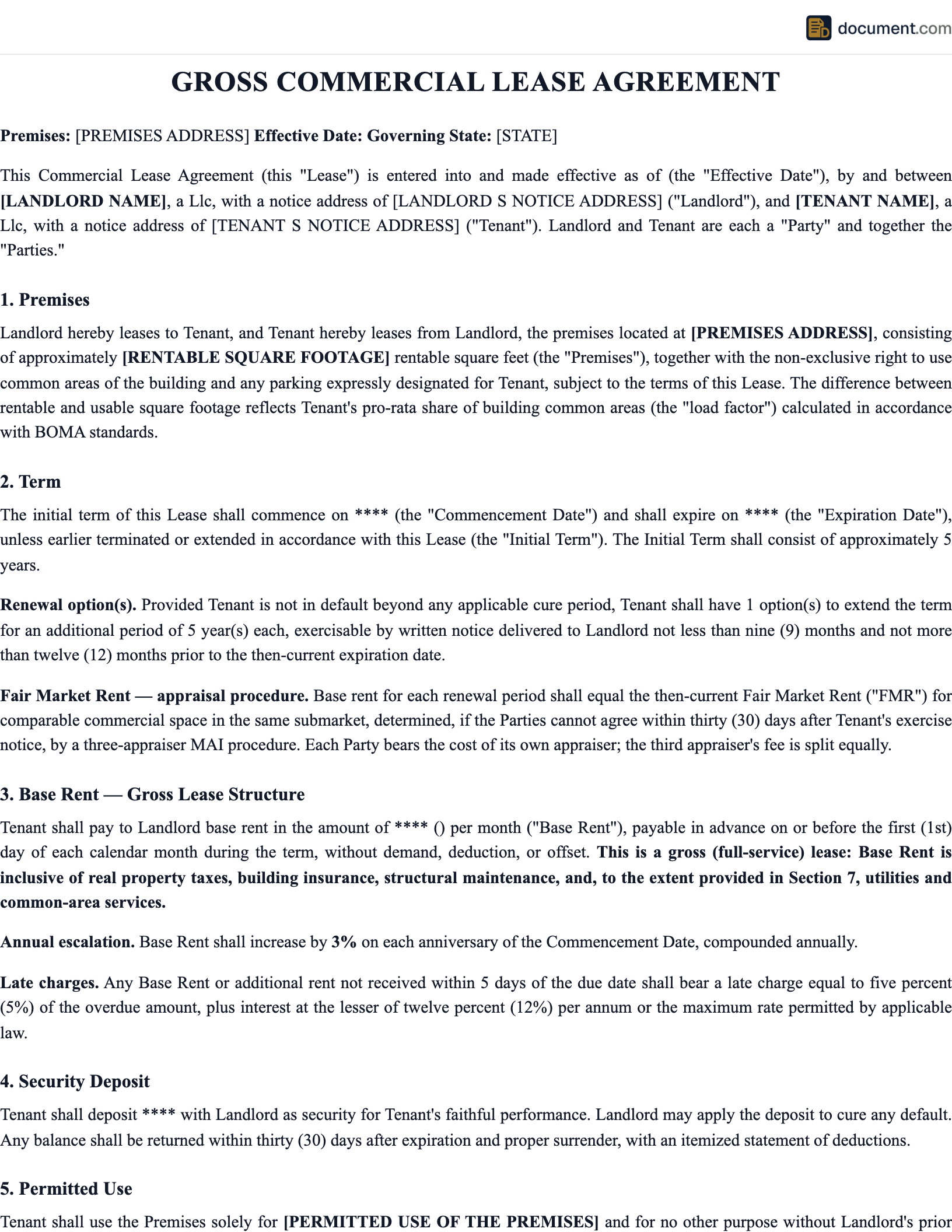
Below is a preview of our Wisconsin-specific template. Your customized document will include all fields and provisions required for filing in any Wisconsin county.
GROSS COMMERCIAL LEASE AGREEMENT
STATE OF WISCONSIN
Legal Document Template
LANDLORD
Name: [Full Legal Name]
Address: [Business Address]
Contact: [Phone/Email]
TENANT
Name: [Full Legal Name / Entity]
Address: [Current Address]
Tax ID: [EIN/SSN]
PREMISES
Address: [Property Address]
Suite: [Number]
Rentable SF: [Square Feet]
Usable SF: [Square Feet]
FINANCIAL TERMS
Base Rent: $[Amount]/month
Expense Stop: $[Amount]/SF
Security Deposit: $[Amount]
Escalation: [%]/year
Wisconsin Gross Commercial Lease Agreement FAQ
Answers to common questions about filing a gross commercial lease agreement in Wisconsin, including requirements, fees, and procedures.
Official Wisconsin Resources
Use these official state resources to verify requirements, find your local filing office, and access government forms for Wisconsin.
Related Wisconsin Documents
Depending on your situation, you may need additional documents alongside your Wisconsin gross commercial lease agreement.
Create your Wisconsin Commercial Gross Lease Agreement in under 5 minutes.
Answer a few questions and download a Wisconsin-compliant document, ready for the state agency.