



Illinois Gross Commercial Lease Agreement Overview
A gross commercial lease in Illinois is a lease structure where the tenant pays one fixed rent amount and the landlord handles most or all building operating costs out of that payment. Property taxes, building insurance, and common area maintenance are landlord obligations, which gives tenants cost certainty that a triple net lease does not. This structure is used throughout Illinois office markets, including the Chicago Loop, River North, Naperville, and Schaumburg, as well as in smaller commercial buildings downstate.
Most Illinois gross leases are not truly flat-cost arrangements. They contain an expense stop tied to a base year, which caps the landlord's expense responsibility and passes cost overruns to the tenant. With Cook County property taxes among the highest in the country for commercial properties, and with a triennial reassessment cycle that can produce large year-over-year swings, the base year and expense stop provisions deserve careful attention before signing.
No state
Commercial rent tax
Common
Expense stop included
Base year
Expense benchmark
Triennial
Cook County reassessment
Illinois Gross Lease Requirements
Illinois gross commercial leases are governed by general contract law under the Illinois Compiled Statutes. There is no state statute specifically regulating commercial lease structure, so the parties negotiate the expense coverage framework directly. The following provisions determine whether the lease actually functions as a true gross lease or as a modified gross with significant tenant exposure.
Illinois Base Year and Expense Stop Note
In most Illinois gross commercial leases, the expense stop is tied to a base year. Choose the base year carefully: a landlord with high vacancies in the base year may show artificially low operating costs, which sets a lower expense stop and increases the tenant's exposure to overages in future years. Negotiate for a fully occupied base year or a gross-up provision that normalizes costs to 95 percent or higher occupancy.
Key Lease Provisions
- Expense Inclusions and Exclusions: List which operating expenses the landlord covers; common exclusions for the tenant are interior janitorial, tenant-specific utilities, and tenant improvement costs
- Expense Stop or Base Year: Set the dollar threshold above which the landlord passes costs to the tenant; define which cost categories are subject to the stop and how the annual reconciliation works
- Gross-Up Provision: Require that variable operating costs be grossed up to reflect a building at 95 percent occupancy in the base year, preventing an artificially low expense stop from creating unexpected overages
- Escalation Clause: Specify the rent escalation structure, whether fixed annual percentage, CPI tied to the Chicago metro index, or stepped rents at defined intervals
- Structural Responsibility: Confirm that structural repairs, roof, and building systems remain landlord obligations; specify the process and timeline for repair requests and landlord response
How to Prepare an Illinois Gross Commercial Lease
Drafting a gross commercial lease for an Illinois property requires careful attention to the expense coverage framework and escalation structure. Follow these steps to prepare a complete, enforceable document.
Clarify What the Gross Rent Includes
Confirm with the landlord exactly which expenses are covered by the base rent. Get a list of what is excluded (such as tenant-specific utilities or janitorial service). Request the property's operating cost history for the past two to three years to evaluate what the expense stop represents in dollar terms.
Negotiate the Expense Stop and Base Year
Agree on a base year that reflects normal occupancy and expense conditions. Request a gross-up provision if the base year had low occupancy. Set the expense stop at a level you can model accurately over the lease term, factoring in the Cook County reassessment cycle if the property is in that county.
Address Escalation and Renewal Terms
Define how the base rent escalates over the lease term. Fixed annual increases of 2 to 3 percent are common in Illinois office markets. If escalation is CPI-based, specify whether it uses the Chicago metro index or a national benchmark. Address renewal option rent at this stage as well.
Confirm Structural Repair Obligations
Under an Illinois gross lease, structural repairs and roof maintenance are generally landlord responsibilities. Make sure the lease explicitly assigns these obligations, sets a landlord response timeline for repair requests, and specifies tenant remedies if repairs are not completed within that period.
Execute and Retain Copies
Both parties sign the executed lease. Provide copies to all parties. For leases over five years, consider recording a memorandum of lease with the county recorder of deeds to protect the tenant's leasehold interest against future property transfers or lender claims.
Illinois Gross Lease Fees & Costs
Typical costs associated with an Illinois gross commercial lease. Tenant-paid utilities and expense stop overages are the main variable items after base rent.
| Cost Item | Typical Amount |
|---|---|
| Base Rent | Negotiated; varies by submarket and building class |
| Expense Stop Overages | Pro-rata share of operating costs above the base year stop |
| Tenant-Paid Utilities | Electric, gas, and data services typically excluded from gross rent |
| Attorney Review | $500 - $2,500+ depending on lease length and complexity |
| Memorandum of Lease Recording (optional) | County recorder fees; Cook County charges per-page fees |
Sample Illinois Gross Commercial Lease Agreement
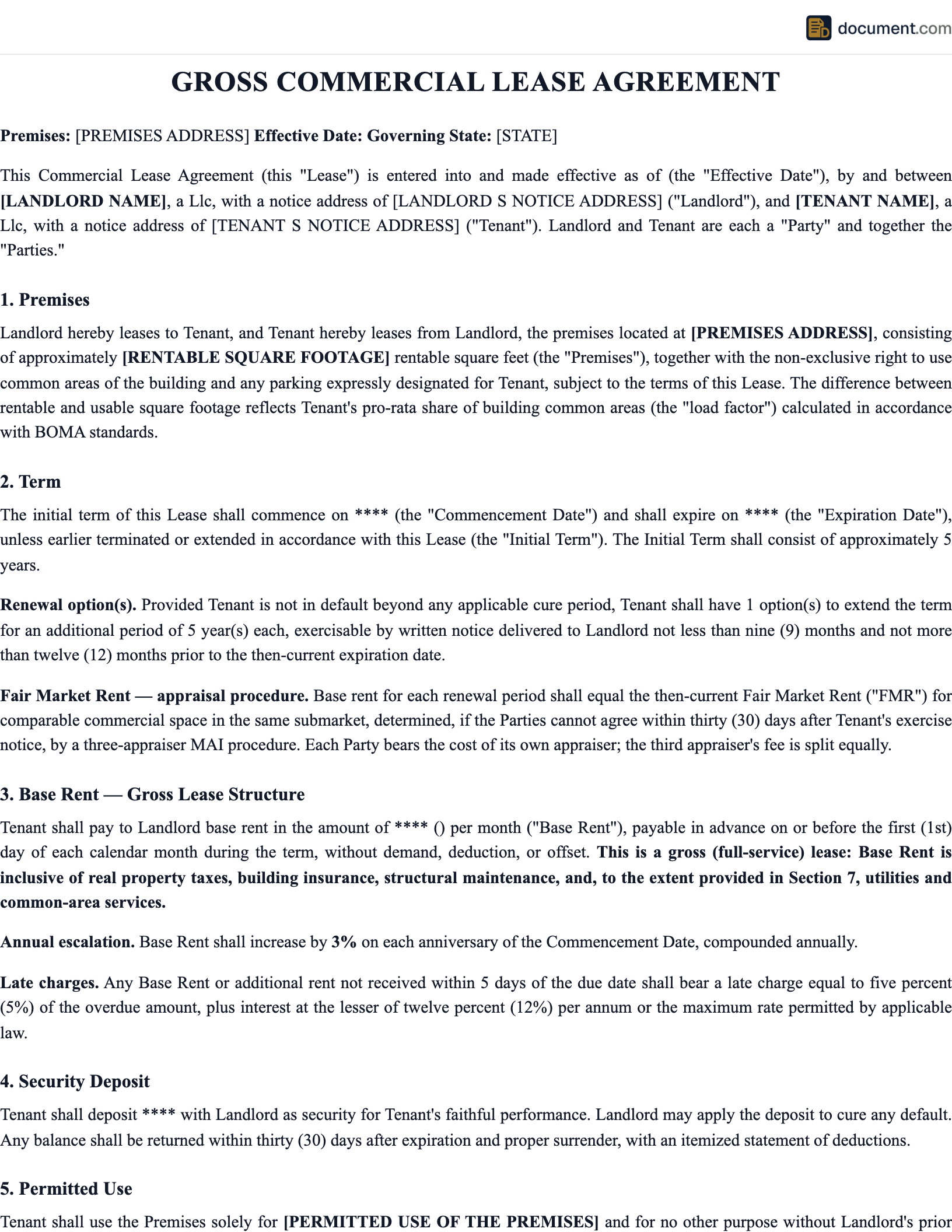
Below is a preview of our Illinois-specific template. Your customized document will include all fields and provisions required for filing in any Illinois county.
GROSS COMMERCIAL LEASE AGREEMENT
STATE OF ILLINOIS
Legal Document Template
LANDLORD
Name: [Full Legal Name]
Address: [Business Address]
Contact: [Phone/Email]
TENANT
Name: [Full Legal Name / Entity]
Address: [Current Address]
Tax ID: [EIN/SSN]
PREMISES
Address: [Property Address]
Suite: [Number]
Rentable SF: [Square Feet]
Usable SF: [Square Feet]
FINANCIAL TERMS
Base Rent: $[Amount]/month
Expense Stop: $[Amount]/SF
Security Deposit: $[Amount]
Escalation: [%]/year
Illinois Gross Commercial Lease Agreement FAQ
Answers to common questions about filing an gross commercial lease agreement in Illinois, including requirements, fees, and procedures.
Official Illinois Resources
Use these official state resources to verify requirements, find your local filing office, and access government forms for Illinois.
Related Illinois Documents
Depending on your situation, you may need additional documents alongside your Illinois gross commercial lease agreement.
Create your Illinois Commercial Gross Lease Agreement in under 5 minutes.
Answer a few questions and download a Illinois-compliant document, ready for the state agency.