



Hawaii Gross Commercial Lease Agreement Overview
A gross commercial lease in Hawaii is a structure where the tenant pays a single base rent and the landlord handles most or all of the building's operating costs out of that rent. This contrasts with a triple net lease where tenants pay taxes, insurance, and maintenance separately. For office tenants and professional service businesses, a gross lease offers cost predictability that a NNN structure cannot. Hawaii's commercial landlords most commonly use gross and modified gross structures in office parks, medical buildings, and older multi-tenant retail centers.
One factor that shapes every Hawaii commercial gross lease is the general excise tax on rental income. Most landlords pass the GET through to tenants as a separately itemized charge on top of base rent, even when the lease is characterized as a gross lease. The effective occupancy cost for a Hawaii gross lease tenant is therefore base rent plus GET, which at the Oahu rate of 4.5% adds meaningfully to total cost. Tenants should verify how GET is handled before comparing gross rent quotes across properties.
$36
Filing fee
Required
Notarization
0
Witnesses required
Bureau
Filing office
Hawaii Gross Lease Requirements
Hawaii commercial leases are governed by contract law rather than a dedicated commercial landlord-tenant statute. That means the written lease terms control most disputes. For a gross lease to be enforceable, it must be in writing if the term exceeds one year under Hawaii's statute of frauds, and it should clearly define what the base rent includes and excludes. Ambiguity in the expense structure is the most common source of gross lease disputes.
Hawaii GET: Gross Lease Trap to Avoid
A landlord quoting a gross rent that does not mention GET may intend to add the GET on top of that rent. Hawaii's GET (4% base rate, 4.5% on Oahu) applies to commercial rental income and is almost always passed to tenants. Confirm in writing whether the stated gross rent is inclusive or exclusive of GET before signing any letter of intent.
Key Provisions for a Hawaii Gross Lease
- Expense Inclusions: List every operating cost covered by the gross rent, such as property taxes, insurance, exterior maintenance, and common area utilities
- Expense Exclusions: Identify any items excluded from the gross rent, typically utilities metered to the premises, janitorial within the suite, and GET
- Expense Stop or Base Year: If the lease has an expense stop or base year, define how overages are calculated and billed to the tenant
- Gross-Up Provision: If a base year is used, include a provision to gross up base year expenses to reflect full building occupancy
- Escalation Clause: Specify how and when base rent increases, whether by fixed percentage, CPI, or periodic fair market adjustment
- GET Passthrough Language: State clearly whether the tenant pays GET in addition to the quoted gross rent and how changes in the GET rate are handled
How to Prepare a Hawaii Gross Commercial Lease
A Hawaii gross lease negotiation typically starts with a letter of intent from the tenant. Once the economic terms are agreed upon, the parties move to the formal lease document. The steps below cover what to address at each stage.
Clarify Whether the Quoted Rent Includes GET
Before negotiating any other terms, confirm in writing whether the gross rent figure includes Hawaii's general excise tax. A $3,000 per month quoted rent becomes roughly $3,135 on Oahu once the 4.5% GET passthrough is added. Settle this in the letter of intent so there are no surprises later.
Negotiate What the Gross Rent Covers
Get a list of what the landlord includes in the quoted rent. Common inclusions are property taxes, building insurance, landscaping, exterior repairs, and common area utilities. Confirm whether interior janitorial, suite utilities, and after-hours HVAC are extra or bundled in.
Review Escalation and Expense Stop Terms
If the landlord uses a base year expense stop, request actual expense data for the base year rather than accepting an estimate. Confirm how the gross-up calculation works for partial-occupancy years. Negotiate a cap on annual rent escalation and make sure the cap applies to both the base rent and any expense overages the lease allows the landlord to pass through.
Confirm Ground Lease Status if Applicable
Many Hawaii commercial buildings are on ground leases from private landowners. If so, ask for the ground lease term and renewal options. A gross lease in a building with a short-horizon ground lease creates real risk for tenants who invest in tenant improvements and expect a long occupancy.
Execute and Distribute
Both landlord and tenant sign the lease. Provide original or certified copies to each party. Attach any exhibits for floor plans, work letter, parking allocations, and the GET passthrough addendum. File a memorandum of lease with the Bureau of Conveyances if recording is desired for public notice purposes.
Hawaii Gross Lease Costs
The primary ongoing cost in a Hawaii gross lease is base rent plus GET. Upfront professional fees depend on lease complexity. The table below summarizes typical cost categories.
| Cost Item | Typical Range |
|---|---|
| General Excise Tax on Rent | 4% statewide; 4.5% on Oahu (usually passed to tenant) |
| Expense Stop Overages (if applicable) | Tenant's pro-rata share of expenses exceeding the base year or stop amount |
| Tenant-Paid Utilities (if excluded) | Varies; electric in Hawaii is among the highest in the nation |
| Attorney Review | $500 to $2,500 depending on lease size and complexity |
| Memorandum of Lease Recording (optional) | $36 base filing fee at Bureau of Conveyances |
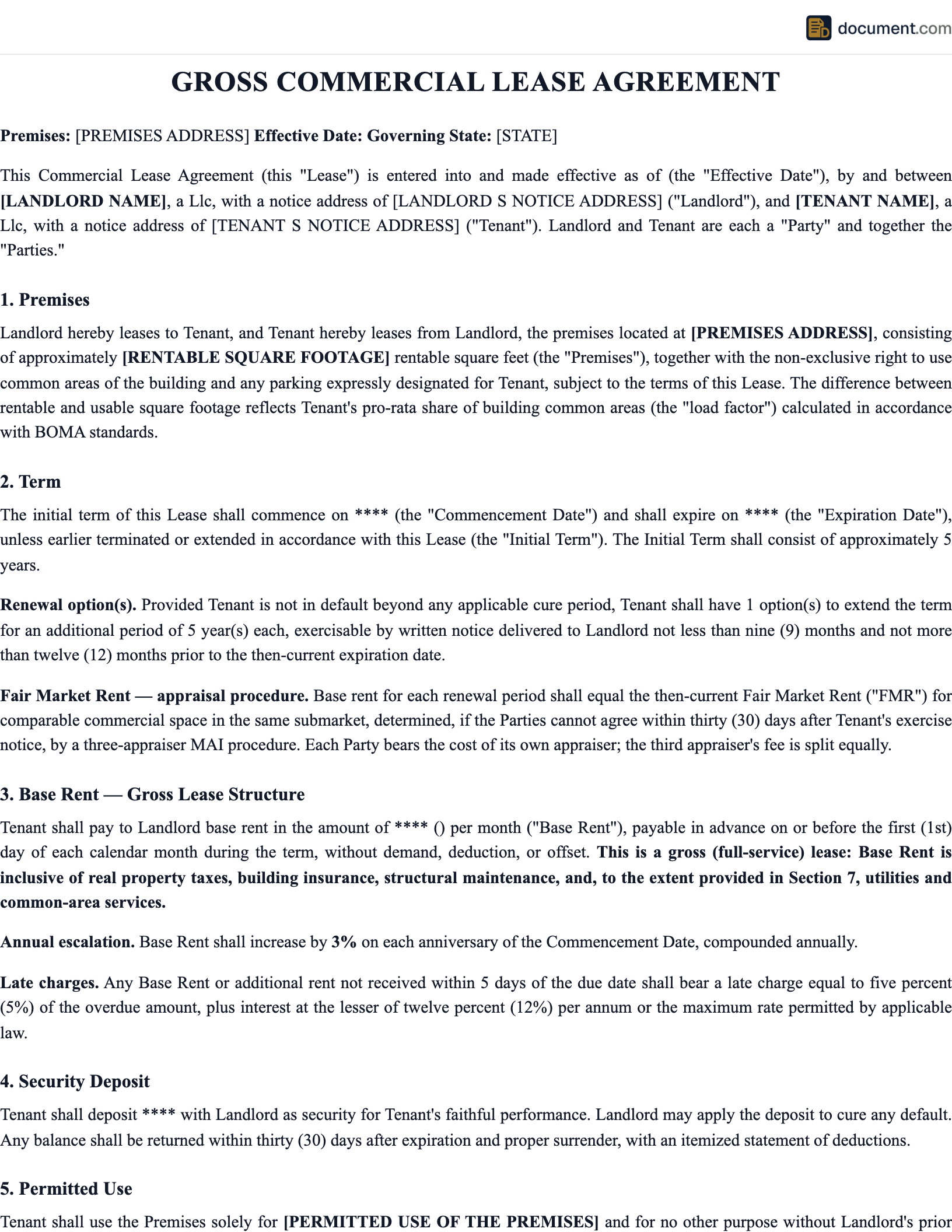
Sample Hawaii Gross Commercial Lease Agreement
Below is a preview of our Hawaii-specific template. Your customized document will include all fields and provisions required for filing in any Hawaii county.
GROSS COMMERCIAL LEASE AGREEMENT
STATE OF HAWAII
Legal Document Template
LANDLORD
Name: [Full Legal Name]
Address: [Business Address]
Contact: [Phone/Email]
TENANT
Name: [Full Legal Name / Entity]
Address: [Current Address]
Tax ID: [EIN/SSN]
PREMISES
Address: [Property Address]
Suite: [Number]
Rentable SF: [Square Feet]
Usable SF: [Square Feet]
FINANCIAL TERMS
Base Rent: $[Amount]/month
Expense Stop: $[Amount]/SF
Security Deposit: $[Amount]
Escalation: [%]/year
Hawaii Gross Commercial Lease Agreement FAQ
Answers to common questions about filing a gross commercial lease agreement in Hawaii, including requirements, fees, and procedures.
Official Hawaii Resources
Use these official state resources to verify requirements, find your local filing office, and access government forms for Hawaii.
Related Hawaii Documents
Depending on your situation, you may need additional documents alongside your Hawaii gross commercial lease agreement.
Create your Hawaii Commercial Gross Lease Agreement in under 5 minutes.
Answer a few questions and download a Hawaii-compliant document, ready for the state agency.