



Virginia Gross Commercial Lease Agreement Overview
A gross commercial lease in Virginia is the structure most commonly found in the state's office market. The landlord covers building operating costs out of the base rent, and the tenant pays a single, predictable monthly amount. Virginia has no statutes specifically governing commercial gross lease expense structures, so the entire arrangement is defined by the lease document. That makes the expense stop clause, the base year selection, and the list of inclusions and exclusions the most important provisions in the deal.
Northern Virginia office markets from Tysons Corner through Reston, Herndon, and the Route 28 technology corridor are the primary home of gross lease arrangements in the state. Federal government tenants and large federal contractors favor gross leases for their budget predictability, which shapes how landlords in those markets structure their lease offerings. Richmond and Norfolk also have active gross lease office markets, though those markets are generally more negotiable than the high-demand NoVA corridor.
All-in
Rent structure
Expense stop
Key provision
Base year
Expense benchmark
Common
NoVA office market
Virginia Gross Lease Requirements
Virginia commercial gross leases are governed by contract law. There are no state statutes that specify how gross lease expense inclusions must be structured or what expense stop formulas must look like. That flexibility is a double-edged sword: tenants can negotiate favorable terms, but anything left vague in the document will be difficult to enforce later. Getting the expense definitions, base year, and gross-up provisions nailed down before signing is essential.
Virginia Specific Note
Northern Virginia institutional landlords often use form leases with expense stop provisions drafted in their favor. The base year, gross-up language, and exclusion list are the three areas where tenants most commonly leave money on the table. Review each of these provisions carefully before executing any Virginia gross commercial lease.
Key Gross Lease Provisions for Virginia
- Expense Inclusions and Exclusions: Confirm exactly which operating costs the landlord covers and which are carved out to the tenant, such as utilities, janitorial, or parking
- Expense Stop Clause: Define the expense stop amount clearly, typically pegged to base year actual expenses, and confirm how overage is calculated and billed
- Base Year Selection: Negotiate a base year that reflects a fully occupied building with normal operating costs to avoid an artificially low expense stop baseline
- Gross-Up Provision: Ensure the lease grosses up variable operating expenses to at least 95 percent occupancy when calculating the expense stop, protecting tenants from paying inflated costs during periods of low building occupancy
- Capital Expenditure Exclusion: Push to exclude capital repairs and major system replacements from the expenses the tenant shares in above the stop
- Audit Rights: Negotiate the right to audit the landlord's operating expense documentation within a reasonable window after receiving any overage statement
How to Negotiate and Execute a Virginia Gross Lease
Negotiating a Virginia gross commercial lease requires more than reviewing the base rent. The expense stop, base year, and gross-up provisions have long-term cost implications that are often more significant than the stated rent. Here is a practical sequence to follow.
Review the Expense Inclusion List
Obtain a clear list of what operating costs are included in the gross base rent and what is excluded. Confirm whether utilities, janitorial, parking, and HVAC service contracts are covered by the landlord or billed separately to the tenant.
Negotiate the Base Year and Expense Stop
Select a base year that reflects normal, fully occupied building operations. Push for a gross-up provision that normalizes variable costs to at least 95 percent occupancy. A landlord-drafted lease will often have a base year favorable to the landlord.
Confirm Capital Expenditure Exclusions
Negotiate language that excludes capital repairs, major system replacements, and structural improvements from the operating expense pool. These should be the landlord's responsibility and should not flow through to the tenant's expense overage obligation.
Execute the Lease with Both Parties
Both landlord and tenant sign the final lease. Virginia does not require notarization for a commercial lease to be enforceable between the parties, but some lenders and institutional landlords require it for their own internal requirements.
Track Lease Dates and Review Any Expense Overages
Calendar the annual lease anniversary and any expense reconciliation windows. If the landlord bills an expense overage above the stop, request supporting documentation and review it against the base year expense schedule before paying.
Virginia Gross Lease Fees & Costs
Below are the typical costs involved in entering into a Virginia gross commercial lease, including upfront transaction costs and the ongoing expense components tenants should budget for.
| Fee / Cost | Typical Amount |
|---|---|
| Base Rent (Gross) | Negotiated per sq ft annually; includes most operating costs; NoVA Class A office often ranges from $35 to $55 per sq ft |
| Expense Overage (above stop) | Depends on operating cost increases above the base year stop; verify the gross-up provision to understand your exposure |
| Excluded Costs (e.g., utilities) | Variable; some Virginia gross leases exclude electric and janitorial from the gross base, billed separately to tenant |
| Security Deposit | Typically one to three months of base rent; negotiated based on tenant creditworthiness |
| Attorney Review (recommended) | $1,000 to $5,000 for Virginia commercial gross lease review; higher for complex NoVA transactions or multi-year terms |
Sample Virginia Gross Commercial Lease Agreement
Below is a preview of our Virginia-specific template. Your customized document will include all fields and provisions required for filing in any Virginia county.
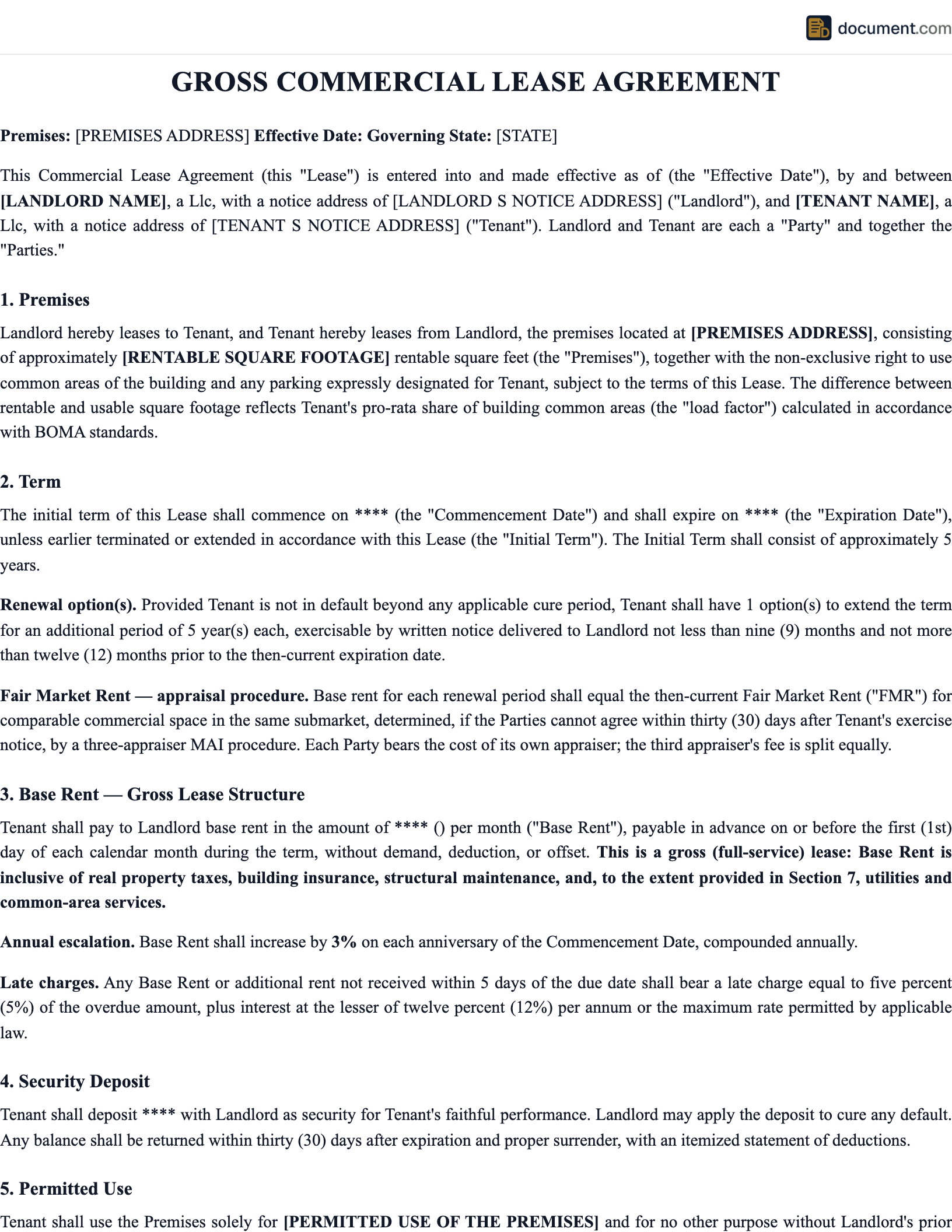
GROSS COMMERCIAL LEASE AGREEMENT
STATE OF VIRGINIA
Legal Document Template
LANDLORD
Name: [Full Legal Name]
Address: [Business Address]
Contact: [Phone/Email]
TENANT
Name: [Full Legal Name / Entity]
Address: [Current Address]
Tax ID: [EIN/SSN]
PREMISES
Address: [Property Address]
Suite: [Number]
Rentable SF: [Square Feet]
Usable SF: [Square Feet]
FINANCIAL TERMS
Base Rent: $[Amount]/month
Expense Stop: $[Amount]/SF
Security Deposit: $[Amount]
Escalation: [%]/year
Virginia Gross Commercial Lease Agreement FAQ
Answers to common questions about filing a gross commercial lease agreement in Virginia, including requirements, fees, and procedures.
Official Virginia Resources
Use these official state resources to verify requirements, find your local filing office, and access government forms for Virginia.
Related Virginia Documents
Depending on your situation, you may need additional documents alongside your Virginia gross commercial lease agreement.
Create your Virginia Commercial Gross Lease Agreement in under 5 minutes.
Answer a few questions and download a Virginia-compliant document, ready for the state agency.