
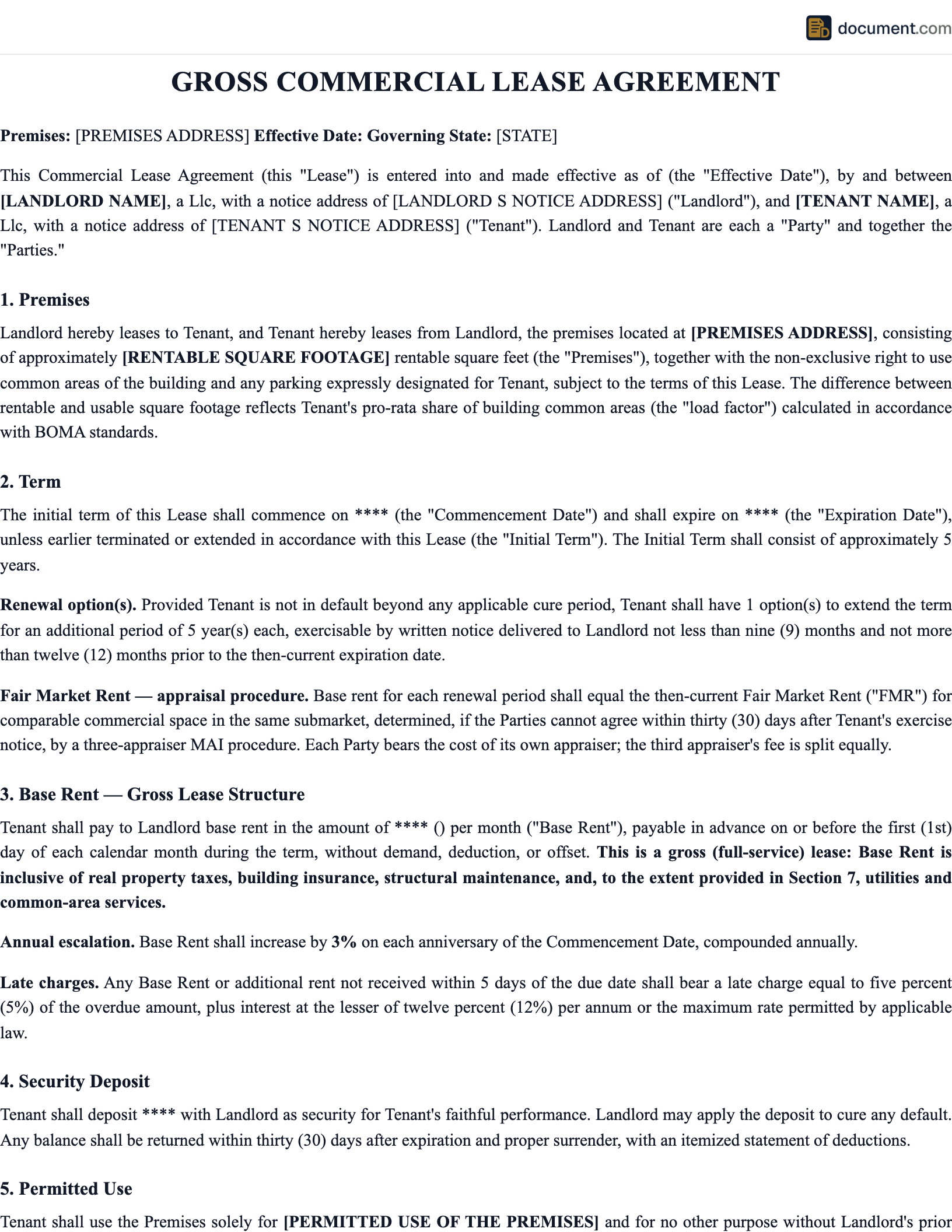



Pennsylvania Gross Commercial Lease Agreement Overview
A gross commercial lease in Pennsylvania is the structure most commonly used for multi-tenant office buildings, particularly in Philadelphia's Center City and University City districts and in Pittsburgh's Downtown and Oakland neighborhoods. Tenants pay a single monthly rent figure, and the landlord covers operating expenses out of that payment. The simplicity of a single payment is attractive to tenants who want predictable occupancy costs, though the trade-off is that gross rents typically run higher than net rents to account for the landlord's expense exposure.
Pennsylvania does not have a statewide commercial rent tax, so gross rent payments are generally not subject to sales or use tax at the state level. Philadelphia landlords must account for the city's Business Income and Receipts Tax on rental income, and that cost often factors into how Philadelphia gross rents are priced compared to suburban markets. For leases beyond a year, Pennsylvania's Statute of Frauds requires a written agreement, making careful drafting of the expense coverage terms especially important.
$188.50
Filing fee
Required
Notarization
0
Witnesses required
Recorder
Filing office
Pennsylvania Requirements
A Pennsylvania gross lease should define clearly which expenses are included in the flat rent, which are excluded, and how expense escalations above a base year are calculated and shared. The clarity of these provisions determines how predictable occupancy costs actually are for the tenant over the lease term.
Pennsylvania-Specific Note
Philadelphia gross leases often use base-year expense stops calibrated to a specific calendar year. If that base year is a high-expense year, tenants may benefit from reduced pass-throughs in early lease years. If it is a low-expense year, pass-throughs could begin immediately. The BIRT also affects landlord cost structure for Philadelphia properties, which can influence gross rent pricing. Tenants outside Philadelphia benefit from a simpler expense environment but should still confirm county-specific property tax exposure before signing.
Key Gross Lease Provisions
- Expense Inclusions: List which operating costs are covered within gross rent, such as property taxes, building insurance, and common area maintenance
- Expense Stop or Base Year: Define the threshold above which tenants bear a pro-rata share of increased operating expenses, and specify the base year used to establish that threshold
- Gross-Up Provision: Include a provision that adjusts variable expenses to a notional full-occupancy level to prevent distortion from high building vacancies
- Exclusions List: Enumerate costs that are specifically excluded from gross rent coverage, such as capital improvements, leasing costs, and expenses related to other tenants
- Landlord Repair Obligations: Specify that the landlord is responsible for structural repairs, roof, building systems, and common areas as part of the gross lease structure
How to Draft a Pennsylvania Gross Commercial Lease
Drafting a Pennsylvania gross lease requires careful attention to expense definitions and base-year methodology, especially for Philadelphia and Allegheny County properties where operating costs can be higher than in suburban markets.
Define Expense Inclusions and Exclusions
List all expenses covered within the gross rent. Then enumerate specific exclusions. For Philadelphia properties, confirm how BIRT exposure affects landlord pricing and whether it is embedded in the gross rent or treated as a separate pass-through.
Negotiate the Base Year and Expense Stop
Agree on which calendar year sets the expense baseline. Request an actual expense statement for the proposed base year to verify it reflects normal operating costs. Evaluate whether a gross-up provision is warranted given current building occupancy levels.
Confirm Landlord Maintenance Obligations
Specify which building systems the landlord maintains as part of the gross rent structure. Roof, structure, HVAC, and common areas should be landlord obligations. Pennsylvania's older Class B office inventory in Pittsburgh and Philadelphia may have deferred maintenance issues worth addressing in the lease before execution.
Execute the Lease
Both parties sign the final document. For terms of one year or longer, Pennsylvania's Statute of Frauds requires a written agreement. Consider having a Pennsylvania real estate attorney review the final lease before execution.
Consider Recording a Memorandum of Lease
For long-term gross leases, recording a memorandum at the county recorder of deeds provides constructive notice to future buyers or lenders. This step is optional but protects tenants if the property changes hands during the lease term.
Pennsylvania Gross Lease Costs
Typical costs associated with a Pennsylvania gross commercial lease. Gross rent amounts vary considerably between Philadelphia, Pittsburgh, and suburban markets.
| Fee / Cost | Amount |
|---|---|
| Monthly Gross Rent | All-inclusive; varies by market and building class |
| Expense Stop Pass-Through (if applicable) | Pro-rata share of operating costs above base-year threshold |
| Tenant-Paid Utilities (if excluded from gross rent) | Depends on lease terms; common exclusion in Pennsylvania office leases |
| County Recording Fee (memorandum of lease) | Varies by county; optional but recommended for long-term leases |
| Attorney Review | $300 to $800 for commercial lease review |
Sample Pennsylvania Gross Commercial Lease Agreement
Below is a preview of our Pennsylvania-specific template. Your customized document will include all fields and provisions required for filing in any Pennsylvania county.
GROSS COMMERCIAL LEASE AGREEMENT
STATE OF PENNSYLVANIA
Legal Document Template
LANDLORD
Name: [Full Legal Name]
Address: [Business Address]
Contact: [Phone/Email]
TENANT
Name: [Full Legal Name / Entity]
Address: [Current Address]
Tax ID: [EIN/SSN]
PREMISES
Address: [Property Address]
Suite: [Number]
Rentable SF: [Square Feet]
Usable SF: [Square Feet]
FINANCIAL TERMS
Base Rent: $[Amount]/month
Expense Stop: $[Amount]/SF
Security Deposit: $[Amount]
Escalation: [%]/year
Pennsylvania Gross Commercial Lease Agreement FAQ
Answers to common questions about filing a gross commercial lease agreement in Pennsylvania, including requirements, fees, and procedures.
Official Pennsylvania Resources
Use these official state resources to verify requirements, find your local filing office, and access government forms for Pennsylvania.
Related Pennsylvania Documents
Depending on your situation, you may need additional documents alongside your Pennsylvania gross commercial lease agreement.
Create your Pennsylvania Commercial Gross Lease Agreement in under 5 minutes.
Answer a few questions and download a Pennsylvania-compliant document, ready for the state agency.