



Michigan Gross Commercial Lease Agreement Overview
A Michigan gross commercial lease is an arrangement in which the landlord includes operating expenses within the base rent, so the tenant writes one check each month without receiving separate invoices for property taxes, insurance, or maintenance. This structure is particularly common in Michigan suburban office markets, where modified gross leases have been the prevailing convention for decades. Under a pure gross lease, the landlord absorbs operating cost fluctuations. Under a modified gross or gross lease with an expense stop, rising costs above a defined baseline are shifted back to the tenant, making the real financial exposure more complex than the single rent figure suggests.
Michigan gross commercial leases are governed by contract law. Michigan's Proposal A property tax assessment cap provides some predictability in how property taxes in a gross building might grow, but operating expenses for utilities, insurance, and maintenance can still increase meaningfully year over year. Tenants should understand the expense stop amount relative to current actual costs and model projected total occupancy expense over the full lease term before committing to a multi-year gross lease in the state.
$15
Filing fee
Required
Notarization
0
Witnesses required
Register
Filing office
Michigan Gross Lease Requirements
The key requirements for a Michigan gross commercial lease are substantive rather than procedural. The lease must clearly define what is included in the gross rent, what expense stop or base year mechanism applies, how the gross-up is calculated for below-full-occupancy buildings, and what happens as operating costs increase over the lease term.
Michigan Gross Lease Note
Michigan suburban office gross leases with expense stops are the dominant structure in markets like Southfield, Troy, and Ann Arbor. Because modified gross leases are standard in those markets, landlords may present them as simple all-in deals, but the expense stop mechanism can result in significant additional charges as operating costs rise. Always request actual current expense data before accepting a proposed stop amount.
Key Provisions to Address in a Michigan Gross Lease
- Expense Inclusions and Exclusions: Confirm which operating expenses are covered by the gross rent and which the tenant pays separately
- Expense Stop Amount: Request current actual operating expense per-square-foot data and compare it to the proposed stop amount to understand what pass-through risk you are accepting
- Base Year Selection: Negotiate a base year that reflects normalized full-occupancy operating costs rather than a low-cost year that benefits the landlord
- Gross-Up Formula: Confirm how variable expenses are calculated when the building is below full occupancy, since gross-up can inflate pass-throughs above actual current costs
- Audit Rights: Negotiate the right to audit expense documentation when an expense stop or base year mechanism can generate additional charges
How to Draft and Execute a Michigan Gross Lease
A Michigan gross commercial lease is a private contract executed between landlord and tenant. Follow these steps to approach it systematically.
Confirm the Lease Structure
In Michigan suburban markets, gross and modified gross leases are both common. Confirm whether the lease is truly gross, modified gross, or gross with an expense stop, and understand precisely which operating costs are included in the base rent versus separately charged to the tenant.
Review Actual Operating Expense Data
Request the building's actual per-square-foot operating expenses for the past two years. Compare that figure to the proposed expense stop to understand whether you will face immediate pass-through charges or are well below the stop at current expense levels.
Negotiate Key Financial Provisions
Focus negotiation on the expense stop level, base year, gross-up formula, utilities treatment, and any annual escalation provisions. Michigan's business-friendly environment and the competitive suburban office market often create room for negotiation on these terms.
Have a Michigan Attorney Review the Lease
A Michigan commercial real estate attorney familiar with Detroit metro suburban office lease conventions can identify expense stop amounts and gross-up formulas that are outside normal market ranges and help you negotiate better terms before signing.
Execute the Lease and Track Key Dates
Both parties sign the final lease. Keep executed copies secure and calendar rent escalation dates, option exercise windows, and any audit right deadlines written into the lease.
Michigan Gross Lease Costs
The primary cost of a Michigan gross commercial lease is the base rent, but expense stop pass-throughs can add meaningful costs over time. Below are typical transaction and ongoing cost ranges.
| Fee / Cost | Amount |
|---|---|
| Michigan Commercial Attorney (Lease Review) | $250 - $450 per hour; suburban Detroit market lease review typically $1,000 - $3,000 |
| Gross Base Rent (Suburban Michigan Office) | Typically $18 - $35 per square foot annually depending on submarket and building class |
| Expense Stop Pass-Through Risk | Varies; can add $2 - $8 per square foot annually if operating costs materially exceed the stop amount |
| Annual Base Rent Escalation | Typically 2 - 3 percent per year; confirm whether escalations also apply to expense stop pass-throughs |
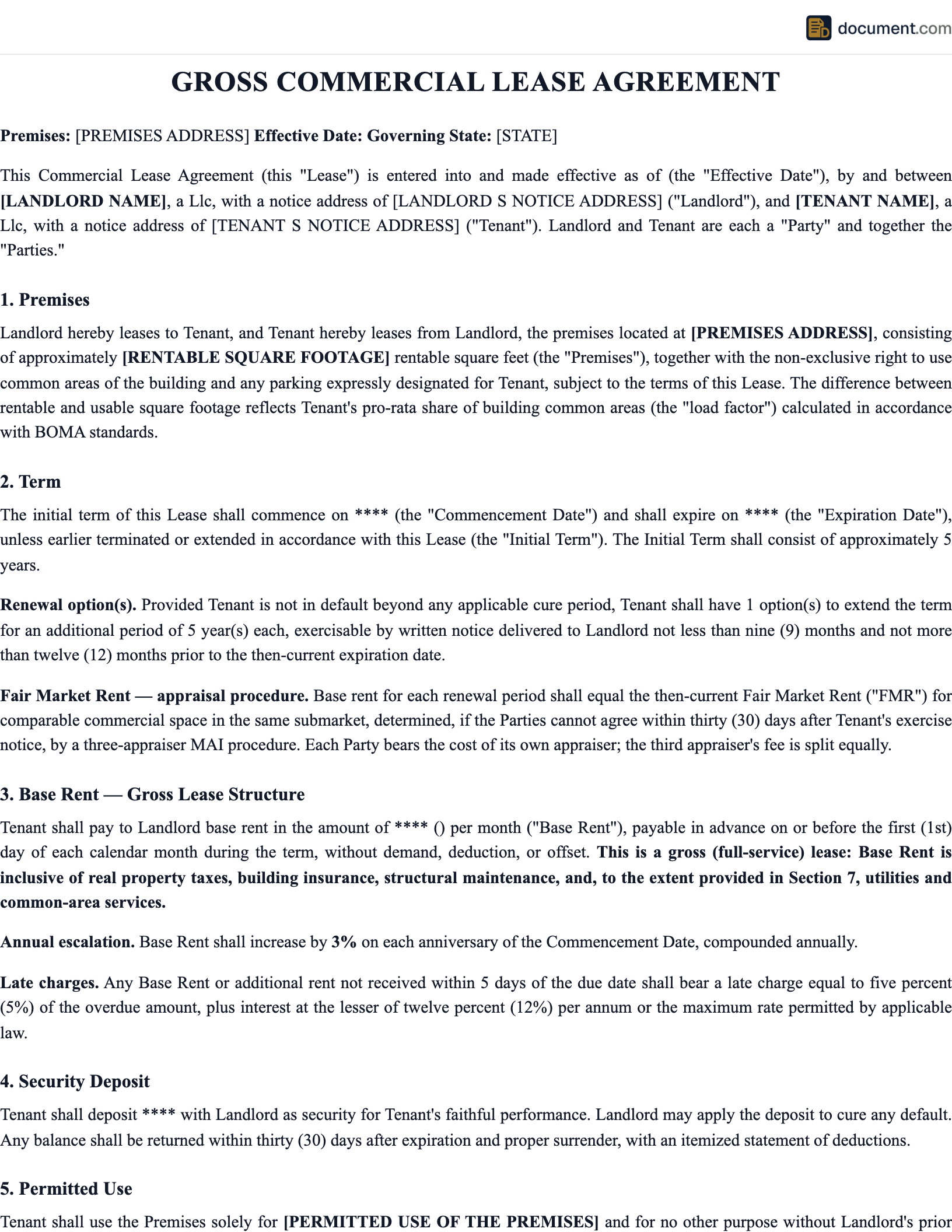
Sample Michigan Gross Commercial Lease Agreement
Below is a preview of our Michigan-specific template. Your customized document will include all fields and provisions required for filing in any Michigan county.
GROSS COMMERCIAL LEASE AGREEMENT
STATE OF MICHIGAN
Legal Document Template
LANDLORD
Name: [Full Legal Name]
Address: [Business Address]
Contact: [Phone/Email]
TENANT
Name: [Full Legal Name / Entity]
Address: [Current Address]
Tax ID: [EIN/SSN]
PREMISES
Address: [Property Address]
Suite: [Number]
Rentable SF: [Square Feet]
Usable SF: [Square Feet]
FINANCIAL TERMS
Base Rent: $[Amount]/month
Expense Stop: $[Amount]/SF
Security Deposit: $[Amount]
Escalation: [%]/year
Michigan Gross Commercial Lease Agreement FAQ
Answers to common questions about filing a gross commercial lease agreement in Michigan, including requirements, fees, and procedures.
Official Michigan Resources
Use these official state resources to verify requirements, find your local filing office, and access government forms for Michigan.
Related Michigan Documents
Depending on your situation, you may need additional documents alongside your Michigan gross commercial lease agreement.
Create your Michigan Commercial Gross Lease Agreement in under 5 minutes.
Answer a few questions and download a Michigan-compliant document, ready for the state agency.